15 Best ETL Tools for Data Integration and Data Pipelines
 Kamran Liaquat Ali
- posted on
- No Comment

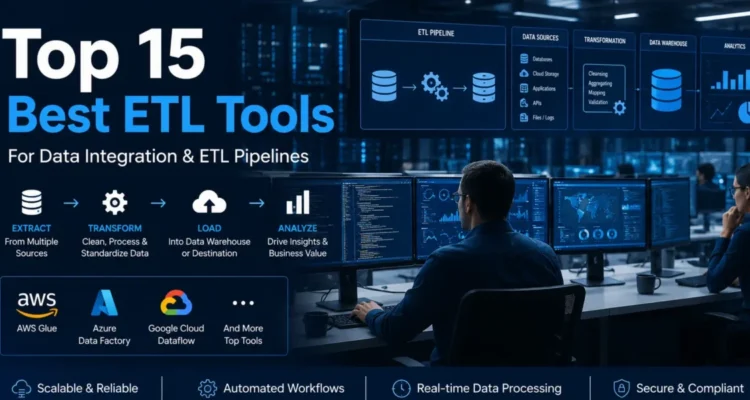
Quick answer: The best ETL tool depends on where your data lives and who will maintain the pipelines. Cloud-native teams usually choose Azure Data Factory, AWS Glue or Google Cloud Dataflow; analytics teams that load a cloud warehouse often pair a managed connector service such as Fivetran or Airbyte with dbt for transformations; and large enterprises with strict governance still rely on Informatica or IBM DataStage. Microsoft SQL Server shops frequently start with SSIS.
Below, each tool is described by what it actually does, who it suits and its main trade-off, followed by a practical method for choosing and testing one. Prices change often, so check each vendor’s current pricing page before deciding.
ETL Tools at a Glance
| Tool | Type | Best for |
|---|---|---|
| Informatica IDMC | Enterprise integration suite | Large, governed, multi-source estates |
| Azure Data Factory | Cloud ETL/ELT service | Microsoft and Azure-centred teams |
| AWS Glue | Serverless Spark ETL | Data lakes on Amazon S3 |
| Google Cloud Dataflow | Managed Apache Beam | Batch and streaming on Google Cloud |
| SSIS | On-premises ETL | SQL Server environments |
| Fivetran | Managed ELT connectors | Loading SaaS data into a warehouse with minimal upkeep |
| Airbyte | Open-source ELT | Teams wanting connector control or self-hosting |
| Matillion | Cloud ELT | Transformations pushed down into Snowflake, Databricks, BigQuery or Redshift |
| Talend (Qlik) | Data integration platform | Mixed ETL, data quality and governance needs |
| Hevo Data | No-code pipelines | Small teams that need quick setup |
| Apache NiFi | Flow-based data routing | Moving and routing data between many systems with provenance |
| Apache Airflow | Workflow orchestrator | Scheduling and coordinating pipelines written in Python |
| dbt | SQL transformation framework | The “T” in ELT inside the warehouse |
| Integrate.io | Low-code ETL/ELT | E-commerce and operational data with a visual designer |
| IBM DataStage | Enterprise parallel ETL | High-volume workloads in IBM environments |
What Is an ETL Tool?
ETL stands for extract, transform, load. An ETL tool pulls data from sources such as databases, SaaS apps and files, cleans and reshapes it, and loads it into a destination such as a data warehouse or data lake. In ELT, the raw data is loaded first and transformed inside the warehouse, which suits modern cloud warehouses with cheap, elastic compute.
| ETL | ELT | |
|---|---|---|
| Where transformation happens | In the tool or a separate engine | Inside the destination warehouse |
| Raw data kept? | Usually not | Yes, so you can reprocess later |
| Typical tools | SSIS, DataStage, Informatica, Glue | Fivetran or Airbyte plus dbt, Matillion |
| Good fit | Strict pre-load cleansing, on-premises targets | Cloud warehouses and analytics teams |
Most real platforms mix both. For example, Azure Data Factory can transform data in its own data flows or simply copy data and call a warehouse to transform it.
The 15 Best ETL and Data Integration Tools
1. Informatica Intelligent Data Management Cloud (IDMC)
Informatica has been an enterprise integration leader for decades. Its cloud platform, IDMC, combines data integration, data quality, master data management and cataloguing, and the long-standing PowerCenter product remains in many on-premises estates. Best for: large organisations that need governance, lineage and data quality in one place. Trade-off: licensing is complex and the platform is more than a small team needs.
2. Azure Data Factory
Azure Data Factory (ADF) is Microsoft’s managed service for building pipelines that copy and transform data. It offers a large connector library, visual mapping data flows that run on managed Spark, and a self-hosted integration runtime for reaching on-premises SQL Server and file shares. It can also run existing SSIS packages in the cloud. A closely related experience is available as Data Factory in Microsoft Fabric. Best for: teams already on Azure. Trade-off: debugging complex pipelines and estimating data-flow cost take practice.
3. AWS Glue
AWS Glue is a serverless service that runs Apache Spark (and Python shell) jobs without servers to manage. Crawlers discover schemas and store them in the Glue Data Catalog, which Athena, Redshift Spectrum and EMR can share. Glue Studio adds a visual editor. Best for: data lakes on Amazon S3. Trade-off: Spark knowledge is still needed for anything non-trivial, and job start-up time makes it less suited to small, frequent loads.
4. Google Cloud Dataflow
Dataflow is Google Cloud’s managed runner for Apache Beam pipelines, so the same code handles batch and streaming. It autoscales workers and integrates closely with Pub/Sub and BigQuery. Best for: streaming and event-driven pipelines on Google Cloud. Trade-off: Beam’s programming model has a learning curve.
5. SQL Server Integration Services (SSIS)
SSIS ships with SQL Server and has been the default ETL tool in Microsoft data teams for years. Packages are built visually in Visual Studio, with control flow, data flow transformations and script tasks in C#. Best for: on-premises SQL Server warehouses and teams with .NET skills. Trade-off: it is Windows-based and not cloud-native, although packages can be lifted into Azure Data Factory.
6. Fivetran
Fivetran is a fully managed ELT service. You pick a source such as Salesforce, HubSpot or PostgreSQL, choose a destination warehouse, and Fivetran keeps the tables in sync, including schema changes. Pricing is usage-based, tied to how many rows change each month. Best for: analytics teams that want reliable SaaS data without maintaining connectors. Trade-off: costs can rise quickly with high-change tables, and transformation happens elsewhere.
7. Airbyte
Airbyte is an open-source ELT platform with a large connector catalogue and a connector development kit for building your own. You can self-host it or use Airbyte Cloud. Best for: teams that want to avoid lock-in or need connectors for niche systems. Trade-off: self-hosting means you own upgrades, monitoring and scaling, and community connectors vary in maturity.
8. Matillion
Matillion is a cloud ELT platform that generates SQL and pushes the work down into Snowflake, Databricks, Amazon Redshift or Google BigQuery. Its visual designer appeals to teams that prefer low-code jobs over hand-written SQL. Best for: warehouse-centred teams that want visual transformations. Trade-off: it is built around a cloud warehouse, so it is not a general integration tool.
9. Talend (now part of Qlik)
Talend offers data integration, data quality and governance tools and became part of Qlik in 2023. The free Talend Open Studio edition has been retired, so new projects use the commercial Qlik Talend products. Best for: organisations that want integration plus data quality in one vendor. Trade-off: teams that relied on the free edition need a new plan.
10. Hevo Data
Hevo is a no-code pipeline service with prebuilt connectors, automatic schema mapping and basic transformations. Best for: small teams that need data in a warehouse quickly without engineers. Trade-off: less flexibility for complex logic than code-based tools.
11. Apache NiFi
NiFi is an open-source, flow-based tool for moving and routing data between systems. Its drag-and-drop interface, back-pressure handling and detailed data provenance make it popular for IoT, logs and file movement. Best for: routing data between many systems with full traceability. Trade-off: it is not designed for heavy analytical transformations.
12. Apache Airflow
Airflow is an orchestrator, not an ETL engine. You write pipelines as Python DAGs that schedule and coordinate tasks, which can call SQL, Spark, dbt or any API. Managed versions include Amazon MWAA, Google Cloud Composer and Astronomer. Best for: engineering teams coordinating many dependent jobs. Trade-off: it needs Python skills and careful operations.
13. dbt
dbt (data build tool) handles transformation inside the warehouse using SQL SELECT statements, with version control, tests, documentation and lineage. dbt Core is open source and a managed cloud product is also available. Best for: analytics engineers building reliable models in ELT. Trade-off: it does not extract or load data, so it is paired with another tool.
14. Integrate.io
Integrate.io provides low-code ETL, ELT, change data capture and reverse ETL in a visual interface, with a focus on operational and e-commerce data. Best for: teams that want a visual designer and vendor support. Trade-off: a smaller ecosystem than the major cloud platforms.
15. IBM DataStage
DataStage is IBM’s long-standing enterprise ETL engine, known for parallel processing of very large volumes. It is available on premises and as part of IBM Cloud Pak for Data. Best for: enterprises already invested in IBM. Trade-off: cost and specialist skills.
How to Choose the Right ETL Tool
| Question | Why it matters |
|---|---|
| Where are your sources and destination? | Cloud-native services are simplest when both ends are in the same cloud; on-premises sources need a gateway or self-hosted runtime. |
| Batch or streaming? | Most loads are fine hourly or daily. Real-time needs point to Dataflow, Kafka-based tools or change data capture. |
| Who maintains it? | Analysts need low-code tools; engineers may prefer code with version control. |
| How will cost grow? | Compare pricing by rows changed, compute hours or connectors using your real volumes. |
| What are the compliance rules? | Check data residency, encryption, private networking and audit logs. |
| How easy is it to leave? | Prefer tools that store logic as code or SQL you can move later. |
Run a Two-Week Proof of Concept
- Pick two or three realistic pipelines, including one awkward source.
- Measure set-up time, run time, failure handling and the effort to change a column.
- Test schema changes: add, rename and drop a column at the source and see what happens.
- Check monitoring and alerts: can the on-call person see what failed and rerun only that part?
- Estimate a year of cost from the proof-of-concept usage, not from the pricing page.
Common ETL Mistakes
- Choosing a tool by connector count instead of testing the connectors you actually need.
- Skipping data quality checks, so bad data reaches reports silently.
- Building pipelines without idempotency, so a rerun creates duplicates.
- Hard-coding credentials instead of using a secret store or managed identity.
- Treating an orchestrator like Airflow as if it were the transformation engine.
Frequently Asked Questions
What is the easiest ETL tool for beginners?
Managed, no-code services such as Fivetran or Hevo are the quickest to start. If you work in the Microsoft stack, Azure Data Factory’s visual designer is a natural next step.
Is SQL an ETL tool?
SQL is a language, not a tool, but much transformation work is written in SQL, especially in ELT with dbt or warehouse stored procedures.
Are there free ETL tools?
Yes. Airbyte, Apache NiFi, Apache Airflow and dbt Core are open source. You still pay for the servers or cloud resources that run them and the time to operate them.
Is BizTalk an ETL tool?
No. BizTalk is message-based integration middleware for business documents. Read our Microsoft BizTalk Server guide to see how it differs.
If you build data apps on .NET, our ASP.NET Core tutorial and programming and development guide are good next reads.
