What Is Search Engine Optimization (SEO)? A Practical Beginner’s Guide
 Kamran Liaquat Ali
- posted on
- No Comment

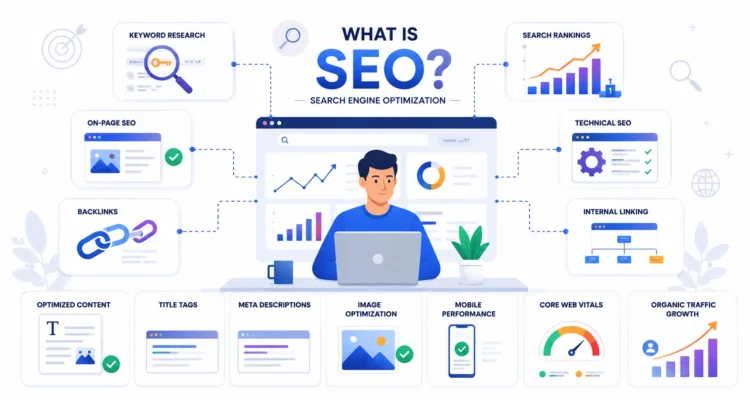
Quick answer: Search engine optimization (SEO) is the work of making web pages easier for search engines to find, understand and trust, so they appear for relevant searches without paying for ads. It has three main parts: technical SEO (crawling, indexing, speed), on-page SEO and content (helpful pages that match what people search for) and off-page signals (mainly links and mentions from other sites).
How Search Engines Work
- Crawling: automated programs such as Googlebot follow links and sitemaps to discover pages.
- Indexing: the search engine reads each page, works out what it is about and decides whether to store it.
- Ranking: when someone searches, the engine orders indexed pages by how relevant, useful and trustworthy they appear for that query.
A page can fail at any stage. If it is blocked from crawling, marked noindex or judged low value, it will not rank no matter how good its keywords are. Google Search Console shows which stage your pages reach.
The Three Pillars of SEO
Technical SEO
| Area | What to check |
|---|---|
| Crawlability | robots.txt allows important pages; internal links reach every page |
| Indexability | No accidental noindex; correct canonical tags |
| Sitemaps | An XML sitemap listing only indexable pages; check yours with our XML sitemap checker |
| Speed and Core Web Vitals | Fast loading (LCP), stable layout (CLS), quick response to input (INP) |
| Mobile friendliness | Readable and usable on phones, since Google indexes the mobile version |
| HTTPS | Every page served securely |
| Structured data | Schema markup such as Article, Breadcrumb and Organization to clarify content |
On-page SEO and content
- Match search intent: understand whether people want a definition, a tutorial, a comparison or a product page.
- Write a clear, unique title tag and meta description for every page.
- Use one descriptive H1 and logical H2/H3 headings.
- Answer the question early, then go deeper with examples, data and visuals.
- Link related pages together so readers and crawlers can follow the topic.
- Use descriptive image alt text and compressed images.
Google’s guidance centres on “helpful, reliable, people-first content”. Pages written mainly to rank, such as mass-produced articles or keyword-stuffed text, tend to perform poorly and can trigger spam policies.
Off-page signals
Links from relevant, reputable websites remain one of the strongest signals that a page is trustworthy. Earn them by publishing things worth citing: original data, useful tools, clear tutorials and expert opinion. Buying links or using link schemes breaks Google’s spam policies.
E-E-A-T: Experience, Expertise, Authoritativeness and Trust
Google’s quality rater guidelines describe E-E-A-T as a way to judge content quality. It is not a single ranking factor, but the signals behind it matter: real author names and bios, first-hand experience, accurate sourcing, clear contact details and a good reputation. These are especially important for health, finance and legal topics.
SEO for AI Search (AEO and GEO)
AI features such as Google’s AI Overviews and chat-based assistants summarise answers from web pages. The same fundamentals help you appear in them:
- Give a direct, accurate answer near the top of the page.
- Use clear headings, lists and tables that are easy to quote.
- Cover the follow-up questions people ask, for example in an FAQ section.
- Be specific and factual, cite sources, and keep pages up to date.
- Make sure the page is crawlable and indexable; AI features draw from indexed content.
A Simple SEO Workflow
- Choose a focused topic and list the questions your audience asks.
- Check what currently ranks to understand intent and gaps.
- Create the most helpful page for one main question.
- Optimise the title, description, headings, images and internal links.
- Publish, submit or inspect the URL in Search Console, and earn links by sharing it where it genuinely helps.
- Review performance after a few weeks and improve pages that get impressions but few clicks.
Our guide to using Search Console to update old content explains the last step in detail.
Common SEO Myths
| Myth | Reality |
|---|---|
| There is an ideal keyword density | Google has no target; write naturally. See our keyword density checker to spot overuse. |
| Longer content always ranks better | Completeness matters, not word count |
| Meta keywords help rankings | Google ignores the meta keywords tag |
| More pages means more traffic | Many thin pages can drag down a whole site |
| SEO is a one-time task | Content, competitors and search engines change constantly |
Frequently Asked Questions
How long does SEO take to work?
Usually months rather than weeks. New sites and competitive topics take longer, and results depend on content quality, competition and links.
Can I do SEO myself?
Yes. Start with Search Console, a good SEO plugin and the basics in this guide. Many small sites grow without hiring an agency.
What is the difference between SEO and SEM?
SEO earns unpaid (organic) traffic. SEM usually refers to paid search ads, such as Google Ads.
Continue with our blogging and SEO guide for the full process.
