What Is Search Engine Optimization? 9 Powerful SEO Basics

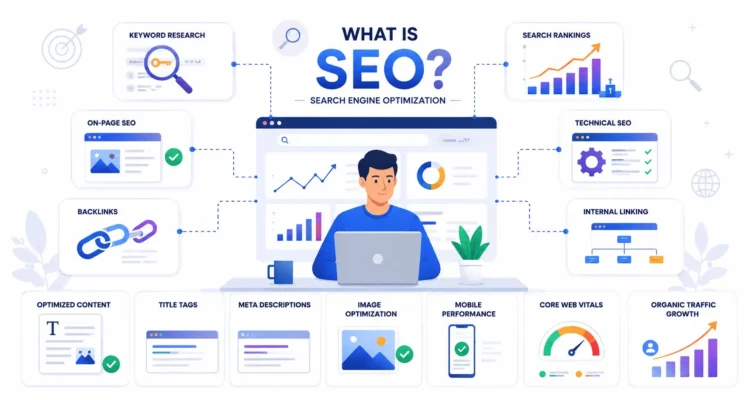
What is search engine optimization illustration showing keywords on-page SEO technical SEO backlinks and organic traffic

If you are starting a website, growing a blog, or trying to attract more visitors from Google, one of the first questions you may ask is what is search engine optimization? Search engine optimization, commonly called SEO, is the process of improving a website so search engines can better understand its content and users can more easily discover it through organic search results.

Unlike paid advertising, SEO focuses mainly on unpaid visibility in search engines. You do not pay Google every time someone clicks an organic search result. Instead, you improve your content, website structure, technical performance, internal linking, relevance, and overall usefulness so your pages have a better opportunity to appear when people search for related information.

Learning what is search engine optimization is important for bloggers, businesses, publishers, affiliate marketers, and website owners because organic search can become a valuable source of relevant visitors over time.

This complete beginner’s guide explains what is search engine optimization, how search engines work, the difference between on-page, technical, and off-page SEO, how keywords and backlinks work, why user experience matters, and how you can start improving your website step by step.

If you want to understand how SEO fits into a broader blogging strategy, also read our complete Blogging and SEO Guide.

What Is Search Engine Optimization?

To understand what is search engine optimization, think about what happens when someone types a question into Google.

Suppose a person searches for “vegan lasagna recipe.” That person is probably looking for ingredients, preparation steps, cooking time, and clear instructions. If you publish an article about vegan lasagna, SEO involves helping search engines understand that your page is relevant to that search while also making sure your content is genuinely useful for the person reading it.

In simple terms, what is search engine optimization means improving a website so search engines can discover, understand, and organize its pages while users can find relevant information through organic search.

Google’s official SEO Starter Guide explains SEO as helping search engines understand content and helping users find a site and decide whether they should visit it through a search engine.

This means that what is search engine optimization is not simply about inserting keywords into an article. Modern SEO includes content quality, search intent, internal links, title tags, meta descriptions, page performance, image optimization, mobile usability, website architecture, backlinks, and regular content improvement.

Why Is Search Engine Optimization Important?

Understanding what is search engine optimization matters because search engines are one of the main ways people discover information online.

When users need a tutorial, product review, local service, comparison, recipe, legal resource, technical answer, or buying guide, many begin with a search engine. If your website appears for a relevant search, you have an opportunity to attract visitors who are already interested in that topic.

SEO can help a website:

  • Increase organic search visibility
  • Attract more relevant visitors
  • Build long-term content value
  • Improve website structure
  • Strengthen topical relevance
  • Help users discover older articles
  • Improve navigation
  • Support business growth
  • Reduce complete dependence on paid traffic

However, knowing what is search engine optimization does not mean that rankings will improve immediately. SEO is usually a long-term process that involves research, publishing, optimization, measurement, and continuous improvement.

How Do Search Engines Work?

Anyone learning what is search engine optimization should first understand how search engines discover and organize web pages.

The process can be simplified into three stages:

  1. Crawling – discovering pages and links.
  2. Indexing – processing and storing eligible pages.
  3. Ranking and serving – selecting results for a user’s search.

Crawling

Search engines use automated programs often called crawlers or bots to discover pages on the web. They can discover new pages through links, sitemaps, and other signals.

Internal linking is important because it helps users and search engines move between related pages.

Google provides detailed information about this process in its official crawling and indexing documentation.

Indexing

After a page is discovered, a search engine may process its text, images, links, structure, and other information.

Understanding indexing is essential when learning what is search engine optimization because a page normally needs to be indexed before it can appear in standard organic search results.

Not every page that is crawled is guaranteed to be indexed. Technical issues, duplicate content, poor quality, indexing directives, or other factors may affect whether a page becomes eligible for search visibility.

Ranking and Serving Results

When a user performs a search, search systems evaluate available indexed pages and determine which results may best satisfy that query.

This is why what is search engine optimization cannot be reduced to one ranking factor. Search visibility depends on many different elements working together.

SEO vs Paid Advertising

Another important part of learning what is search engine optimization is understanding the difference between SEO and paid search advertising.

SEO focuses on improving organic visibility.

Paid advertising involves paying for advertising placements according to the advertising platform’s system.

The basic difference is:

  • SEO: focuses on organic search visibility.
  • Paid advertising: focuses on paid placements.

SEO is not necessarily free. Website hosting, content creation, SEO tools, technical development, professional services, and research can all involve costs.

So when answering what is search engine optimization, it is more accurate to say that SEO targets organic search rather than saying SEO costs nothing.

The Three Main Types of Search Engine Optimization

When people ask what is search engine optimization, SEO is often divided into three major areas:

  • On-page SEO
  • Technical SEO
  • Off-page SEO

These areas work together. A website may have strong content but poor technical performance, or excellent technical SEO but weak content. Sustainable SEO usually requires balance.

1. On-Page SEO

On-page SEO refers to optimization performed directly on your own website and individual pages.

If you are learning what is search engine optimization, on-page SEO is a good place to begin because you have direct control over most of these elements.

On-page SEO includes:

  • Content quality
  • Search intent
  • Keywords
  • Title tags
  • Meta descriptions
  • Headings
  • Internal links
  • Image alt text
  • URLs
  • Readability
  • Content structure

Content Quality

Content quality is one of the most important parts of understanding what is search engine optimization.

Before publishing a page, ask:

  • Does the article answer the user’s question?
  • Is the information useful?
  • Is it accurate?
  • Is it easy to read?
  • Does it provide original value?
  • Is the topic covered clearly?
  • Is the content well organized?

Google’s official helpful content guidance emphasizes creating reliable, people-first content rather than content created mainly to manipulate search performance.

This is a critical lesson when understanding what is search engine optimization: SEO should improve useful content, not replace it.

Search Intent

Search intent is the reason behind a user’s search.

For example:

  • “What is SEO?” – informational intent
  • “WordPress vs Blogger” – comparison intent
  • “How to connect Search Console” – instructional intent
  • “Best SEO tools” – commercial investigation

A page may include the exact keyword but still perform poorly if it does not satisfy the searcher’s intent.

That is why anyone learning what is search engine optimization should understand search intent before writing an article.

Keywords

Keywords are words and phrases people use when searching for information.

The primary keyword of this article is what is search engine optimization. Related phrases include SEO basics, organic search, search rankings, on-page SEO, off-page SEO, technical SEO, crawling, indexing, backlinks, title tags, meta descriptions, and internal linking.

Google’s Search Essentials recommends using words people may use to find your content and placing important terms in prominent locations.

However, keywords should be used naturally.

Understanding what is search engine optimization does not mean repeating a keyword in every sentence. The goal is to make the topic clear while maintaining good readability.

Title Tags

Title tags help describe the topic of a page and may influence how a page’s title appears in search results.

Google recommends using descriptive and concise title text. You can read the official Google title link guidance for more information.

Good title text should generally:

  • Clearly describe the page
  • Be relevant to the content
  • Avoid unnecessary repetition
  • Be readable
  • Avoid vague wording

For a page about what is search engine optimization, the title should clearly communicate that the page explains SEO.

Meta Descriptions

A meta description is a short description of a page’s content.

Google may use the meta description when generating a search snippet if it provides a useful summary of the page.

Google’s official snippet documentation explains how snippets and meta descriptions may be used in search results.

A good meta description should:

  • Describe the page accurately
  • Be unique
  • Encourage relevant users to click
  • Avoid misleading promises
  • Use the main topic naturally

When optimizing a page targeting what is search engine optimization, the description should make it clear that users will learn what SEO is and how it works.

HTML Headings

Headings help organize content and make long articles easier to scan.

A logical structure generally uses:

  • H2 headings for major topics
  • H3 headings for subsections
  • H4 headings only when further hierarchy is genuinely needed

Clear headings also make it easier for readers to quickly find the section they need.

Image ALT Text

Image alt text provides a textual description of an image.

Alt text improves accessibility and can also help search engines understand an image in context.

Google’s official image SEO documentation recommends using descriptive alt text and placing relevant images near related content.

For an article explaining what is search engine optimization, a suitable image description might be:

Search engine optimization illustration showing keywords, organic rankings, technical SEO, content and backlinks.

Internal Linking

Internal linking connects pages within the same website.

Internal links can:

  • Help visitors discover related content
  • Help search engines discover pages
  • Connect pillar and child articles
  • Improve site navigation
  • Provide additional context

Internal linking is especially important when learning what is search engine optimization because search engines need logical pathways through a website.

After reading this article, you can continue with our complete Blogging and SEO Guide.

You can also learn how to connect Blogger to Google Search Console or review our Blogger SEO settings guide.

Good navigation helps users find important pages quickly.

Your navigation should:

  • Use clear labels
  • Keep important content accessible
  • Work on mobile devices
  • Avoid unnecessary complexity
  • Support your website’s content hierarchy

Navigation supports what is search engine optimization because a well-organized site is easier for both users and search engines to explore.

2. Technical SEO

Technical SEO is another important part of understanding what is search engine optimization.

Technical SEO focuses on the infrastructure and technical conditions that affect crawling, indexing, rendering, performance, and usability.

Important technical SEO areas include:

  • Page speed
  • Mobile usability
  • HTTPS
  • XML sitemaps
  • Indexing controls
  • Robots directives
  • Canonical URLs
  • Structured data
  • Core Web Vitals
  • Broken links

Core Web Vitals

Core Web Vitals are metrics designed to measure important aspects of real-world user experience.

The current Core Web Vitals are:

  • Largest Contentful Paint (LCP) – loading performance
  • Interaction to Next Paint (INP) – responsiveness
  • Cumulative Layout Shift (CLS) – visual stability

Google currently recommends aiming for an LCP of 2.5 seconds or less, INP below 200 milliseconds, and CLS below 0.1 for a good experience.

You can review the latest guidance in Google’s official Core Web Vitals documentation.

This is especially relevant when learning what is search engine optimization because older SEO articles may still mention First Input Delay, or FID, as a current Core Web Vital.

Page Speed

Page speed can have a major effect on user experience.

A slow website may cause users to leave before the page fully loads.

Common performance improvements include:

  • Compressing large images
  • Using modern image formats
  • Reducing unnecessary scripts
  • Using browser caching
  • Optimizing CSS and JavaScript
  • Choosing reliable hosting
  • Using lazy loading appropriately

You can test a page using Google’s PageSpeed Insights.

When understanding what is search engine optimization, remember that page performance is not only about getting a high score. The real objective is giving visitors a fast and stable experience.

Mobile Usability

A modern website should function properly on smartphones, tablets, and desktop computers.

Responsive layouts help content adapt to different screen sizes without forcing users to zoom or scroll horizontally.

Mobile usability is a major part of what is search engine optimization because a large percentage of users browse websites from mobile devices.

HTTPS

HTTPS helps protect the connection between a visitor’s browser and your website.

Site owners should ensure important pages load securely and avoid mixed-content issues.

XML Sitemaps

An XML sitemap provides search engines with information about important URLs on your site.

A sitemap does not guarantee indexing, but it can help search engines discover pages.

Google provides an official sitemap guide explaining how sitemaps work.

Descriptive URLs

URLs should be understandable and descriptive whenever possible.

For example:

Descriptive:
/seo-what-is-search-engine-optimization/

Less descriptive:
/post?id=86374

Descriptive URLs support what is search engine optimization because they make page topics easier to recognize and manage.

3. Off-Page SEO

Off-page SEO refers to activities and signals that happen outside your own website.

Understanding what is search engine optimization means recognizing that SEO does not end when you publish an article.

Off-page SEO can include:

  • Backlinks
  • Brand mentions
  • Digital PR
  • Content distribution
  • Industry relationships
  • Relevant online communities

A backlink is a link from another website to your website.

Backlinks can help users discover content and can help search engines understand relationships between websites.

However, backlink quality matters more than simply collecting large numbers of links.

Useful backlinks may come from:

  • Relevant websites
  • Editorial references
  • Original research
  • Useful tools
  • Detailed guides
  • Industry resources
  • Legitimate collaborations

Google’s spam policies warn against manipulative link practices designed primarily to influence rankings.

So when learning what is search engine optimization, remember that earning relevant links is different from creating spammy links.

Social Media and Content Distribution

Social media can help people discover your content and build awareness around your website.

Depending on your niche, useful distribution channels may include:

  • Pinterest
  • Medium
  • LinkedIn
  • Reddit
  • Industry communities
  • Email newsletters

Social media should mainly be treated as a distribution and audience-building channel rather than a direct ranking shortcut.

Brand Mentions

A brand mention happens when another website or publication refers to your brand or website.

A mention does not always include a backlink, but genuine brand visibility can still help people discover your site.

Brand development supports a broader understanding of what is search engine optimization because SEO increasingly works alongside content marketing, reputation, and audience development.

On-Page SEO vs Off-Page SEO

A common question after learning what is search engine optimization is whether on-page or off-page SEO matters more.

The answer is that both serve different purposes.

On-page SEO focuses on elements you directly control, including:

  • Content
  • Keywords
  • Titles
  • Headings
  • Internal links
  • Images
  • Page structure

Off-page SEO focuses more on:

  • Backlinks
  • Mentions
  • Promotion
  • Relationships
  • External discovery

Technical SEO supports both by helping your website remain accessible, fast, organized, and crawlable.

How Keywords Work in SEO

Keywords remain an important part of what is search engine optimization, but keyword strategy should not be based on repeating one phrase unnaturally.

A good keyword strategy includes:

  • A clear primary keyword
  • Related secondary phrases
  • Search intent
  • Supporting questions
  • Relevant concepts
  • Natural language

For example, this article targets what is search engine optimization while also discussing organic traffic, on-page SEO, technical SEO, off-page SEO, crawling, indexing, rankings, title tags, meta descriptions, backlinks, SERPs, internal links, and Search Console.

This creates stronger topical coverage while maintaining natural readability.

What Is a SERP?

SERP stands for Search Engine Results Page.

It is the page displayed after a person performs a search.

A SERP may contain:

  • Organic results
  • Paid advertisements
  • Images
  • Videos
  • Local results
  • Featured information
  • Other search features

When learning what is search engine optimization, the goal should not simply be “rank number one.” The better objective is to appear for relevant searches where your content can genuinely help the user.

What Is Google Search Console?

Google Search Console is a free Google service that helps website owners understand how their pages perform in Google Search.

It can provide information about:

  • Search queries
  • Clicks
  • Impressions
  • Average positions
  • Indexing
  • Sitemaps
  • Core Web Vitals
  • Search-related issues

You can access the official Google Search Console.

Search Console is extremely useful when learning what is search engine optimization because it provides real data about how users find your website.

If you are using Blogger, read our guide on how to connect your Blogger blog to Google Search Console.

How to Start SEO as a Beginner

If you understand what is search engine optimization but are unsure where to start, follow a simple process.

  1. Choose a clear niche.
  2. Understand your target audience.
  3. Research relevant keywords.
  4. Identify search intent.
  5. Create useful original content.
  6. Use clear titles and headings.
  7. Write useful meta descriptions.
  8. Add relevant internal links.
  9. Optimize images and alt text.
  10. Improve page speed.
  11. Check mobile usability.
  12. Connect Google Search Console.
  13. Submit or verify your sitemap.
  14. Monitor impressions and clicks.
  15. Update older content.
  16. Promote your articles naturally.
  17. Build relevant external references over time.

This beginner process summarizes what is search engine optimization in practical terms: create useful pages, make them accessible, connect them logically, measure their performance, and keep improving them.

For a larger step-by-step framework, visit our Blogging and SEO Guide.

Common SEO Mistakes to Avoid

Knowing what is search engine optimization also means knowing what can weaken an SEO strategy.

Keyword Stuffing

Keywords help search engines and readers understand a page’s subject, but using them unnaturally can harm readability.

Your focus keyword should appear in important locations, but the page should still sound natural.

Publishing Thin Content

Do not publish articles simply to increase the number of pages on your website.

Each article should have a clear purpose and provide useful information.

Internal links help organize related content.

A pillar page should link to relevant child pages, and child articles should link back to the pillar where appropriate.

This content structure is an important practical part of what is search engine optimization.

Copying Competitor Content

Competitor research can help identify topics, but your final article should provide original explanations, examples, structure, and value.

A large number of poor-quality links is not a substitute for useful content.

Focus on relevant references, genuine outreach, useful resources, and legitimate relationships.

Ignoring Mobile Visitors

Always review important pages on mobile devices.

Navigation, images, buttons, tables, and text should remain easy to use on smaller screens.

Ignoring Technical Issues

Broken links, slow pages, incorrect indexing settings, oversized images, and poor navigation can weaken a website.

Never Updating Old Content

SEO information, products, interfaces, statistics, and best practices can change.

Updating older pages is therefore an important part of what is search engine optimization.

How Long Does SEO Take?

Another common question after what is search engine optimization is how quickly SEO works.

There is no guaranteed timeframe.

SEO results can depend on:

  • Website history
  • Competition
  • Content quality
  • Technical health
  • Search demand
  • Existing authority
  • Internal linking
  • External references
  • Content freshness

Some pages may begin receiving impressions relatively quickly, while other topics may require significantly more time and improvement.

The better approach is to monitor trends over time rather than expecting immediate rankings.

Is SEO Free?

Organic search listings are not paid placements, but implementing SEO may still require investment.

Possible costs include:

  • Hosting
  • SEO software
  • Content creation
  • Technical development
  • Design
  • Research
  • Digital PR
  • Professional SEO services

Therefore, a complete explanation of what is search engine optimization should distinguish organic visibility from zero-cost marketing.

Does SEO Guarantee a Number-One Ranking?

No. SEO does not guarantee a specific ranking position.

Google explicitly states in its SEO Starter Guide that there are no secret techniques that automatically rank a website first.

A better SEO strategy focuses on improving areas you can control:

  • Useful content
  • Logical structure
  • Search intent
  • Technical performance
  • Internal links
  • Mobile usability
  • Helpful images
  • Relevant external references
  • Continuous improvement

This is a much more realistic understanding of what is search engine optimization.

SEO Checklist for Beginners

If you want a quick summary of what is search engine optimization, use this checklist when reviewing an article or website.

  • Is the page useful?
  • Does it satisfy search intent?
  • Is the focus keyword clear?
  • Is the title descriptive?
  • Is the meta description relevant?
  • Are headings organized properly?
  • Are images optimized?
  • Do images have useful alt text?
  • Are related pages internally linked?
  • Does the website work on mobile?
  • Is the page reasonably fast?
  • Can search engines crawl the page?
  • Is the page eligible for indexing?
  • Is Search Console configured?
  • Is outdated information reviewed regularly?

This checklist covers many of the practical foundations behind what is search engine optimization.

Frequently Asked Questions About Search Engine Optimization

What is search engine optimization in simple words?

What is search engine optimization in simple words? SEO is the process of improving a website so search engines can understand its pages and relevant users can discover them through organic search results.

What are the three main types of SEO?

The three commonly discussed types are on-page SEO, technical SEO, and off-page SEO.

What is on-page SEO?

On-page SEO includes content optimization, keywords, headings, titles, meta descriptions, internal links, images, and page structure.

What is technical SEO?

Technical SEO focuses on crawling, indexing, page speed, mobile usability, Core Web Vitals, sitemaps, canonical URLs, structured data, and technical website health.

What is off-page SEO?

Off-page SEO includes backlinks, brand mentions, content distribution, outreach, and other external signals or relationships.

Does SEO require paid advertising?

No. SEO and paid advertising are separate marketing channels. SEO focuses primarily on organic search visibility.

Relevant backlinks can help people discover content and may provide useful signals about relationships between pages and websites. Quality and relevance matter more than simply collecting large numbers of links.

Is keyword density important?

Keyword usage helps establish a page’s topic, but there is no reason to sacrifice readability for an artificial percentage. Use the primary phrase naturally while also covering related terms and questions.

Can beginners learn SEO?

Yes. Beginners can learn what is search engine optimization by starting with content quality, search intent, keywords, internal linking, Search Console, page performance, and technical fundamentals.

Internal links help visitors discover related content and help search engines understand relationships between pages on your website.

What are the current Core Web Vitals?

The current Core Web Vitals are Largest Contentful Paint, Interaction to Next Paint, and Cumulative Layout Shift.

Is SEO a one-time task?

No. Search engine optimization is an ongoing process. Content should be monitored, updated, improved, and connected to new relevant resources over time.

Final Thoughts on What Is Search Engine Optimization

So, what is search engine optimization? SEO is the ongoing process of improving a website so search engines can understand its content and relevant users can discover useful pages through organic search.

A strong SEO strategy does not depend on one trick. It combines useful content, search intent, keywords, titles, meta descriptions, internal links, technical performance, mobile usability, image optimization, backlinks, website structure, and regular updates.

If you are just beginning to learn what is search engine optimization, start with the fundamentals. Create useful content, organize your website logically, connect related pages, optimize your images, improve performance, monitor Search Console, and update important articles when necessary.

Over time, these improvements can create a stronger website that is easier for both search engines and users to understand.

Now that you understand what is search engine optimization, continue with our complete Blogging and SEO Guide to learn how SEO fits into a broader strategy for creating, growing, promoting, and monetizing a blog.

Leave A Comment