What Is the Metaverse? Meaning, Examples and Where It Stands
 Kamran Liaquat Ali
- posted on
- No Comment

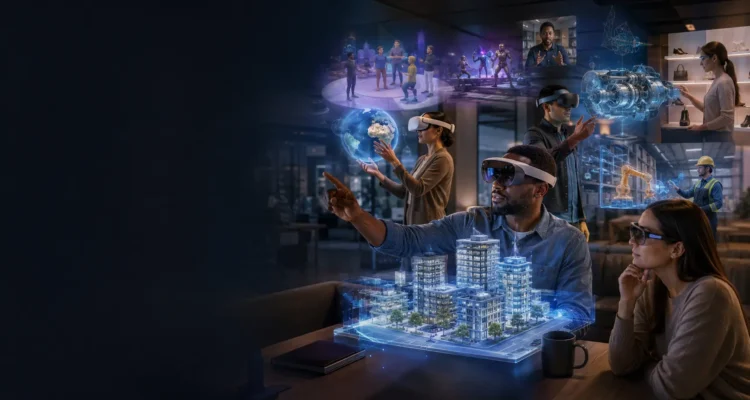
Quick answer: The metaverse is the idea of shared, persistent 3D online spaces where people meet, play, work and shop as avatars, using a headset, a phone or a computer. It is not one product or one company. Parts of it already exist in games like Roblox and Fortnite, in VR apps and in industrial “digital twins”, but the fully connected virtual world that was promised in 2021 has not arrived.
This guide explains the idea in plain language, the technology behind it, where it is used today and how to judge the hype. It is part of our Technology and AI guide.
In this guide
What Is the Metaverse in Simple Terms?
Think of today’s internet as pages you look at. The metaverse is the idea of an internet you step into: a 3D space where you are present as an avatar, other people are there at the same time, and what happens persists after you leave.
The word comes from Neal Stephenson’s 1992 science-fiction novel Snow Crash. It went mainstream in 2021 when Facebook renamed itself Meta and said building these virtual worlds was its future.
How It Works
A shared virtual world combines a few layers:
- Devices: VR headsets, AR glasses, phones, PCs and consoles.
- 3D worlds: game engines such as Unity and Unreal render the spaces and avatars.
- Networking and cloud: servers keep many users in sync in real time.
- Identity and payments: accounts, avatars and digital goods that you own or can buy.
- AI: increasingly used to create 3D content, power characters and translate speech.
Core Technologies
| Technology | What it does |
|---|---|
| Virtual reality (VR) | Fully replaces your view with a digital world |
| Augmented reality (AR) | Adds digital objects on top of the real world |
| Mixed reality and spatial computing | Blends both, with apps placed around your room |
| Game engines | Build and render 3D environments |
| Digital twins | Live virtual copies of real factories, buildings or cities |
| Blockchain | Optional, used by some platforms for ownership records |
Compared With VR, AR and Spatial Computing
VR and AR are ways to access virtual spaces; the metaverse is the idea of the shared spaces themselves. Apple avoids the word altogether and calls its approach “spatial computing”, introduced with the Apple Vision Pro, which places apps and windows in your real surroundings rather than taking you to a separate world.
How It Differs From Today’s Internet
The web is mostly 2D, page-based and used alone. A virtual world is 3D, live and social, closer to being in a room with people than reading a website.
Where It Is Used Today
Gaming and Social Spaces
Roblox, Fortnite and Minecraft are the closest thing most people have to a working metaverse: millions of players, user-made worlds, live concerts and a large economy of digital items. Social VR apps such as VRChat and Meta Horizon Worlds offer similar experiences in headsets.
Work, Education and Training
Virtual reality training is one of the most practical uses. Surgeons, pilots, factory workers and emergency teams can practise dangerous or expensive procedures safely. Virtual offices exist too, but most companies still prefer ordinary video calls.
Manufacturing and Digital Twins
Industrial companies build detailed virtual copies of factories to plan layouts, test changes and train robots before touching the real line. This “industrial metaverse” is quietly one of the most successful uses, and it ties closely to AI in manufacturing.
Retail, Healthcare and Events
Brands use virtual try-on with AR, hospitals use 3D models for surgical planning and therapy, and event organisers run virtual concerts and conferences, with mixed results.
Benefits and Risks
| Benefits | Risks |
|---|---|
| Presence and shared experience at a distance | Privacy: headsets can track eyes, hands, voice and rooms |
| Safe training for dangerous or costly tasks | Harassment and child safety in open social spaces |
| New creative and business opportunities | Addictive design and time spent |
| Better design and planning through digital twins | Platform lock-in and loss of digital purchases |
Costs and Limitations
- Good headsets are expensive and still heavy for long sessions.
- Some people feel motion sickness in VR.
- Platforms rarely work together, so avatars and purchases do not move between them.
- Building quality 3D content costs far more than building a web page.
Do You Need a Headset?
No. Most people visit these virtual worlds on phones, PCs and consoles. A headset gives a stronger sense of presence and is useful for training, fitness and some games, but it is not required.
Is the Metaverse Dead?
The hype has faded. Meta’s Reality Labs division has lost tens of billions of dollars, many companies closed their virtual offices and stores, and attention moved to AI. But the useful parts keep growing: gaming worlds, VR training, mixed-reality headsets and digital twins. The more accurate view is that the idea has narrowed rather than died.
How AI and Blockchain Fit In
AI is making 3D worlds cheaper to build, with tools that generate objects, scenes and voices from text, and it powers characters that can hold conversations. Smart glasses with built-in assistants, related to on-device AI assistants, may become an easier way into mixed reality than headsets.
Blockchain and NFTs were promoted as the way to own items across virtual worlds. In practice most successful platforms do not use them. Learn the basics in our explainer on blockchain technology.
How Businesses Should Evaluate a Project
- What problem does it solve that a website, app or video call cannot?
- Will the target users actually own or wear the required device?
- What is the cost to build and maintain 3D content?
- How will you measure success: sales, training time, errors avoided?
- What data is collected, and how is user safety handled?
Projects with a clear, measurable purpose, such as training or design reviews, tend to succeed. Projects launched mainly for publicity usually do not.
What Comes Next?
Expect gradual progress: lighter mixed-reality headsets and glasses, AI-generated 3D content, larger gaming platforms and wider use of digital twins in industry. A single connected virtual world that everyone lives in is unlikely any time soon. What may happen instead is that 3D and spatial features slowly become a normal part of devices and apps people already use.
Frequently Asked Questions
Who owns the metaverse?
Nobody. It is a concept, not a product. Many companies, including Meta, Roblox, Epic Games, Microsoft, Apple and NVIDIA, build parts of it.
Is Roblox the metaverse?
Roblox is one of the best examples of a metaverse-style platform, with persistent user-made worlds and a virtual economy, but it is one platform rather than the whole idea.
Is it safe for children?
Open social spaces carry real risks, including contact with strangers and inappropriate content. Use age ratings, parental controls and private spaces, and talk with children about online safety.
Can you make money in virtual worlds?
Some creators earn from selling games, items or experiences on platforms like Roblox, but income is uneven and most creators earn little. Treat claims of easy profits with caution.
Final Thoughts
The metaverse is best understood as a direction, not a destination: more of our digital life becoming 3D, shared and present. The grand promises of 2021 were overblown, but games, training and industrial design show where the idea already works. For more explainers, return to the Technology and AI guide.
