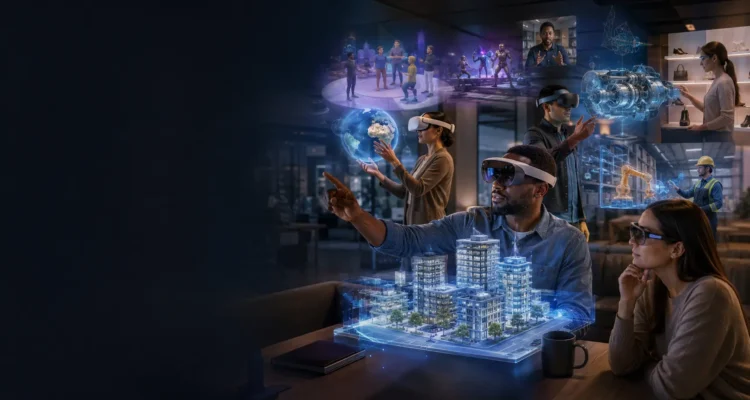
What Is the Metaverse? 9 Powerful Facts and Uses

What is the metaverse

What is the metaverse? The metaverse describes persistent digital spaces where people meet, work, learn, play, create, shop, and interact through avatars or spatial interfaces. It is not one website, headset, or company.

This evergreen guide separates working technology from marketing hype. Some experiences run on phones and computers, while others use VR headsets or AR glasses. For wider context, see our technology and AI guide.

Quick answer: The metaverse is an evolving collection of immersive environments rather than a finished replacement for the internet. Its strongest uses are gaming, social presence, training, design review, digital twins, education, and remote collaboration.

What Is the Metaverse in Simple Terms?

The metaverse is a broad idea for persistent digital spaces where people meet, work, learn, play, create, shop, and interact through avatars or spatial interfaces. It is not one website, headset, or company. Today the term covers virtual worlds, mixed-reality experiences, digital twins, immersive games, and three-dimensional collaboration tools. A simple way to answer what is the metaverse is that it makes online activity more spatial and participatory.

Instead of only reading a page or watching a flat video, a user may enter a shared environment, move through it, manipulate 3D objects, speak with other people, and retain a recognizable identity across sessions. No universal world currently connects every platform. Most services remain separate ecosystems with their own accounts, rules, devices, currencies, and content.

How Does the Metaverse Work?

A metaverse experience combines software, networks, devices, identity systems, and digital content. A platform renders an environment and synchronizes changes so multiple users see and influence the same space. Cloud servers may manage accounts, inventories, physics, moderation, and communication, while a phone, computer, console, headset, or smart glasses displays the experience. Sensors track the head, hands, eyes, voice, and physical surroundings.

Artificial intelligence can power conversational characters, translation, content creation, recommendations, accessibility, and safety systems. Spatial audio makes voices and events sound as if they come from particular directions. The feeling of being present with other people is a defining goal, but quality depends on latency, design, comfort, and reliable network access. For readers asking what is the metaverse, the practical answer depends on whether shared space, persistence, and interaction improve this specific use.

Core Technologies Behind the Metaverse

Virtual reality replaces most visible surroundings with a computer-generated environment. Augmented reality places information over the real world, while mixed reality anchors virtual objects to physical space. AI generates environments, dialogue, animation, recommendations, translation, and moderation. Cloud infrastructure synchronizes users and stores persistent state; low latency matters because delays can break immersion or cause discomfort. 3D engines render objects, lighting, physics, and movement.

Spatial mapping helps devices understand walls, floors, furniture, and distance. Blockchain can record certain digital assets, but it is not required for the metaverse. Many successful virtual economies use conventional databases. Token projects require careful review of custody, fees, fraud, ownership rights, and platform dependence. For readers asking what is the metaverse, the practical answer depends on whether shared space, persistence, and interaction improve this specific use.

The Metaverse vs the Internet

The internet is the global network that carries data, while the web is a system of linked pages and applications running on that network. Metaverse platforms also use the internet, but emphasize real-time presence, shared space, three-dimensional content, embodiment, and interaction. The metaverse is therefore one possible evolution of online experiences, not a separate network replacing the internet. Websites remain faster and more accessible for reading, comparing prices, completing forms, and sending messages.

Spatial interfaces become valuable when scale, movement, collaboration, simulation, or presence materially improves a task. The best future will probably combine conventional pages, mobile apps, voice interfaces, and immersive spaces rather than force every activity into a virtual world. For readers asking what is the metaverse, the practical answer depends on whether shared space, persistence, and interaction improve this specific use.

Metaverse vs VR, AR, and Spatial Computing

VR and AR are interface technologies; the metaverse is a broader concept involving spaces, communities, economies, identity, and experiences. A VR fitness app can be immersive without being a metaverse. A persistent social world can be metaverse-like even when accessed through a laptop. Spatial computing emphasizes placing digital applications and objects in three-dimensional space. Apple describes Vision Pro as blending digital content with physical space, while Meta develops mixed-reality hardware and AI glasses. These labels overlap but are not interchangeable. What is the metaverse depends more on persistent shared interaction than on a specific device. A headset can deepen presence, yet it is only one doorway into the experience. For readers asking what is the metaverse, the practical answer depends on whether shared space, persistence, and interaction improve this specific use.

Gaming and Social Experiences

Gaming provides the clearest examples of persistent identity, shared events, creator economies, customizable avatars, and user-built environments. People attend virtual concerts, collaborate on projects, compete, and socialize. Platforms such as Roblox, Fortnite, Minecraft, and VR social applications demonstrate metaverse behavior, although their worlds and purchases are usually not interoperable. A player cannot assume that an outfit, identity, achievement, or currency will transfer to another service.

Strong communities need effective moderation, clear rules, accessible controls, and meaningful creative tools. The most durable platforms give users reasons to return beyond speculation, including friendship, play, expression, learning, and collaboration. For readers asking what is the metaverse, the practical answer depends on whether shared space, persistence, and interaction improve this specific use.

Work, Education, and Training

Immersive collaboration can help distributed teams review 3D models, practice procedures, arrange spatial workspaces, and communicate with stronger nonverbal context than a standard video call. Students can explore anatomy, machinery, architecture, history, and hazardous environments through interactive simulation. Training can be repeatable and measurable without consuming physical materials or exposing learners to real danger. Good programs still require qualified instruction, accessible alternatives, validated content, and clear learning objectives.

A virtual classroom should improve understanding rather than merely look impressive. Businesses should measure task completion, learning retention, travel reduction, employee comfort, and support costs before expanding a pilot. For readers asking what is the metaverse, the practical answer depends on whether shared space, persistence, and interaction improve this specific use.

Manufacturing and Digital Twins

An industrial metaverse connects 3D models, operational data, simulations, and remote expertise. A digital twin represents a machine, factory, building, or process so teams can test layouts, predict problems, train workers, and plan maintenance. This is among the most practical uses because results can be tied to safety, quality, uptime, energy use, and cost. Immersive review lets experts collaborate around the same model without traveling.

The model must still use accurate data, secure connections, proper access controls, and accountable decisions. A beautiful simulation is not useful when it does not reflect real equipment. Learn more in our AI in manufacturing guide. For readers asking what is the metaverse, the practical answer depends on whether shared space, persistence, and interaction improve this specific use.

Healthcare, Retail, and Events

Healthcare teams can use immersive simulations for education, rehabilitation, and procedure planning, subject to clinical validation, privacy controls, and professional oversight. Retailers can provide 3D product previews, virtual showrooms, and guided shopping. Property buyers may tour a digital representation before visiting a location. Museums and event organizers can extend access beyond a physical venue. These applications do not automatically need a token, avatar, or fully virtual universe.

The appropriate level of immersion depends on the user’s goal. Sensitive fields must also offer accessible alternatives and protect health, payment, identity, location, and behavioral information. For readers asking what is the metaverse, the practical answer depends on whether shared space, persistence, and interaction improve this specific use.

Benefits of the Metaverse

The main benefits are presence, visualization, safe simulation, creative opportunity, remote access, and operational insight. Shared space can make distant collaboration more immediate. Complex objects become easier to inspect at realistic scale. Learners can repeat dangerous or expensive procedures without consuming materials. Creators can build environments, objects, games, and services. Captions, translation, adjustable environments, and remote participation may remove some barriers. Digital twins can support planning and maintenance.

These benefits depend on design quality. An immersive interface should solve a real problem more effectively than a phone, website, video call, or physical meeting. Otherwise, hardware, training, motion discomfort, and development costs become disadvantages. For readers asking what is the metaverse, the practical answer depends on whether shared space, persistence, and interaction improve this specific use.

Privacy, Safety, and Ethical Risks

Metaverse systems may collect movement, gaze, voice, room geometry, social connections, and behavioral signals. This information can reveal interests, routines, health characteristics, and emotional responses. Users should review permissions, recording indicators, privacy policies, account security, retention, and deletion controls. Harassment, scams, impersonation, manipulation, unsafe content, and addictive design may feel more intense in embodied spaces. Platforms need reporting, blocking, personal boundaries, age-appropriate defaults, human moderation, and transparent enforcement.

Parents should understand who can contact a child, what purchases are possible, and whether voice or movement data is retained. Safety must be built into the environment rather than added after harm occurs. For readers asking what is the metaverse, the practical answer depends on whether shared space, persistence, and interaction improve this specific use.

Costs and Technical Limitations

Barriers include headset price, physical discomfort, battery life, accessibility, fragmented standards, weak interoperability, computing requirements, and energy use. Some people experience eyestrain or motion sickness. Others cannot use hand tracking, voice commands, or head-mounted displays. High-quality 3D content is expensive to create and maintain. Platforms may close or change their terms, leaving purchased goods inaccessible. Internet latency can damage real-time interaction.

Organizations also need technical support, training, sanitation procedures for shared devices, security testing, and an exit strategy. These practical constraints explain why the metaverse is growing through specialized applications rather than replacing every screen at once. For readers asking what is the metaverse, the practical answer depends on whether shared space, persistence, and interaction improve this specific use.

Do You Need a Headset?

No. Many metaverse-style platforms work on phones, tablets, consoles, and computers. A headset provides stronger immersion and spatial interaction, but it adds cost, setup time, isolation, discomfort, battery limitations, and accessibility challenges. The best device depends on the experience. A designer reviewing a full-scale model may benefit from mixed reality, while a student attending a discussion may prefer a laptop. Good platforms offer multiple access methods instead of treating expensive hardware as the only doorway.

This wider access also matters for businesses and schools that cannot issue specialized equipment to every participant. For readers asking what is the metaverse, the practical answer depends on whether shared space, persistence, and interaction improve this specific use.

Is the Metaverse Dead?

The hype cycle cooled, but immersive technology did not disappear. Consumer attention shifted toward generative AI, while mixed reality, spatial computing, digital twins, simulation, and creator platforms continued developing. The label may be used less often by some companies, yet the underlying capabilities remain active. A realistic view avoids both extremes. The metaverse has not replaced daily computing, but it is more than a failed trend.

It is becoming a collection of specialized tools where immersive interaction creates enough value to justify effort and cost. Strong projects emphasize utility, safety, and repeat use instead of virtual-land speculation or unrealistic promises. For readers asking what is the metaverse, the practical answer depends on whether shared space, persistence, and interaction improve this specific use.

How AI Is Changing the Metaverse

Generative AI can turn prompts and images into 3D concepts, accelerate world building, animate characters, translate speech, and make virtual assistants responsive. It can reduce the expertise and time required to prototype an experience. On-device processing may reduce latency and keep some personal information local; our on-device AI guide explains that shift.

The same systems can enable impersonation, biased moderation, copyright disputes, synthetic misinformation, and floods of low-quality content. Provenance, consent, testing, and human oversight matter. AI should expand human creativity and accessibility without hiding accountability for automated decisions. For readers asking what is the metaverse, the practical answer depends on whether shared space, persistence, and interaction improve this specific use.

Blockchain, NFTs, and Ownership

Blockchain is sometimes presented as the economic layer of the metaverse, but the connection is optional. A token may represent access or an item, and an NFT may record control of a unique identifier. That record does not automatically grant copyright, permanence, portability, or value. Associated media can remain dependent on a server or platform. Before buying, users should understand the contract, custody, fees, recovery options, legal rights, and resale conditions. Many virtual goods work without blockchain.

Our blockchain technology guide explains distributed ledgers without confusing the technology with every virtual-world business model. For readers asking what is the metaverse, the practical answer depends on whether shared space, persistence, and interaction improve this specific use.

How Businesses Should Evaluate a Project

Start with a specific problem rather than a fashionable platform. Define the audience, task, measurable outcome, acceptable data use, accessibility requirements, device support, and exit plan. Run a limited pilot and compare it with a simpler alternative. Useful metrics include training retention, design errors, time to competence, travel avoided, conversion, safety incidents, and user satisfaction. Review identity management, encryption, content ownership, vendor stability, moderation, integration, and data export.

A project should still have a plan if hardware changes, prices rise, or a supplier closes. Sustainable strategy favors open formats, portable content, and results that survive marketing cycles. For readers asking what is the metaverse, the practical answer depends on whether shared space, persistence, and interaction improve this specific use.

What Is the Future of the Metaverse?

The likely future is not one universal virtual universe. It is a gradual expansion of spatial interfaces across work, entertainment, education, engineering, healthcare, and communication. Headsets may become lighter, displays sharper, tracking more natural, and AI-generated content easier to create. Phones, glasses, computers, and immersive displays will coexist. Interoperability will remain difficult because identity, safety rules, business models, rendering engines, and asset rights differ. Standards may improve portability, but seamless movement of every avatar and purchase is not guaranteed.

The broader technology and AI guide places this evolution alongside AI, robotics, semantic memory, and changing digital work. For readers asking what is the metaverse, the practical answer depends on whether shared space, persistence, and interaction improve this specific use.

Frequently Asked Questions

What is the metaverse? It is a broad term for persistent, interactive digital environments where people communicate, create, work, learn, shop, or play.

Is it the same as virtual reality? No. VR is one access method; metaverse-style experiences also run on phones and computers.

Does it require blockchain? No. Conventional accounts and databases can support virtual worlds.

Who owns the metaverse? No single company owns the concept. Individual platforms have separate operators and rules.

Is it safe for children? Safety varies. Parents should review age ratings, contact controls, purchases, privacy, moderation, and reporting tools. For readers asking what is the metaverse, the practical answer depends on whether shared space, persistence, and interaction improve this specific use.

What is the metaverse for creators? It is a medium for building shared environments and interactive stories. What is the metaverse for learners? It is a way to explore difficult subjects through spatial simulation. What is the metaverse for remote teams? It is a collaboration option when three-dimensional presence improves the work.

Final Thoughts

Understanding what is the metaverse requires looking beyond futuristic promises. It is an evolving family of immersive technologies with genuine value in games, collaboration, training, visualization, and digital twins, alongside serious privacy, safety, cost, and interoperability challenges. Judge each experience by the problem it solves, the data it collects, and whether its benefit exceeds its complexity.

Useful projects focus on people and measurable outcomes rather than hype. For connected explanations of spatial computing, AI, robotics, and other trends, return to our complete technology and AI guide.

Leave A Comment