AI in Manufacturing: How It Is Transforming Industry
 Kamran Liaquat ali
- posted on
- No Comment

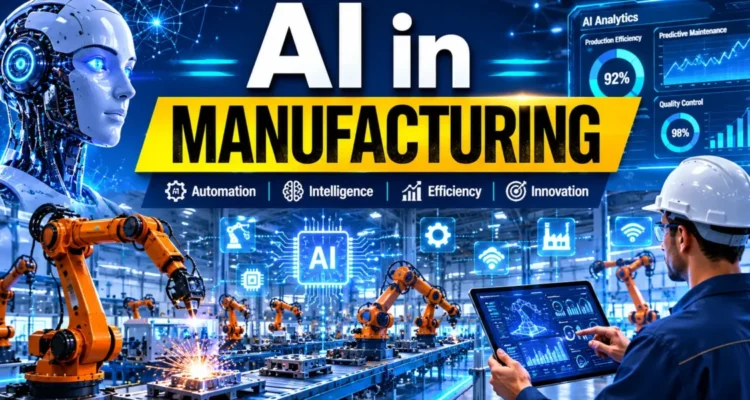
AI in manufacturing uses machine learning, computer vision, optimization, and generative AI to improve how factories plan, produce, inspect, maintain, and deliver products. In practice, AI in manufacturing does not replace an entire factory overnight. They solve defined operational problems with trustworthy data, measurable outcomes, and human oversight.
This evergreen guide explains the leading applications, benefits, risks, costs, and implementation steps for manufacturers of every size. It also connects industrial AI with robotics, autonomous agents, and other developments covered in our technology and AI guide.
Quick answer: Manufacturers commonly use AI for predictive maintenance, visual quality inspection, process optimization, demand forecasting, energy management, worker assistance, and generative design. Successful adoption starts with one costly problem, clean operational data, a baseline metric, a controlled pilot, and a plan for integrating the model into daily work.
Table of Contents
What Is Artificial Intelligence in Manufacturing?
Artificial intelligence in manufacturing means applying algorithms that learn from production data or reason over technical information to support decisions and actions. Data may come from machine sensors, cameras, maintenance records, enterprise systems, quality measurements, operator notes, or supply-chain platforms.
Unlike fixed automation, which follows predefined rules, a machine-learning system can identify complex patterns and update predictions as conditions change. It may estimate when a bearing is likely to fail, detect a subtle surface defect, recommend a process setting, or forecast demand. AI in manufacturing still operates inside engineering limits, safety rules, permissions, and human responsibility.
AI, Automation, and Industry 4.0
Automation performs repeatable actions; AI adds perception, prediction, language understanding, or adaptive decision support. Industry 4.0 is the broader connected-factory model that combines sensors, data platforms, robotics, digital twins, cloud or edge computing, and intelligent analytics. AI becomes useful when it turns those connected data streams into an operational result.
9 Powerful Applications of AI in Manufacturing
1. Predictive Maintenance
Predictive maintenance models analyze vibration, temperature, sound, pressure, current, oil condition, and historical failures to estimate equipment health. Maintenance teams can investigate a developing problem before an unexpected shutdown. The goal is not maximum maintenance; it is the right intervention at the right time.
A reliable program needs failure definitions, sensor quality checks, enough operating history, and a workflow for technicians to confirm or reject alerts. False alarms waste labor, while missed failures damage trust. Start with a critical asset whose downtime cost and failure modes are already understood.
2. Computer-Vision Quality Inspection
Cameras and vision models can inspect dimensions, labels, assembly completeness, welds, surfaces, packaging, and other visible attributes at production speed. AI can flag uncertain items for human review rather than making every decision alone.
Performance depends on lighting, camera position, representative defect examples, product variation, and the cost of false acceptance versus false rejection. Manufacturers should measure results by defect type and production condition, not only one overall accuracy score.
3. Process Optimization
Models can relate process settings, material properties, environmental conditions, cycle data, and final quality. Engineers use those relationships to find stable operating windows, reduce scrap, improve yield, or shorten cycle time. Recommendations must remain inside validated equipment and safety limits.
4. Demand and Inventory Forecasting
AI forecasts can combine orders, seasonality, promotions, lead times, market signals, and disruptions. Better forecasts support purchasing, staffing, capacity, safety-stock, and production planning. Because unusual events can break historical patterns, planners need scenario tools and the ability to override recommendations with documented reasons.
5. Robotics and Autonomous Material Handling
AI helps robots perceive objects, adapt paths, inspect work, or navigate changing environments. Collaborative robots can assist people with repetitive or ergonomically difficult tasks, while autonomous mobile robots move material through approved routes. Physical systems require risk assessment, guarding, emergency stops, validated behavior, and trained operators. Explore the wider trend in our guide to the future of AI robots.
6. Generative Design and Engineering
Generative design explores many geometries against constraints such as weight, stiffness, cost, material, and manufacturing method. Generative AI can also summarize requirements, draft work instructions, explain technical documents, or help engineers search prior designs. Outputs remain proposals until validated through engineering analysis, simulation, testing, and change control.
7. Digital Twins
A digital twin represents an asset, line, or process using real and simulated data. Teams can test scheduling changes, maintenance strategies, layouts, or control settings before affecting production. A twin is only as useful as its assumptions, calibration, and connection to current operating conditions.
8. Energy and Sustainability Optimization
AI can identify abnormal energy use, schedule flexible loads, improve heating or cooling, reduce compressed-air losses, and connect resource consumption with product and process conditions. Sustainability claims should use verified baselines and account for the energy and hardware consumed by the AI system itself.
9. Knowledge Assistants for Workers
A controlled assistant can search approved manuals, procedures, maintenance history, and troubleshooting guides. It may explain a fault code, draft a shift handover, or guide an operator through an authorized checklist. Source citations, document version control, role-based access, and escalation rules are essential.
Benefits of AI in Manufacturing
- Less unplanned downtime: earlier warning supports planned maintenance.
- Higher quality: continuous inspection and process insight reduce escapes and rework.
- Better productivity: teams focus on exceptions and high-value decisions.
- Lower waste: stable processes use material, energy, and time more effectively.
- Faster decisions: operational signals become prioritized recommendations.
- Safer work: monitoring and robotics can reduce exposure to hazardous or repetitive tasks.
NIST describes applications ranging from predictive maintenance to generative design and emphasizes efficiency, quality, and competitiveness. Its manufacturing AI overview also recognizes that adoption barriers differ across organizations.
Challenges and Risks
Data Quality and Context
Industrial data is often incomplete, inconsistent, isolated, or collected for control rather than analytics. A model may mistake a maintenance change, product mix, or sensor replacement for a meaningful pattern. Data engineering and process expertise frequently require more effort than model training.
Cybersecurity and Access
Connecting operational technology creates new paths for attack or accidental disruption. Segment networks, use unique identities, limit permissions, secure remote access, inventory assets, patch safely, log actions, and preserve manual recovery. AI recommendations should never bypass safety interlocks.
Model Drift and Reliability
Equipment, suppliers, products, and operating conditions change. Monitor input drift, alert quality, business outcomes, and operator feedback. Define when a model must be retrained, restricted, or retired.
Integration and Return on Investment
A technically accurate model creates no value if it does not fit the maintenance, quality, planning, or control workflow. Calculate total cost across sensors, connectivity, storage, software, integration, validation, cybersecurity, training, and support. Compare benefits with a documented baseline.
Workforce Trust and Skills
Operators and technicians hold context that datasets miss. Include them in problem selection, labeling, testing, and workflow design. Explain what the system measures, when it can be wrong, and how feedback changes it. The employment effects are broader than simple replacement, as discussed in our AI jobs analysis.
How to Implement AI in Manufacturing
1. Choose a Business Problem
Select a recurring, costly problem with an accountable owner. Define the decision that will change and the metric that proves value: downtime hours, scrap rate, first-pass yield, energy per unit, lead time, or forecast error.
2. Establish a Baseline
Measure current performance, variation, costs, and existing interventions. Without a baseline, a successful demonstration can be mistaken for business improvement.
3. Assess Data and Infrastructure
Identify required signals, ownership, sampling rates, missing periods, labels, retention, and access restrictions. Decide whether processing belongs at the edge, on premises, in the cloud, or in a hybrid architecture.
4. Run a Controlled Pilot
Begin in advisory mode on one asset, line, product, or facility. Compare predictions with actual outcomes and existing practice. Test failures, unusual products, sensor outages, and operator overrides.
5. Integrate With Work
Deliver the insight where a person can act: a maintenance system, quality station, planning screen, or approved alert channel. Define ownership, response time, escalation, and documentation.
6. Validate Safety and Governance
Document intended use, limitations, training data, permissions, testing, monitoring, fallback, and change approval. High-impact actions need human authorization. Autonomous workflows share principles with agentic AI: bounded tools, observable actions, and a safe stop.
7. Scale Only After Evidence
Confirm repeatable value before expanding. A model that works on one line may fail where equipment, lighting, products, maintenance history, or operator practices differ. Standardize interfaces and governance while allowing local validation.
AI in Manufacturing for Small Companies
For small companies, AI in manufacturing does not require a factory-wide platform to begin. Practical starting points include analyzing existing downtime records, adding vision inspection to one station, forecasting a volatile component, or creating an approved-document assistant. Prefer a narrow project with visible payback over a broad “AI transformation” program.
Before purchasing a solution, ask who owns the data, how performance is validated, what integration is required, how the model handles change, what happens without connectivity, and how the system can be exported or retired. Avoid vendors that promise a universal model without studying the process.
The Future of AI in Manufacturing
The future of AI in manufacturing is moving toward more adaptive production, edge intelligence, natural-language interfaces, digital twins, flexible robotics, and systems that coordinate multiple tools. NIST’s 2026 smart-manufacturing roadmap highlights efficiency, adaptability, autonomy, measurement, quality assurance, and industrial value chains.
For AI in manufacturing, human-machine collaboration will remain central. The World Economic Forum expects AI, robotics, and automation to reshape tasks and skills through 2030, with work increasingly divided among people, technology, and combined approaches. The strongest factories will pair domain expertise with reliable data and carefully governed tools. See how this connects to the wider technology and AI landscape.
Frequently Asked Questions
What is the best use of AI in manufacturing?
The best use depends on the plant’s largest measurable problem. Predictive maintenance, visual quality inspection, process optimization, and demand forecasting are common starting points because their outcomes can be compared with clear baselines.
Does industrial AI replace workers?
It can automate specific tasks, but it also changes jobs and creates demand for data, robotics, maintenance, integration, and oversight skills. Most deployments still rely on workers to provide context, handle exceptions, and authorize consequential actions.
Can small manufacturers use AI?
Yes. A small company can begin with one bounded use case and existing data. Success depends more on problem clarity, process knowledge, and integration than on launching a large platform.
What data does manufacturing AI need?
It may use sensor readings, images, quality results, machine states, maintenance events, production records, orders, or technical documents. The required data must represent the decision and operating conditions accurately.
How is AI performance measured in a factory?
Measure both model performance and business outcomes. Useful metrics include false-alarm rate, missed defects, downtime, first-pass yield, scrap, cycle time, energy per unit, forecast error, response time, and verified financial impact.
Final Thoughts
AI in manufacturing creates value when prediction or automation improves a real operational decision. It is not a substitute for process knowledge, reliable equipment, cybersecurity, safety engineering, or workforce engagement.
Start with a measurable problem, prove the result in a controlled pilot, integrate it into daily work, and scale only after evidence. For related developments in coding agents, robotics, private assistants, and changing jobs, continue with our complete technology and AI guide.
