Witnessing the Marvel: A Guide to Solar Eclipses
Kamran Liaquat ali
- posted on
- Comments Off on Witnessing the Marvel: A Guide to Solar Eclipses
In the vast expanse of our celestial ballet, few phenomena
rival the awe-inspiring spectacle of a solar eclipse. It’s a moment when the
mundane patterns of our daily lives are momentarily eclipsed by the
extraordinary dance of celestial bodies. With its ethereal beauty and profound
significance, a solar eclipse has captivated humans for millennia, prompting
cultures around the world to create myths, legends, and rituals to explain and
honor this cosmic event.
What is a Solar Eclipse?
At its core, a solar eclipse occurs when the Moon passes
between the Earth and the Sun, obscuring the Sun either partially or entirely
from our view. This alignment casts a shadow upon the Earth, plunging regions
into temporary darkness and creating a mesmerizing display of celestial
geometry.
Types of Solar Eclipses:
There are primarily three types of solar eclipses:
1.Total Solar Eclipse: In
this rare and breathtaking event, the Moon completely covers the Sun, revealing
its majestic corona—a halo of plasma that surrounds the Sun’s surface.
Totality, as it’s called, is a surreal experience where the sky darkens,
temperatures drop, and stars emerge in broad daylight.
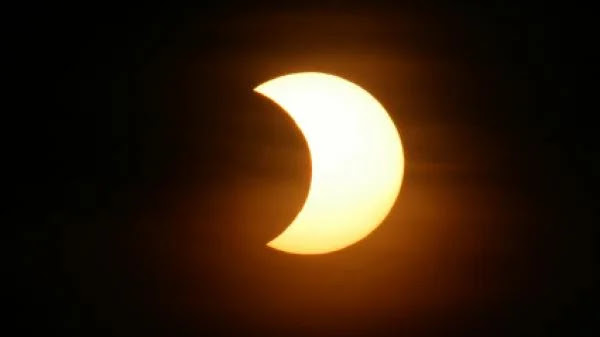
2.Partial Solar Eclipse: Unlike
the total eclipse, a partial eclipse occurs when only a portion of the Sun is
obscured by the Moon. While not as dramatic as totality, a partial eclipse
still offers a remarkable sight as the Moon takes a ‘bite’ out of the Sun,
casting intriguing crescent shapes onto the landscape.
3.Annular Solar Eclipse: This
occurs when the Moon is too far from the Earth to completely cover the Sun’s
disk. As a result, a ring of sunlight remains visible around the Moon, creating
what’s often referred to as a ‘ring of fire.’
Where and When to Witness:
Solar eclipses are not frequent occurrences in any given
location, but they do happen around the world with relative regularity. The key
to experiencing one is knowing when and where to look. Eclipses are typically
announced well in advance, allowing enthusiasts and curious onlookers to plan
their viewing experience.
Safety Precautions:
It’s crucial to emphasize the importance of viewing a solar
eclipse safely. Staring directly at the Sun, even during an eclipse, can cause
permanent eye damage or blindness. Specialized solar viewing glasses, solar
filters, or indirect viewing methods, such as pinhole projectors or solar
telescopes, are essential for protecting your eyes while observing this
celestial event.
Cultural Significance:
Throughout history, solar eclipses have held profound
cultural significance. Many ancient civilizations interpreted eclipses as omens
or celestial battles between mythical figures. Today, solar eclipses continue
to inspire wonder and reverence, prompting gatherings, festivals, and scientific expeditions to witness and
study these rare events.
The Cosmic Dance Continues:
As we stand on the precipice of the universe, gazing up at
the celestial ballet unfolding above us, a solar eclipse reminds us of our
place in the cosmos. It’s a reminder of the beauty, mystery, and
interconnectedness of the universe—a fleeting moment where the mundane is
eclipsed by the extraordinary, leaving an indelible mark on our collective
consciousness. So, when the next solar eclipse graces the sky, take a moment to
pause, look up, and marvel at the cosmic dance that continues to unfold above
us.
