Automobile Manufacturing Process: 7 Powerful Stages Explained
 Kamran Liaquat Ali
- posted on
- No Comment

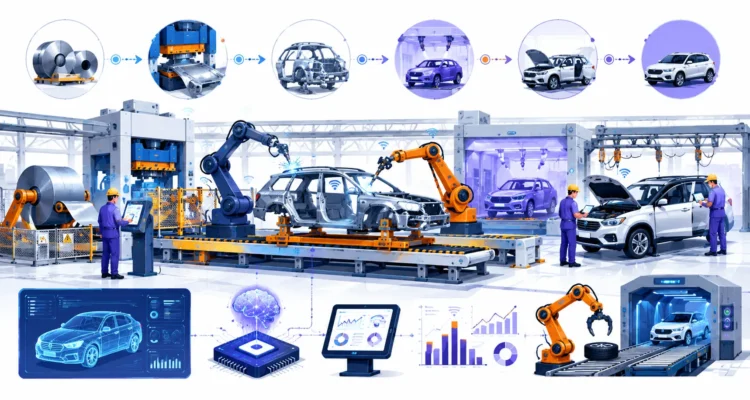
The automobile manufacturing process is one of the most impressive examples of modern engineering, automation, logistics, and quality control working together. A finished vehicle may look like a single product, but producing it requires thousands of individual parts to move through a carefully controlled sequence of manufacturing operations.
Inside a modern automobile manufacturing plant, sheets of metal are transformed into body panels, robots join structural components together, multiple coating systems protect and finish the vehicle body, and workers and automated equipment install everything from engines and batteries to seats, dashboards, wiring, glass, and wheels.
Modern car factories are also becoming increasingly digital. Sensors, industrial robots, artificial intelligence, machine vision, connected equipment, and digital twins can help manufacturers monitor production, detect problems, improve quality, and make better operational decisions.
So, how does a car actually go from raw materials and individual components to a completed vehicle?
This guide explains the automobile manufacturing process through seven major stages and explores the engineering, automation, quality systems, sustainability practices, and smart-manufacturing technologies behind today’s automotive factories.
Table of Contents
What Is the Automobile and Car Manufacturing Process?
The automobile manufacturing process is the organized sequence of engineering and production operations used to transform materials and components into a finished vehicle.
The car manufacturing process—also known as automotive manufacturing or automotive production—moves a vehicle through carefully coordinated stages, from raw materials and metal stamping to welding, painting, final assembly and testing. In simple terms, the process of car manufacturing turns thousands of individual components into a safe and complete vehicle. Each stage of this car-making process depends on precise engineering, automation, skilled workers and strict quality control.
Although the exact production system varies by manufacturer, vehicle type, factory layout, and powertrain, a large vehicle plant commonly includes operations such as:
- Material and component preparation
- Metal stamping
- Body welding and joining
- Surface treatment and painting
- Powertrain and component preparation
- Final vehicle assembly
- Inspection, testing, and quality assurance
These operations do not function independently. Production planning, material handling, logistics, maintenance, engineering, quality assurance, and information systems must coordinate with the manufacturing line to keep vehicles moving through the factory efficiently.
A useful real-world example is Toyota’s Kentucky manufacturing facility. Toyota lists vehicle-production operations at the site including stamping, body weld, paint, plastics, and assembly, demonstrating how several major manufacturing stages can be integrated within a large automotive facility.
1. Raw Materials and Component Supply
The first stage of the automobile manufacturing process begins before a vehicle reaches the main production line.
Automobiles require a wide range of materials and manufactured components. Depending on the vehicle, these can include:
- Steel
- Aluminum
- Plastics and polymers
- Glass
- Rubber
- Copper and other conductive materials
- Electronic components
- Textiles and interior materials
- Motors, engines, transmissions, or battery components
Many of these items arrive from specialized suppliers rather than being produced entirely inside the final vehicle assembly plant.
This makes supply-chain coordination extremely important. Manufacturers need the correct component, in the correct quantity, at the correct production location and at the correct time.
Why Material Quality Matters
A defective component entering production can create problems later in the manufacturing process. For this reason, automotive manufacturers and suppliers use specifications, inspections, measurements, traceability systems, and quality-management procedures to control incoming materials.
Material properties are especially important for structural components. Engineers must consider characteristics such as strength, weight, corrosion resistance, manufacturability, and cost when selecting materials for different parts of a vehicle.
2. Stamping: Turning Metal Sheets Into Car Panels
In the automobile manufacturing process, stamping is one of the most recognizable stages inside an automobile factory.
Large sheets or coils of metal are processed using powerful presses and precision dies. These tools form relatively flat material into three-dimensional automotive components.
Stamped components can include:
- Doors
- Hoods
- Roof panels
- Fenders
- Floor sections
- Body-side components
- Structural reinforcements
Producing these components requires extremely accurate tooling because even small dimensional variations can affect later operations such as welding, door alignment, sealing, and final assembly.
How Automotive Stamping Works
The process can involve several forming operations rather than a single press action. Depending on the component, material may be drawn into shape, trimmed, pierced, flanged, or otherwise formed before becoming a finished body panel.
Automation is widely used for moving material between operations because automotive panels can be large, production rates are high, and repeatable positioning is essential.
Once stamped components meet dimensional and surface-quality requirements, they can move to the next major stage of the automobile manufacturing process: body construction.
3. Body Shop: Welding the Vehicle Structure Together
The body shop is where separate stamped pieces begin to resemble an automobile.
Panels and structural components are positioned using fixtures and then joined together to create the vehicle’s body structure, often called the body-in-white before painting and final equipment installation.
Depending on the design and materials involved, manufacturers can use multiple joining methods, including:
- Resistance spot welding
- Arc or laser-based welding processes
- Structural adhesives
- Rivets and mechanical fasteners
- Specialized joining techniques for mixed materials
Why Robots Are Common in Automotive Body Shops
Industrial robots are particularly suitable for repetitive operations requiring consistent positioning and repeatability.
Robotic systems can perform welding, material handling, component positioning, adhesive application, inspection-related tasks, and other production operations.
Automation does not eliminate the need for people. Engineers, technicians, maintenance specialists, production workers, quality personnel, and automation professionals are still required to operate, monitor, maintain, troubleshoot, and improve manufacturing systems.
The scale of automotive body-shop automation can be substantial. The U.S. Department of Energy has previously highlighted a General Motors body shop containing more than 1,400 robots, illustrating the level of automation possible in large automotive manufacturing operations.
4. Paint Shop: Protecting and Finishing the Vehicle Body
After the body structure has been assembled, it needs protection against corrosion and a high-quality exterior finish.
The paint shop is therefore much more sophisticated than simply spraying a visible color onto a vehicle.
Although processes vary by manufacturer and facility, vehicle bodies can move through multiple preparation, treatment, coating, curing, and inspection stages.
The objectives include:
- Cleaning the vehicle body
- Preparing surfaces for coating
- Providing corrosion protection
- Applying protective and appearance-related coatings
- Producing a consistent exterior finish
- Detecting coating or surface defects
Automation in the Paint Shop
Robotic equipment can provide repeatable application while reducing unnecessary variation. Process conditions also need careful control because coating quality can be influenced by contamination, temperature, humidity, material properties, equipment condition, and application parameters.
Inspection remains critical. Surface defects that are difficult or expensive to correct after final assembly are better identified earlier in production.
5. Powertrain, Battery and Major Component Preparation
While the vehicle body moves through stamping, body construction, and painting, other parts of the factory or external suppliers may prepare major mechanical and electrical systems.
For a conventional internal-combustion vehicle, these may include:
- Engine
- Transmission
- Exhaust-related components
- Cooling-system components
- Fuel-system components
Hybrid and battery-electric vehicles introduce different manufacturing requirements. Depending on the factory and product, major systems may include electric drive units, power electronics, high-voltage wiring, battery packs, thermal-management components, and related control systems.
The growing variety of vehicle powertrains means automotive factories increasingly need flexible manufacturing systems capable of supporting different configurations and product variants.
6. Final Assembly: Where the Complete Car Comes Together
Final assembly is the stage most people imagine when thinking about the automobile manufacturing process.
The painted body travels through a sequence of workstations while components are installed in a carefully planned order.
Depending on the vehicle and production system, final assembly may involve installing:
- Wiring harnesses
- Instrument panels and dashboards
- HVAC components
- Seats
- Interior trim
- Windows and windshields
- Suspension components
- Braking systems
- Powertrain or electric-drive components
- Battery systems
- Doors and exterior components
- Wheels and tires
- Electronic modules
The Importance of Assembly-Line Sequencing
A modern assembly line must coordinate thousands of components with the specific vehicle being built.
This becomes especially challenging when one production line handles multiple models, trim levels, colors, powertrain options, interior packages, or market-specific configurations.
Production and logistics systems therefore help ensure that the appropriate parts arrive at the relevant workstation when required.
Tools, fastening systems, scanners, sensors, identification technologies, and computerized work instructions can also help operators complete assembly tasks consistently.
Humans and Automation Work Together
Automobile manufacturing is highly automated, but many assembly tasks still benefit from human flexibility.
A robot is excellent at repeating a precisely defined motion. A skilled worker, however, can adapt to variations, recognize unusual conditions, handle certain flexible components, and perform tasks that may be difficult to automate economically.
Modern automotive production therefore often combines human skills with automation rather than relying exclusively on either one.
7. Quality Control and Vehicle Testing
Quality control is not simply the final stage of the automobile manufacturing process. It occurs throughout production.
Manufacturers can inspect stamped parts, body dimensions, welds, coatings, installed components, electrical systems, software functions, and completed vehicles at different stages.
Common Quality-Control Technologies
Modern manufacturing facilities can use technologies such as:
- Machine vision
- Industrial cameras
- Laser measurement systems
- Torque-monitoring tools
- Dimensional measurement equipment
- Electronic diagnostic systems
- Automated inspection equipment
- Production-data analysis
Quality data can also be traced back to individual processes. If a recurring defect appears, engineers can investigate the relevant operation and identify possible causes rather than relying only on end-of-line inspection.
End-of-Line Testing
Before a completed vehicle leaves the manufacturing facility, it can undergo a range of functional and quality checks.
Depending on the manufacturer, vehicle, and facility, these may examine areas such as:
- Electrical functions
- Warning systems
- Braking performance
- Wheel alignment
- Lighting
- Water sealing
- Electronic diagnostics
- Noise or vibration concerns
- General fit and finish
Only after required inspections and tests are successfully completed is the vehicle ready for distribution.
How the Automobile Assembly Line Works
The assembly line remains one of the foundations of high-volume automotive manufacturing.
Instead of one group building an entire automobile in one location, the vehicle moves through a sequence of specialized operations. Each station performs a defined set of tasks before the product advances.
This approach offers several advantages:
- Repeatable production sequences
- Specialized tools at individual stations
- Better material-flow planning
- Standardized work
- Easier production monitoring
- High-volume manufacturing capability
Modern assembly systems, however, are much more sophisticated than early moving production lines. Today’s factories can combine programmable automation, robotics, digital tracking, sensors, flexible tooling, and computerized production planning.
Quality Control in the Automobile Manufacturing Process
Automotive quality is particularly important because manufacturing defects can affect reliability, customer satisfaction, regulatory compliance, and safety.
Instead of waiting until the entire vehicle is complete, modern quality systems aim to identify variation as close as possible to the process where it originates.
In-Process Inspection
Measurements can be taken while components and assemblies move through production. If dimensions or process values move outside specified limits, the manufacturing team can investigate before the issue affects a large number of vehicles.
Machine Vision
Cameras combined with image-processing software can inspect certain features rapidly and consistently. Potential applications include checking component presence, orientation, surface conditions, labels, and assembly characteristics.
Process Data
Connected manufacturing equipment can generate large amounts of data. Engineers can analyze this information to understand process stability, equipment behavior, production losses, and recurring quality problems.
Artificial intelligence and machine learning are increasingly relevant here. NIST’s 2026 roadmap for AI and machine learning in smart manufacturing identifies areas such as advanced sensing, autonomous systems, robotics, digital twins, industrial data analytics, and sustainable manufacturing as important applications of AI in modern industrial environments.
Smart Factories and Industry 4.0 in Automobile Manufacturing
The next evolution of the automobile manufacturing process is closely connected to smart manufacturing and Industry 4.0.
A smart factory uses connected machines, sensors, software, data, and automation to provide greater visibility into manufacturing operations.
Important technologies include:
- Industrial Internet of Things (IIoT)
- Artificial intelligence
- Machine learning
- Digital twins
- Industrial robotics
- Machine vision
- Cloud and edge computing
- Advanced production analytics
Industrial Internet of Things
IIoT technologies allow equipment and sensors to generate and exchange operational information.
Manufacturers can use connected data to monitor production rates, equipment conditions, process parameters, quality indicators, and other operational metrics.
Artificial Intelligence and Machine Learning
AI and machine learning can help manufacturers analyze large industrial datasets, identify patterns, improve inspection, support predictive maintenance, and optimize certain production decisions.
However, industrial AI must also be reliable. Manufacturing environments involve physical equipment, safety requirements, quality standards, and expensive production assets, so trustworthy implementation matters as much as raw algorithmic capability.
Digital Twins in Automobile Manufacturing
In the automobile manufacturing process, a digital twin is more than a static 3D model. In advanced manufacturing, it can serve as a synchronized virtual representation connected to information about a physical system or process.
The National Institute of Standards and Technology’s Digital Twins for Advanced Manufacturing program explains that digital twins can help manufacturers represent, diagnose, predict, and optimize manufacturing operations.
Potential applications can include:
- Production-system analysis
- Equipment monitoring
- Process optimization
- Maintenance planning
- Simulation of operational changes
- Quality improvement
NIST also emphasizes the importance of standards, interoperability, verification, validation, and trustworthiness when implementing manufacturing digital twins.
For automobile factories, these capabilities could allow engineers to evaluate certain changes digitally before disrupting a real production system.
Predictive Maintenance in Automotive Factories
Unexpected equipment failure can interrupt production and create significant costs in a high-volume manufacturing plant.
Traditional maintenance may rely on scheduled servicing or repairs after equipment fails. Predictive approaches attempt to use equipment-condition data to identify developing problems earlier.
Data sources may include:
- Temperature
- Vibration
- Motor current
- Pressure
- Cycle time
- Equipment alarms
- Historical maintenance records
When combined with appropriate analytics, this information can help maintenance teams prioritize inspections and interventions.
The objective is not to predict every failure perfectly. It is to make better maintenance decisions using available equipment data.
Sustainability in Automobile Manufacturing Plants
Modern manufacturers also face pressure to reduce the environmental and financial costs associated with energy, water, materials, and waste.
Automotive plants can contain large production systems, compressed-air equipment, motors, pumps, ventilation systems, paint processes, heating and cooling systems, lighting, and other energy-consuming infrastructure.
Efficiency improvements may therefore involve:
- Energy-management systems
- Efficient motors and drives
- Improved HVAC operation
- Compressed-air optimization
- Heat recovery
- Water conservation
- Material recycling
- Waste reduction
- Renewable-energy projects
The U.S. Department of Energy’s Better Plants program works with industrial organizations on improvements involving energy, water, waste, and manufacturing competitiveness. Participating manufacturers can commit to substantial long-term reductions in energy intensity.
The automotive sector provides real examples of structured energy management. The U.S. Department of Energy has documented automotive manufacturing facilities using formal energy-management approaches across operations including body shops, paint shops, component manufacturing, and general assembly.
How Long Does It Take to Manufacture a Car?
There is no universal number of hours required to manufacture every automobile.
The answer depends on what is being measured.
If someone measures only the time a vehicle spends moving through a particular final assembly line, the result can be very different from measuring the complete production journey including stamping, body construction, painting, curing, intermediate storage, inspections, sequencing, and testing.
Manufacturing time is also affected by:
- Vehicle complexity
- Factory design
- Production volume
- Level of automation
- Product variation
- Powertrain type
- Production scheduling
For that reason, claims that “every car takes X hours to manufacture” should be treated carefully unless the measurement method and specific factory are clearly identified.
Why Automobile Manufacturing Plants Are So Complex
A modern vehicle factory is not simply a collection of machines. It is a highly interconnected production system.
Changing one process can influence several others.
For example, increasing the speed of one workstation does not automatically increase total factory output if another downstream process becomes the bottleneck. Similarly, improving robotic cycle time provides little benefit if required components are not delivered to the line when needed.
Automotive manufacturing therefore requires expertise across multiple disciplines, including:
- Mechanical engineering
- Industrial engineering
- Electrical engineering
- Automation and controls
- Manufacturing engineering
- Quality engineering
- Maintenance engineering
- Supply-chain management
- Data and software systems
This combination of physical engineering and digital technology is one reason modern automobile plants are valuable examples of advanced manufacturing.
The Future of the Automobile Manufacturing Process
The automobile manufacturing process will continue to evolve as vehicle technology and industrial automation advance.
Several trends are likely to remain particularly important.
More Flexible Production
Factories may need to accommodate multiple powertrains, changing vehicle platforms, and greater product variation without requiring complete production-system redesigns.
Greater Use of Manufacturing Data
Connected equipment will continue producing more operational data. The challenge will increasingly be converting that data into reliable decisions rather than simply collecting it.
Smarter Automation
Traditional industrial automation excels at repeatable tasks. Newer sensing, machine vision, and AI technologies may allow automation systems to respond to a wider range of production conditions.
Digital Twins
Digital twins can help manufacturers model, diagnose, predict, and optimize manufacturing operations. NIST identifies them as an important part of the ongoing digital transformation of manufacturing.
AI-Assisted Manufacturing
AI may increasingly support inspection, equipment monitoring, robotics, process optimization, logistics, and maintenance. NIST’s current smart-manufacturing research also highlights the importance of trustworthy and explainable AI in industrial environments.
Energy and Resource Efficiency
Energy, material, water, and waste efficiency will remain important because improvements can reduce both operating costs and environmental impact.
When evaluating the automobile manufacturing process, examine material flow, takt time, safety controls, quality gates, energy use, and traceability together. A capable automobile manufacturing process keeps those elements synchronized instead of optimizing one station in isolation. Improving the automobile manufacturing process therefore requires verified data, controlled changes, and feedback from operators, maintenance teams, suppliers, and customers. This systems view makes the automobile manufacturing process more reliable, flexible, and sustainable.
A well-managed automobile manufacturing process depends on accurate production data and fast corrective action. Reviewing the automobile manufacturing process as one connected system helps teams prevent local improvements from creating downstream quality, safety, or delivery problems.
The automobile manufacturing process depends on synchronized material delivery and reliable production data. Each automobile manufacturing process must also control variation across stamping, welding, painting, and final assembly. Engineers improve the automobile manufacturing process by measuring bottlenecks, defects, equipment condition, and energy use. A resilient automobile manufacturing process includes traceability and practical contingency plans. Reviewing the automobile manufacturing process as one connected system prevents local changes from damaging downstream performance. Continuous feedback keeps the automobile manufacturing process safe, consistent, and adaptable.
Explore More Engineering and Manufacturing Guides
Use our engineering and manufacturing guide to place vehicle production within the wider world of industrial processes, quality, safety, energy, and smart manufacturing.
Continue with our guides to CNC machining, computational fluid dynamics, and the potential of cloud manufacturing. These sibling resources explain precision production, engineering simulation, and connected factory operations.
Frequently Asked Questions About the Automobile Manufacturing Process
What is an automobile manufacturing plant?
In the automobile manufacturing process, an automobile manufacturing plant is an industrial facility where vehicles or major vehicle components are produced. A large vehicle plant may include stamping, body construction, painting, component production, final assembly, inspection, logistics, and supporting engineering operations.
What are the main stages of the automobile manufacturing process?
The major stages generally include material and component preparation, stamping, body welding and joining, painting, major component preparation, final assembly, and quality testing. The exact sequence and operations vary between manufacturers and vehicle types.
What is stamping in automobile manufacturing?
Stamping uses presses and precision dies to form metal sheets into automotive panels and structural components. These parts can include doors, roofs, hoods, floor sections, and other elements of the vehicle body.
Why are robots used in automobile manufacturing?
Robots are useful for repetitive, precise, and highly repeatable operations such as welding, material handling, coating-related tasks, and certain inspection processes. They often work as part of a larger manufacturing system that also relies on skilled human workers.
What is a body-in-white?
Body-in-white generally refers to the joined vehicle body structure before painting and before most final components, interior equipment, and powertrain systems have been installed.
How is quality checked during car manufacturing?
Quality checks can occur throughout production using manual inspection, dimensional measurement, machine vision, process monitoring, electronic diagnostics, and end-of-line vehicle testing. The exact methods depend on the manufacturer and process.
How is AI used in automobile manufacturing?
Artificial intelligence and machine learning can support applications such as industrial data analysis, machine vision, equipment monitoring, robotics, predictive maintenance, quality assurance, and production optimization.
What is a digital twin in automobile manufacturing?
A digital twin is a digital representation connected to a physical manufacturing system or process. It can help engineers represent, analyze, diagnose, predict, and optimize aspects of manufacturing operations when implemented with suitable data and validated models.
How long does the automobile manufacturing process take?
There is no single manufacturing time for every vehicle. The duration depends on the factory, vehicle, production volume, powertrain, process sequence, automation level, and whether the measurement includes only final assembly or the complete manufacturing journey.
Are automobile factories fully automated?
No. Modern factories can use extensive automation, particularly in areas such as body welding, material handling, and coating processes, but human workers remain important for assembly, maintenance, engineering, quality control, troubleshooting, supervision, and other complex tasks.
Use the automobile manufacturing process as a practical example of how engineering, automation, logistics, and quality work together. For the complete topic cluster, return to our engineering and manufacturing guide.
Final Thoughts
The automobile manufacturing process demonstrates how mechanical engineering, industrial automation, materials science, logistics, quality management, and digital technology can operate as one coordinated production system.
A vehicle begins as materials and thousands of separate components. Stamping presses form body panels, automated joining systems create the vehicle structure, sophisticated paint processes protect and finish the body, and carefully sequenced assembly operations bring together mechanical, electrical, electronic, and interior systems.
Quality control operates throughout this journey rather than only after the vehicle is finished. Meanwhile, smart sensors, industrial data, artificial intelligence, machine vision, predictive maintenance, and digital twins are creating new ways to understand and optimize factory operations.
As electric vehicles, flexible production systems, smarter automation, and connected manufacturing continue to develop, the automobile manufacturing process will become even more data-driven and adaptable.
Yet the fundamental objective remains unchanged: transform thousands of individual materials and components into a safe, reliable, consistent, and high-quality finished vehicle through a controlled and repeatable manufacturing process.
