Albert Einstein Biography: 10 Powerful Facts About His Life, Theories & Achievements
Kamran Liaquat ali
- posted on
- Comments Off on Albert Einstein Biography: 10 Powerful Facts About His Life, Theories & Achievements
Introduction
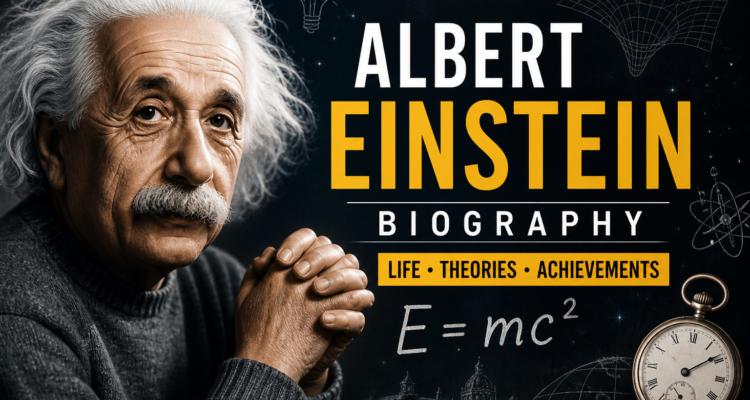
Albert Einstein biography is the story of one of the greatest scientific minds in history. Albert Einstein revolutionized modern physics with his groundbreaking theories and unmatched intellect. His work changed our understanding of space, time, and energy, leaving a lasting impact on science and humanity.
Table of Contents
Early Life and Education
Albert Einstein was born on March 14, 1879, in Ulm, Germany. From an early age, he showed a deep interest in mathematics and science. Although he struggled with traditional schooling, his curiosity and passion for learning helped him excel in physics.
Einstein later studied at the Swiss Federal Polytechnic in Zurich, where he developed the foundation for his future discoveries.
Major Scientific Contributions
Special Theory of Relativity
One of the most important parts of the Albert Einstein biography is his Special Theory of Relativity, published in 1905. This theory explains that the laws of physics are the same for all observers and that the speed of light remains constant.
General Theory of Relativity
In 1915, Einstein introduced the General Theory of Relativity. This theory changed the way we understand gravity, describing it as the curvature of space and time caused by mass and energy.
Photoelectric Effect
Einstein explained the photoelectric effect in 1905, showing how light can release electrons from a material. This discovery was extremely important and earned him the Nobel Prize in Physics in 1921.
Mass-Energy Equivalence
Einstein’s famous equation E = mc² is a key highlight of the Albert Einstein biography. It shows that mass and energy are interchangeable and can be converted into each other.
You can learn more about relativity from NASA
Personal Life and Beliefs
Einstein had a rich personal life. He married twice and had three children. He was also known for his strong beliefs in peace, human rights, and equality.
He openly spoke against war and supported civil rights movements, making him not just a scientist but also a humanitarian.
Einstein’s Influence on Science
The Albert Einstein biography continues to influence modern science. His theories are used in areas like space exploration, GPS technology, and advanced physics research.
Scientists today still build upon his work to explore the universe.
Awards and Recognition
Einstein received many awards during his lifetime, including:
- Nobel Prize in Physics (1921)
- Copley Medal
- Franklin Medal
His name is now a symbol of intelligence and genius.
Einstein in Popular Culture
Einstein’s image, with his unique hairstyle and personality, became a global symbol of genius. His name is often used to describe highly intelligent individuals.
Criticism and Controversies
Despite his success, Einstein faced criticism for his scientific ideas and political views. Some people disagreed with his theories, while others opposed his strong opinions on global issues.
Death and Legacy
Albert Einstein passed away on April 18, 1955. However, the Albert Einstein biography remains alive through his contributions to science and his impact on the world.
His legacy continues to inspire students, scientists, and thinkers across generations.
You can also explore how to write a captivating blog post
Conclusion
The Albert Einstein biography is a powerful example of how curiosity and dedication can change the world. His theories transformed physics, and his ideas continue to guide modern science.
Einstein’s life reminds us that great discoveries come from questioning the world and thinking differently.
FAQs
What is Albert Einstein famous for?
Albert Einstein is famous for the theory of relativity and the equation E = mc².
Did Einstein win a Nobel Prize?
Yes, he won the Nobel Prize in Physics in 1921.
What is Einstein’s biggest contribution?
His biggest contributions include relativity and the photoelectric effect.
Why is Einstein important today?
His theories are still used in modern science and technology.
