Building Connections: 17 Powerful Relationship Strategies
 Kamran Liaquat Ali
- posted on
- No Comment

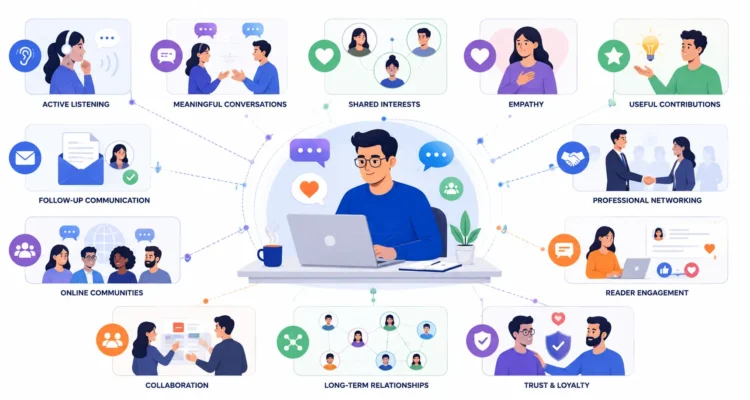
Meaningful relationships can play an important role in blogging, business, freelancing, content creation, and professional growth. Publishing useful content may introduce you to an audience, but building connections through genuine interaction can turn occasional readers, creators, and industry contacts into long-term relationships.
Online networking does not need to mean collecting hundreds of contacts or sending promotional messages to strangers. The strongest relationships usually develop through shared interests, useful conversations, active listening, mutual respect, and consistent interaction over time.
This guide explains practical ways to create stronger online and professional relationships, how bloggers can interact with readers and other creators, why valuable communication matters, and which networking mistakes can make your outreach appear spammy or transactional.
If you are developing a blog and audience from the ground up, visit our complete Blogging and SEO Guide. You can also learn how to participate naturally in discussions through our Impactful Blog Comments guide.
Table of Contents
What Does Building Connections Mean?
Building connections means developing meaningful relationships through useful, respectful, and repeated interaction. These relationships may be personal, professional, or based around a shared community or interest.
A connection might develop between:
- A blogger and a regular reader
- Two creators in the same niche
- A freelancer and a potential client
- A business owner and an industry professional
- An expert and a learner
- Two websites serving similar audiences
The important difference between genuine relationship development and aggressive networking is the intention behind the interaction.
If every conversation begins with “What can this person do for me?”, the relationship will probably feel transactional. A better question is whether both people can exchange knowledge, support useful work, solve problems, or learn from each other.
Why Meaningful Connections Matter for Bloggers
Blogging can easily become an isolated activity. You research a topic, write an article, publish it, optimize it, and move to the next post. However, the people around your content can be just as valuable as the content itself.
Meaningful relationships can contribute to:
- Reader loyalty
- Constructive feedback
- Professional introductions
- Expert interviews
- Collaboration opportunities
- Relevant referral traffic
- Content ideas
- Brand recognition
- Industry knowledge
However, relationships should not be created purely as an SEO backlink scheme. Google’s official Web Search spam policies specifically address manipulative link practices and user-generated spam, including spammy comments.
Real building connections should therefore begin with people and useful interaction rather than links.
1. Start With Genuine Shared Interests
Common ground makes conversations easier and more natural.
Shared interests might include:
- The same industry
- A blogging niche
- A professional skill
- A software platform
- A common business problem
- A hobby
- A particular research topic
For example, if two bloggers publish content about SEO, both already have many natural subjects to discuss, including content updates, internal linking, Search Console, site performance, or keyword research.
Instead of sending a generic networking message, begin with something specific that genuinely interested you.
Specificity makes building connections feel natural rather than manufactured.
2. Practice Active Listening
Communication is not only about explaining your own ideas. Good relationships require understanding what the other person is actually saying.
Active listening can include:
- Reading carefully
- Allowing someone to finish their point
- Asking relevant follow-up questions
- Remembering important details
- Clarifying misunderstandings
- Responding to the actual subject
This principle applies online as well.
If you leave a blog comment, read the article first. If you reply to a discussion, understand the conversation before entering it. If you email another creator, learn enough about their work to know why you are contacting them.
Resources from the Center for Creative Leadership explain active listening as paying focused attention and responding in ways that demonstrate understanding.
3. Show Genuine Interest in Other People
A common networking mistake is spending the entire conversation talking about yourself.
Instead, ask questions that show genuine curiosity.
For example:
- What made you choose this approach?
- What did you learn from that project?
- Have you tested the strategy on a smaller website?
- What was the most difficult part?
- Would you approach it differently today?
Questions like these create deeper conversations than immediately asking for a link, collaboration, or favor.
4. Add Value Before Asking for Something
One of the strongest principles behind building connections is contributing something useful before requesting something in return.
Value can be simple.
You might:
- Answer a question
- Share a useful resource
- Provide constructive feedback
- Point out an opportunity
- Share relevant experience
- Recommend someone’s useful work
This does not mean providing unlimited professional services for free. It means showing that your interest in the relationship is broader than your immediate needs.
5. Have Meaningful Conversations
Small talk can help begin a relationship, but meaningful discussion is what usually makes someone memorable.
Useful conversation topics can include:
- Current projects
- Industry challenges
- Lessons from mistakes
- Interesting experiments
- Changes in your niche
- Professional goals
You do not need to make every conversation highly serious. The goal is simply to move beyond generic statements.
Instead of:
Great article!
you might say:
Your point about refreshing older articles stood out to me. I have noticed that fixing outdated internal links and screenshots can sometimes make an older article much more useful than publishing another similar post.
That provides something another person can actually respond to.
6. Use Blog Comments for Real Discussion
Thoughtful blog comments can be a simple way of building connections with authors and readers who already care about your niche.
A useful comment generally:
- Mentions something specific from the article
- Adds a relevant thought
- Uses natural language
- Respects the author’s perspective
- Avoids unnecessary promotion
If you want practical examples, read our guide to writing impactful blog comments.
Do not treat comment sections as places to drop promotional links. Google lists comment spam among examples of user-generated spam in its spam policies.
7. Participate in Online Communities Before Promoting
Industry forums, Reddit communities, creator groups, professional platforms, and niche communities can introduce you to people with similar interests.
A simple rule works well:
Participate before promoting.
Useful participation can involve:
- Answering questions
- Joining discussions
- Providing constructive feedback
- Sharing relevant experience
- Helping new community members
If every contribution contains a link to your website, other members may quickly stop viewing your account as genuine.
Community participation works better when your profile becomes associated with helpful contributions first.
8. Use Social Media for Continued Interaction
Social media can support relationships after an initial interaction.
You might:
- Reply thoughtfully to a post
- Share genuinely useful content
- Congratulate someone on a milestone
- Participate in professional discussions
- Continue conversations that began elsewhere
Avoid connecting with someone and immediately sending a sales message.
Allow familiarity and trust to develop naturally.
9. Use Email When the Conversation Becomes More Specific
Email is useful when a discussion becomes too detailed for a comment section or public social thread.
A professional outreach email should normally be:
- Personalized
- Concise
- Relevant
- Clear
- Respectful
For example, instead of:
Hello, I love your blog. Please link to my article.
you could write:
I enjoyed your section on content updates, particularly the point about reviewing old internal links. I recently worked through a similar cleanup and found several older URLs still linked internally even after redirects were created. Your article was a useful reminder to audit both.
The second message starts a conversation without immediately demanding something.
10. Follow Up Without Becoming Persistent
Relationships sometimes require follow-up, but there is an important difference between a useful reminder and repeated unwanted messages.
A good follow-up may:
- Reference the previous conversation
- Add relevant information
- Ask one clear question
- Respect the person’s time
If someone does not respond after reasonable attempts, leave the conversation there.
Respecting attention and boundaries is an important part of building connections.
11. Remember Details From Previous Conversations
People appreciate being remembered.
You might remember:
- A project they were launching
- An article they were working on
- A professional challenge they mentioned
- An event they planned to attend
- A topic they were researching
A later message such as “How did that project launch go?” shows that you actually paid attention.
This small habit can make professional interaction feel far more human.
12. Be Consistent Without Overcommunicating
One conversation rarely creates a strong relationship.
You may occasionally:
- Comment on a useful article
- Reply to a discussion
- Share someone’s work
- Send a relevant resource
- Check in after an important project
Consistency helps with building connections, but constant messaging can have the opposite effect.
Quality of interaction matters more than frequency.
13. Respect Personal and Professional Boundaries
Good networking requires knowing when not to push further.
Avoid:
- Demanding replies
- Repeated unsolicited sales messages
- Pressuring someone into a partnership
- Requesting personal information unnecessarily
- Assuming friendliness means business interest
Professional boundaries help relationships remain comfortable and sustainable.
14. Support Good Work Without Expecting Immediate Returns
If you find a genuinely useful article, tool, video, project, or resource, there is nothing wrong with supporting it.
You could:
- Share it with your audience
- Recommend it to someone who needs it
- Give appropriate credit
- Leave thoughtful feedback
- Congratulate the creator
Do not make every supportive action conditional on receiving something back.
Mutual support develops more naturally when it is not treated as an immediate exchange.
15. Look for Natural Collaboration Opportunities
As relationships grow, collaboration may become appropriate.
Examples include:
- Expert interviews
- Podcasts
- Joint research
- Co-created resources
- Guest contributions
- Webinars
- Professional referrals
A collaboration should make sense for both sides and their audiences.
Do not propose a partnership simply because someone has a large following.
16. Meet People Offline When Opportunities Exist
Online communication is convenient, but face-to-face conversations can create a different level of familiarity.
Relevant opportunities might include:
- Professional conferences
- Local meetups
- Workshops
- Industry exhibitions
- Networking events
After meeting someone in person, a short follow-up message can help continue the conversation online.
17. Maintain Authenticity
You do not need to agree with every person you meet.
Respectful disagreement can actually produce stronger conversations than artificial praise.
You might say:
I understand why you prefer that approach, although I have had a slightly different experience with smaller websites.
This keeps the focus on ideas rather than personalities.
Authenticity strengthens building connections because people are more likely to trust communication that feels natural.
Building Connections Through Reader Engagement
Bloggers sometimes focus so heavily on networking with other creators that they overlook their own readers.
Your audience can become one of your most valuable communities.
You can interact through:
- Blog comments
- Email newsletters
- Reader questions
- Surveys
- Social platforms
- Community discussions
Reader conversations can also produce excellent content ideas.
If several people repeatedly ask the same question, that may indicate a useful topic for a future article.
Encourage Useful Discussion on Your Own Blog
If your website supports comments, create an environment where useful interaction is welcome.
You can:
- Ask a relevant question at the end of an article
- Reply to genuine comments
- Remove spam
- Keep discussion civil
- Answer reasonable reader questions
If you use Blogger, Google’s official Blogger comment management documentation explains how to control who can comment, enable moderation, and manage comments.
Building Connections and SEO
Relationships and SEO can overlap, but they should not be confused.
The goal of building connections should not be manufacturing backlinks. Genuine relationships may eventually lead to people naturally discovering, recommending, mentioning, or linking to useful work, but that should be an outcome rather than the sole objective.
Google’s official Search Essentials emphasizes creating helpful content and avoiding spam practices designed to manipulate rankings.
If you want to learn the fundamentals separately, read our What Is Search Engine Optimization guide.
Building Connections vs Collecting Contacts
A large contact list does not necessarily mean you have strong relationships.
Collecting contacts may focus on:
- Follower numbers
- Business cards
- Email lists
- Connection counts
Meaningful networking focuses more on:
- Trust
- Recognition
- Mutual respect
- Useful conversations
- Long-term interaction
Five genuine professional relationships may ultimately be more valuable than hundreds of people who barely remember who you are.
How Valuable Interaction Can Help a Blog Grow
Useful relationships can support a blog in ways that are difficult to measure immediately.
Over time, a relationship might lead to:
- A reader recommending your article
- An expert contributing an insight
- A creator inviting you to collaborate
- A professional referring a client
- Another publisher mentioning a useful resource
- A new topic idea
These opportunities work best when they arise naturally.
Common Mistakes When Building Connections
Trying to Sell During the First Interaction
A first conversation rarely needs a sales pitch.
Only Contacting People When You Need Help
If every message contains a request, the relationship becomes one-sided.
Using Generic Outreach Templates
Personalized communication is much more likely to demonstrate genuine interest.
Talking Only About Yourself
Healthy communication is two-way.
Ignoring Replies
If someone provides a thoughtful response, acknowledge it.
Using Blog Comments for Spam
Promotional comment links and copied comments are not genuine interaction.
Expecting Immediate Benefits
Relationships develop over time.
Forcing a Relationship
Not every conversation will develop into a long-term connection, and that is completely normal.
A Simple Framework for Building Better Relationships
A practical approach can be summarized in four stages:
- Discover: Find people and communities with genuinely shared interests.
- Engage: Join conversations and contribute useful ideas.
- Develop: Continue relevant interaction naturally over time.
- Collaborate: Explore mutually useful opportunities when the relationship supports them.
This framework keeps building connections focused on relationships instead of shortcuts.
Building Connections Checklist
Before or after an interaction, ask yourself:
- Do we genuinely share an interest?
- Did I listen carefully?
- Was my message personalized?
- Did I add something useful?
- Was I respectful?
- Did I avoid unnecessary promotion?
- Am I asking for too much too soon?
- Would a follow-up actually be useful?
- Am I respecting the other person’s boundaries?
- Can this relationship grow naturally over time?
Frequently Asked Questions About Building Connections
What does building connections mean?
Building connections means developing meaningful relationships through shared interests, useful communication, trust, mutual respect, and continued interaction.
How do you build a connection with someone?
Begin with genuine common ground, listen carefully, ask relevant questions, contribute something useful, and allow the relationship to develop naturally.
Why is active listening important?
Active listening helps you understand the other person’s perspective and respond to what they actually said instead of simply waiting for your opportunity to speak.
Can blog comments help create relationships?
Yes. Thoughtful comments can begin useful discussions with authors and readers. Comments should be written to contribute to the conversation rather than simply place promotional links.
Can social media help with professional networking?
Yes. Social platforms can help you discover people in your industry, participate in discussions, and continue existing relationships.
How often should I follow up?
There is no universal schedule. Follow up when you have something relevant to add, and avoid repeatedly contacting someone who is not responding.
What is the difference between networking and meaningful connections?
Networking can sometimes focus on expanding the number of professional contacts, while meaningful relationship development focuses more strongly on trust, shared value, and genuine interaction.
Does networking improve SEO?
Networking itself is not an SEO ranking technique. Genuine relationships may indirectly lead to discovery, referrals, mentions, or natural links, but manipulative link schemes should be avoided.
How can bloggers connect with readers?
Bloggers can respond to comments, answer questions, send useful newsletters, engage in relevant communities, and create articles based on reader needs.
What is the biggest networking mistake?
One of the biggest mistakes is treating every person as an opportunity for a backlink, sale, or favor rather than as someone with whom you may have a genuinely useful relationship.
Final Thoughts on Building Connections
Building connections is ultimately about people, not numbers. A large follower count or contact list has limited value if there is no genuine interaction behind it.
Start by finding shared interests. Listen carefully, ask thoughtful questions, participate in meaningful discussions, and contribute something useful when you can.
For bloggers, relationships can develop through comments, professional communities, email, social platforms, reader engagement, conferences, and collaborations. The channel matters less than the quality of the interaction.
Avoid treating relationships as a shortcut to backlinks or immediate promotion. Google’s spam policies make a clear distinction between genuine participation and manipulative spam practices.
Instead, focus on trust, useful communication, consistency, and mutual respect. When those foundations are present, referrals, collaborations, recommendations, and other opportunities can develop naturally.
If blog commenting forms part of your building connections strategy, continue with our Impactful Blog Comments guide.
For the complete strategy covering blog creation, content, SEO, reader engagement, traffic growth, and monetization, return to our Blogging and SEO Guide.
