Mechanical Pencils Guide: 7 Powerful Benefits
 Kamran Liaquat Ali
- posted on
- No Comment

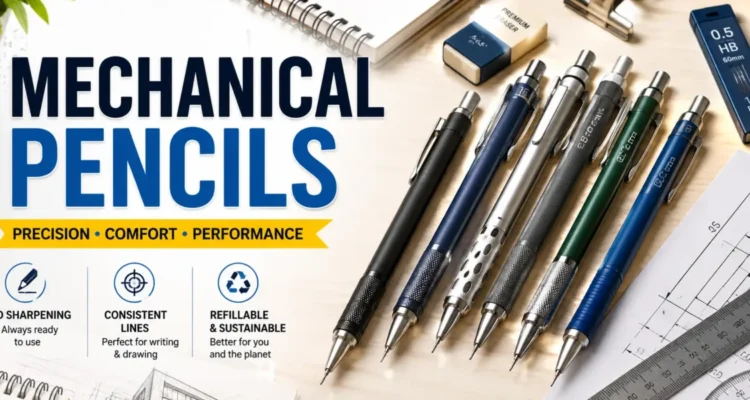
Mechanical pencils provide a clean, consistent and refillable way to write, sketch, calculate and draft without stopping to sharpen a wooden pencil. Their thin lead, reusable body and predictable line make them useful for students, artists, engineers, office workers and anyone who values precise handwriting. This practical guide explains their benefits, lead sizes, mechanisms, materials, costs and care so you can choose a model that genuinely matches your work.
Table of Contents
Quick Answer
The main benefits of mechanical pencils are consistent line width, no sharpening, less waste, comfortable long sessions and easy control over lead hardness. A 0.5 mm model is the best all-round choice for ordinary writing, while 0.3 mm suits very fine work and 0.7 or 0.9 mm provides greater strength. The best choice is not necessarily the most expensive; it is the pencil whose grip, balance, lead size and advance mechanism fit your hand and task.
Mechanical pencils belong in a wider group of practical household and study purchases. Our home and lifestyle buying guide explains how to compare fit, durability, maintenance and long-term value before buying everyday products.
What Is a Mechanical Pencil?
A mechanical pencil is a reusable writing instrument that holds replaceable graphite lead inside a barrel. Pressing a top button, side control or shaker mechanism advances a small length of lead through the tip. Unlike a wooden pencil, the body does not become shorter as the lead is used.
Most modern mechanical pencils use polymer-bound graphite leads. The word “lead” is traditional; ordinary pencil cores do not contain metallic lead. The refill is available in several diameters and hardness grades, allowing one pencil body to serve different writing or drawing needs.
Basic components
- Barrel: the main plastic or metal body.
- Grip: the area held by the fingers, sometimes cushioned or textured.
- Clutch: the internal mechanism that grips and advances the refill.
- Lead sleeve: the narrow tube supporting the lead near the paper.
- Advance control: a top button, side button, twist control or shaker system.
- Eraser and clean-out rod: often stored beneath the cap.
7 Benefits of Mechanical Pencils
1. Consistent line width
A wooden pencil becomes broader and softer as its point wears down. Mechanical pencils maintain almost the same diameter until the refill is exhausted. That consistency helps with mathematics, diagrams, annotations, tables and handwriting that must fit into small spaces.
For technical work, a predictable line can make symbols and dimensions easier to read. Artists also benefit when adding fine details, cross-hatching or preliminary construction lines. Rotating the barrel occasionally helps the graphite wear more evenly.
2. No sharpening interruptions
One of the most practical benefits of mechanical pencils is that they do not require a sharpener. A short press advances fresh graphite, so the user can continue working with minimal interruption. This is valuable during lectures, examinations, meetings and long calculation sessions.
No sharpening also means fewer graphite shavings on desks, inside pencil cases or around studio equipment. The advantage seems small, but repeated convenience is what makes a writing tool valuable over several years.
3. Refillable and potentially less wasteful
The barrel can be reused while only the thin graphite refill is replaced. A durable body may outlast many disposable wooden pencils. Environmental benefit depends on construction, packaging and how long the user keeps the instrument, so buying one reliable model is usually better than collecting many low-quality bodies.
Refillable erasers and replaceable parts can extend service life further. Before buying premium mechanical pencils, check whether compatible leads and erasers are widely available in your region.
4. Precise control for writing and drawing
Different lead diameters allow precise control. Fine 0.3 mm lead can produce small notes and detailed lines. Common 0.5 mm lead balances precision and strength. Wider 0.7 and 0.9 mm refills tolerate more pressure and suit bold writing, shading or younger users.
A good mechanical pencil guide must emphasize technique as well as specifications. Extending too much lead increases breakage. Advance only a small amount and allow the sleeve to support it.
5. Comfortable for long sessions
Mechanical pencil bodies can be shaped for comfort in ways that wooden pencils cannot. Rubber grips, knurled metal sections, low centers of gravity and balanced barrels give users many options. A comfortable grip may reduce the force needed to control the tool, although no single shape suits every hand.
People who write for hours should test grip diameter and weight whenever possible. A heavy metal model can feel stable but tiring; a light plastic model can be agile but less substantial. The best mechanical pencils feel controlled without forcing the fingers into an awkward position.
6. Economical over time
A basic pencil body and a tube of refills can provide months or years of use. Long-term cost depends on lost pencils, broken mechanisms and refill availability. A moderately priced model with common lead sizes often provides better value than a specialized design requiring rare supplies.
To compare total value, include the pencil, replacement leads, erasers and expected lifespan. The same value-per-use principle appears in our complete household buying guide.
7. Cleaner storage and portability
A retractable or capped tip protects pockets, bags and pencil cases. Because the barrel maintains its size, it fits the same holder throughout its life. Some designs retract the metal sleeve; others use fixed drafting tips that require a protective case.
Students and commuters should prioritize secure clips and retractable tips. Artists and desk users may prefer a fixed sleeve for better visibility near a ruler or template.
Mechanical Pencil Lead Sizes Explained
Lead diameter strongly affects the writing experience. Selecting the correct size reduces breakage and produces the line you need. These mechanical pencils accept multiple refill widths; the STAEDTLER lead reference provides a useful manufacturer overview of available widths and hardness grades.
0.3 mm
This very fine size supports tiny handwriting, detailed drawings and compact technical notation. It requires a light hand and breaks more easily under side pressure. It is usually a specialist choice rather than a beginner’s first pencil.
0.5 mm
The most versatile size for notes, schoolwork, office writing, sketching and calculations. Refills are widely available, and the line remains fine without being excessively fragile. Most people beginning with mechanical pencils for writing should start here.
0.7 mm
A stronger lead for people who press firmly or prefer darker, broader handwriting. It works well for quick notes, forms and general classroom use. The additional strength can be helpful for younger students.
0.9 mm and wider
Thicker leads suit bold writing, loose sketching, shading and carpentry-style marking. They are durable but less suitable for very small text. Some wide-lead holders use 2 mm graphite and function more like reusable drafting pencils.
Lead Hardness: H, HB and B Grades
Diameter controls line width, while hardness influences darkness, smoothness and smudging. HB is the standard balanced grade for everyday writing. B and 2B leads are softer and darker but may smear more. H and 2H leads are firmer and lighter, making them useful for fine construction lines.
Hardness can feel different between manufacturers because formulations vary. Start with HB, then test a small pack of another grade rather than buying a large supply immediately. Keep softer graphite away from pages that will be handled heavily unless smudging is acceptable.
Types of Mechanical Pencil Mechanisms
Top-button advance
The most common and dependable design. Pressing the cap advances the lead. It is simple to understand, easy to refill and available at nearly every price level.
Side-button advance
A side button lets the user advance graphite without changing hand position. Placement matters: a poorly positioned control may be pressed accidentally, while a good one improves speed.
Shaker mechanism
A brief shake moves an internal weight that advances the lead. This can be convenient during rapid notes, but it adds moving parts and may create noise. Many shaker pencils also retain a normal push button.
Automatic advance
Some designs use the movement of the protective sleeve against the paper to advance lead automatically. They can support uninterrupted writing but feel different from conventional pencils. Users who lift the pencil frequently may not notice as much benefit.
Rotating lead mechanism
A rotating system turns the graphite slightly as the tip repeatedly touches the page, helping it wear more evenly. It is most effective for users who lift the pencil between characters. Continuous sketching strokes may not activate rotation in the same way.
How to Choose the Best Mechanical Pencils
Match the lead size to the task
Choose 0.5 mm for general use, 0.7 mm for stronger writing, 0.3 mm for detailed work and 0.9 mm or wider for bold lines. Common sizes make refills easier to find and usually lower ongoing cost.
Check grip comfort
Soft rubber grips provide cushioning but can become sticky or worn. Metal knurling offers secure control and durability but may feel harsh. Smooth plastic is light and easy to clean. Select the surface and diameter that let you hold the pencil gently.
Consider balance and weight
Low-centered weight can improve control for drawing, while an evenly balanced lightweight body suits rapid notes. The best mechanical pencils should not force you to grip harder to prevent slipping.
Inspect the lead sleeve
A fixed long sleeve works well with rulers and provides a clear view of the line. A retractable sleeve is safer for pockets and bags. Sliding sleeves can reduce breakage by supporting the lead as it wears.
Evaluate refill availability
Confirm that the diameter, erasers and any special parts are sold locally. A sophisticated model loses value if essential supplies are difficult or expensive to obtain.
Set a realistic budget
Entry-level models can write very well. Higher prices may provide metal construction, tighter tolerances, replaceable parts or advanced mechanisms. Pay for features you will use, not status or unnecessary complexity.
Mechanical Pencils for Different Users
Students
Students generally need a light, affordable 0.5 or 0.7 mm pencil with a secure clip, comfortable grip and common refills. A retractable tip is useful inside crowded bags. For standardized tests, follow the examination provider’s rules because some require a specific pencil type.
Artists
Artists may combine several diameters and hardness grades. Fine leads help with details and construction, while wider soft leads support shading. A stable tip and comfortable low grip can improve control.
Engineers and designers
Technical users often value a fixed sleeve, precise clutch, clear size marking and balanced metal grip. Modern digital workflows have reduced some traditional drafting use, but mechanical pencils remain useful for calculations, sketches and field notes.
Office and everyday users
A dependable 0.5 mm HB model is sufficient for planners, forms, notes and document marking. Portability, eraser quality and a clip may matter more than advanced mechanisms.
How to Use and Maintain a Mechanical Pencil
- Confirm the lead diameter printed on the barrel.
- Remove the cap or eraser according to the instructions.
- Insert a small number of straight, undamaged refills.
- Replace the eraser and cap securely.
- Press the advance control until a short length appears.
- Write with moderate pressure and rotate the pencil occasionally.
Do not mix diameters, force broken fragments through the clutch or overfill the storage tube. If the mechanism jams, remove the lead and use the supplied clean-out rod only as directed. Never use a sewing needle that may damage the clutch or become stuck.
Wipe the grip with a slightly damp cloth when appropriate, keeping water away from internal metal parts. Store fixed-tip pencils in a case. These simple habits help mechanical pencils last longer and maintain reliable advancement.
Building a Better Everyday Writing Setup
A good pencil works best as part of a simple, reliable writing setup. Keep one tube of the correct lead grade, a small refill eraser and a protective case in the same place. This prevents the common situation in which a useful tool becomes unavailable because the owner cannot find compatible supplies. Students can keep a backup pencil for examinations, while professionals may prefer one pencil at a desk and another in a work bag.
For long sessions, pair mechanical pencils with smooth paper that does not catch the lead sleeve. A slightly softer lead can reduce the pressure required for dark writing, while a broader barrel may reduce finger fatigue. These small adjustments matter more than decorative features. The most practical mechanical pencil guide is therefore not about buying the most expensive model; it is about matching the pencil, lead and paper to the way you actually work.
Create a simple refill routine
Check the lead supply before a class, meeting or trip instead of waiting for the barrel to become empty. Load only the amount recommended by the manufacturer because overfilling can obstruct the feed mechanism. Keep different lead grades in clearly labelled tubes so that HB, B and H refills are not mixed accidentally. If several people share stationery, colour-coded containers make the system easier to manage.
Choose quality over unnecessary complexity
The best mechanical pencils are dependable, comfortable and easy to refill. A complicated mechanism adds little value if replacement parts are unavailable. Before buying, check whether the lead diameter is printed clearly on the barrel, the tip retracts or has a cap, and the eraser can be replaced. These details improve daily usability and help a pencil remain useful for years.
Use the right tool for permanent work
Mechanical pencils for writing are ideal for planning, calculations, annotations and drafts, but graphite can smudge and be erased. Use ink or another approved permanent medium when a form, signature, laboratory record or regulated document requires permanence. Choosing the correct tool for the record is part of responsible stationery use.
Common Problems and Solutions
Lead breaks repeatedly
Advance less lead, reduce writing pressure, try a wider diameter or use a stronger hardness grade. Check whether the sleeve is bent or the refill has fractured inside the barrel.
Lead will not advance
Confirm the correct diameter, empty excess refills and inspect the tip for fragments. Follow the manufacturer’s clearing instructions rather than forcing the button.
Lead slides back into the barrel
The clutch may be dirty, worn or holding the wrong diameter. Clean it only if the pencil is designed to be disassembled. Otherwise, use warranty support or replace an inexpensive damaged model.
Grip becomes uncomfortable
Relax pressure, take short breaks and try a wider, lighter or differently textured body. Comfort is personal, so highly rated models may still be wrong for your hand.
Frequently Asked Questions
Are mechanical pencils better than wooden pencils?
They are better for consistent fine lines, portability and no-sharpening convenience. Wooden pencils remain excellent for expressive shading, broad points and simple low-cost use. The better option depends on the task.
What size mechanical pencil is best for writing?
For most users, 0.5 mm provides the best balance of precision, availability and strength. People with heavy pressure may prefer 0.7 mm.
Do mechanical pencil leads contain lead metal?
Ordinary pencil refills are generally made from graphite combined with binders and do not use metallic lead. Follow the manufacturer’s safety and age guidance, especially around small refill pieces.
Why does my mechanical pencil keep breaking?
Too much exposed graphite, excessive pressure, a very fine diameter, damaged refills or a bent sleeve can cause breakage. Extend only a short length and store refills carefully.
Can mechanical pencils be used for drawing?
Yes. They are particularly effective for line work, construction, detail and controlled hatching. Artists often combine multiple diameters and hardness grades.
How long does a mechanical pencil last?
A well-built model can last for years when it is not lost, dropped on its tip or forced during a jam. Refill availability and replaceable erasers improve usable life.
Related Home and Lifestyle Guides
Once you have selected reliable mechanical pencils, organize them with the same value-focused approach used for other everyday purchases. Our best kitchen gadgets buying guide shows how to compare practical features without paying for hype, while the quick home maintenance guide explains simple routines for keeping household equipment useful. Like mechanical pencils, well-chosen everyday tools deliver the most value when they are maintained and used regularly.
Final Thoughts
Mechanical pencils are valuable because they combine precision, convenience, refillability and choice in one compact tool. A dependable 0.5 mm HB model is the safest starting point, while wider or finer leads should be selected for specific pressure and detail needs.
Focus on grip comfort, balance, sleeve design, mechanism reliability and refill availability. That practical approach will help you choose a pencil you use for years rather than a novelty that stays in a drawer. For a broader method of evaluating everyday purchases, revisit our home and lifestyle buying guide.
