Car Insurance in the UK: Coverage, Costs and Policies
 Kamran Liaquat ali
- posted on
- No Comment

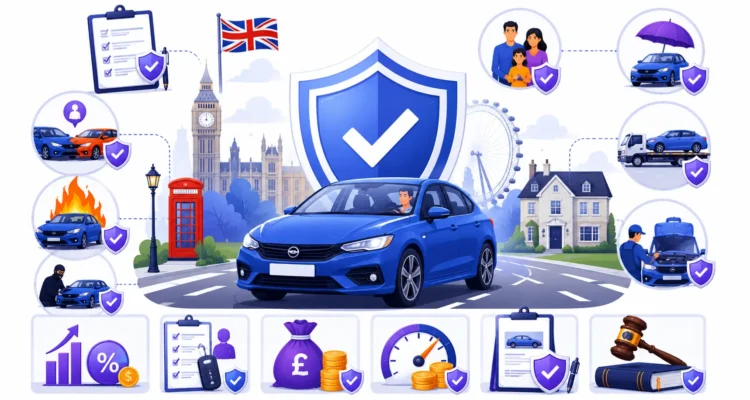
Car insurance in the UK is an essential part of owning and driving a vehicle. It provides financial protection when covered events such as accidents, theft, fire, or vehicle damage occur, depending on the type of policy you purchase. More importantly, having appropriate motor insurance is a legal requirement when driving on UK roads.
Understanding car insurance in the UK can initially seem complicated. Drivers encounter terms such as third-party cover, comprehensive insurance, voluntary excess, compulsory excess, no-claims discount, named drivers, business use, legal protection, and breakdown cover. Each can affect either the protection you receive or the amount you pay.
This complete guide explains car insurance in the UK in straightforward language. We will cover the legal requirements, the three main levels of cover, factors that influence premiums, excess, no-claims discounts, optional extras, named drivers, policy renewals, claims, and common mistakes to avoid.
If you are new to insurance generally, start with our What Is Insurance? guide. You can also explore our complete Insurance and Legal Guide for information about other forms of insurance and legal protection.
Table of Contents
What Is Car Insurance in the UK?
Car insurance in the UK is a contract between a policyholder and an insurer that provides specified financial protection against risks associated with driving and owning a vehicle.
You pay the insurer a premium. In return, the insurer agrees to cover specified losses and liabilities according to the terms, limits, conditions, and exclusions of the policy.
The exact protection depends on the level of car insurance in the UK that you choose.
According to official UK Government vehicle insurance guidance, motorists must have motor insurance to drive a vehicle on UK roads, and third-party insurance is the legal minimum.
11 Essential Facts About Car Insurance in the UK
These eleven facts provide a useful starting point for understanding car insurance in the UK before comparing policies.
1. Third-Party Insurance Is the Legal Minimum
The most important fact about car insurance in the UK is that third-party insurance is the minimum level required to drive legally on UK roads.
Third-party insurance covers liability for injury or damage you cause to other people or their property, subject to the policy.
However, basic third-party insurance does not normally pay to repair your own vehicle following an accident for which you need to claim under your own policy.
The UK Government confirms that third-party insurance is the legal minimum and covers damage or injury caused to another person, vehicle, animal, or property.
2. There Are Three Main Levels of Motor Insurance
The Association of British Insurers identifies three main types of car insurance in the UK:
- Third party
- Third party, fire and theft
- Comprehensive
Each provides a different level of protection, so understanding the differences is important before choosing a policy.
3. Comprehensive Cover Provides the Broadest Main Level of Protection
Comprehensive car insurance in the UK generally offers the broadest of the three main levels of motor insurance.
According to the Association of British Insurers, comprehensive motor insurance can protect against third-party injury and vehicle damage while also providing protection for your own vehicle against risks including accidental damage, theft, and fire, subject to policy terms.
However, “comprehensive” should not be interpreted as meaning that absolutely every possible loss is covered. Always read exclusions and policy conditions.
4. The Cheapest Level of Cover Is Not Always Third Party
Drivers sometimes assume basic third-party car insurance in the UK must automatically be the cheapest because it offers less protection.
Insurance pricing does not work that simply.
Insurers calculate premiums using risk information, and different companies use different data and pricing models. The ABI explains that insurers assess how likely a claim is and whether an individual presents greater or lower risk than an average policyholder.
Therefore, compare actual quotations rather than assuming one cover level will always cost less.
5. Your Excess Affects What You Pay When Claiming
Excess is an important part of car insurance in the UK.
The excess is generally the amount you are responsible for paying toward an eligible claim before or as part of the insurer’s settlement process, depending on the policy.
You may encounter:
- Compulsory excess – set by the insurer.
- Voluntary excess – an additional amount you agree to contribute.
A higher voluntary excess can sometimes reduce the premium, but it can also increase the amount you must contribute if you make a claim.
Do not select an excess purely to achieve the lowest quotation. Consider whether you could realistically afford it following an accident.
6. No-Claims Discounts Can Affect Premiums
A no-claims discount or no-claims bonus is another familiar feature of car insurance in the UK.
Insurers may provide a discount based on qualifying claim-free driving history. The exact calculation and treatment of claims varies between insurers.
Some insurers also offer optional protection for a no-claims discount. However, protecting a discount does not necessarily mean the overall premium can never increase.
7. How You Use the Car Matters
When buying car insurance in the UK, you need to describe how the vehicle will actually be used.
Different usage categories can apply depending on the insurer and policy, including social use, commuting, and business use.
The ABI specifically advises that people who use a car as part of their employment should ensure that their policy includes appropriate business-use coverage.
Giving inaccurate information about vehicle use could create serious problems if a claim occurs.
8. Named Drivers Must Be Declared Correctly
A named driver is someone added to another person’s car insurance in the UK policy and permitted to drive the insured vehicle according to the policy terms.
However, the person who genuinely uses the car most should normally be correctly identified as the main driver.
The ABI warns against “fronting,” where someone is incorrectly declared as the main driver to obtain a cheaper premium when another person is actually the main user.
You can read the ABI guidance on named drivers for further information.
9. Add-Ons Can Increase the Overall Cost
When comparing car insurance in the UK, the headline premium is only one part of the decision.
Depending on the provider, optional products or features may include:
- Breakdown cover
- Motor legal protection
- Courtesy-car options
- Key cover
- Enhanced personal accident cover
- Protected no-claims discount
Availability and terms vary significantly.
Instead of automatically selecting every extra, check whether you already have similar protection elsewhere and whether the additional benefit is worth its cost.
10. You Should Review Your Policy at Renewal
Renewal is a good opportunity to review your car insurance in the UK rather than automatically continuing without checking the details.
The Financial Conduct Authority has rules intended to improve transparency and consumer outcomes in home and motor insurance renewals. It also introduced pricing rules under which renewing home and motor insurance customers should not be quoted a higher price than an equivalent new customer would be offered through the same channel.
You can review the FCA guidance on insurance renewals.
Even with these protections, it can still be sensible to check whether your current policy remains appropriate for your circumstances.
11. Driving Without Appropriate Insurance Has Serious Consequences
Driving without valid car insurance in the UK can lead to significant penalties.
According to GOV.UK guidance on driving without insurance, police can issue a fixed penalty of £300 and six penalty points. If the matter goes to court, an unlimited fine or disqualification can apply. Police also have powers to seize, and in some circumstances destroy, an uninsured vehicle.
Importantly, simply knowing that a vehicle itself has insurance does not necessarily mean every person is insured to drive it.
Types of Car Insurance in the UK Explained
Choosing the correct type of car insurance in the UK begins with understanding the three main coverage levels.
Third-Party Only Car Insurance
Third-party insurance is the legal minimum.
It is designed primarily to cover liability for injury or damage you cause to other people and their property.
For example, if you cause an accident that damages another person’s vehicle, third-party cover may respond to the third party’s insured loss according to the policy.
It does not provide the same protection for damage to your own car.
Third-Party, Fire and Theft
Third-party, fire and theft car insurance in the UK adds certain protection for your own vehicle on top of basic third-party coverage.
According to the ABI, this level includes basic third-party protection plus cover against the insured vehicle being stolen or damaged or destroyed by fire, subject to policy terms.
However, it does not provide the same own-vehicle accidental-damage protection as comprehensive insurance.
Comprehensive Car Insurance
Comprehensive car insurance in the UK provides the broadest of the three standard coverage levels.
Depending on the policy, comprehensive cover may include:
- Third-party liability
- Damage to your own vehicle
- Fire
- Theft
- Accidental damage
- Other specified benefits
Policy wording varies, so compare the actual coverage rather than relying only on the word “comprehensive.”
Third Party vs Comprehensive Car Insurance
When comparing car insurance in the UK, many drivers need to decide between basic third-party and comprehensive cover.
Third-party cover focuses on your liability toward other people.
Comprehensive cover generally adds protection for your own vehicle against specified risks.
The decision should not be based solely on the amount of coverage. Compare:
- Premium
- Compulsory excess
- Voluntary excess
- Own-vehicle protection
- Policy exclusions
- Optional extras
- Claims conditions
A comprehensive quotation can sometimes be competitive, so compare all suitable levels instead of automatically assuming basic cover offers the best value.
What Affects the Cost of Car Insurance in the UK?
The price of car insurance in the UK is based on risk assessment rather than a single fixed formula.
Factors considered by insurers may include:
- Driver age
- Driving history
- Claims history
- Vehicle type
- Vehicle performance
- Repair costs
- Location
- Annual mileage
- How the vehicle is used
- Where the vehicle is kept
- Chosen excess
- Other underwriting information
The ABI explains that insurance premiums reflect the likelihood and potential cost of claims. Different insurers can assess the same driver differently because they may use different risk data and underwriting models.
That is one reason quotations for apparently similar car insurance in the UK policies can vary significantly between providers.
How to Compare Car Insurance in the UK
Finding suitable car insurance in the UK should involve more than choosing the lowest number on a comparison screen.
Compare the Same Level of Cover
Make sure quotations provide broadly comparable protection.
A cheaper policy may have a larger excess or fewer included benefits.
Check the Excess
Look at compulsory and voluntary excess together so you understand your potential contribution to a claim.
Read Important Exclusions
Check circumstances where coverage may not apply.
Review Optional Extras
Decide whether additional products provide meaningful value for your circumstances.
Check Vehicle-Use Restrictions
If you commute, travel for work, or use the vehicle commercially, make sure the policy reflects that usage.
Compare More Than One Provider
Because insurers assess risk differently, shopping around can help you understand the range of available premiums and coverage.
What Is Excess in UK Car Insurance?
Excess is one of the most important terms to understand when purchasing car insurance in the UK.
Suppose a policy has an applicable total excess of £500 and a covered claim involves £3,000 of eligible damage. Subject to the exact policy and claims arrangements, the excess represents the portion for which the policyholder is responsible.
Choosing a very high voluntary excess simply to reduce the premium can be risky if you would struggle to pay that amount after an accident.
Always evaluate both the annual premium and potential claim cost.
What Is a No-Claims Discount?
A no-claims discount can reward qualifying claim-free history by reducing the price of car insurance in the UK.
The size of the discount and how claims affect it vary between insurers.
Some policies allow drivers to pay extra to protect their no-claims discount.
However, no-claims protection generally protects the discount rather than guaranteeing that the underlying premium itself can never change.
Car Insurance for Named Drivers
Adding another person to car insurance in the UK may be appropriate when that person genuinely needs to drive the vehicle.
However, always provide accurate information about who the main driver is.
The ABI specifically warns that falsely declaring a lower-risk person as the main driver when another person actually uses the vehicle most is known as fronting and can constitute insurance fraud.
Also, do not automatically assume your own comprehensive policy allows you to drive any other car with comprehensive protection. ABI guidance notes that Driving Other Cars cover, where available, may provide only third-party protection.
Car Insurance for Business Use
Standard personal car insurance in the UK may not automatically cover every form of work-related driving.
If you use your vehicle as part of your employment, check that the policy includes the appropriate business use.
Businesses using vehicles commercially can have different requirements. The ABI confirms that businesses using motor vehicles are legally required to have motor insurance and specialist policies may be needed for activities such as taxi or courier operations.
What Happens If Your Car Is Written Off?
A vehicle may be treated as a total loss or “written off” when repairing it is not economically appropriate compared with its value and associated costs.
The ABI explains that insurers use an industry-wide salvage categorisation system for damaged vehicles.
Depending on the policy and circumstances, comprehensive or third-party fire and theft insurance may provide relevant protection when an insured vehicle is stolen or treated as a total loss.
You can read the ABI guide to written-off and total-loss vehicles for additional information.
What Happens After a Car Accident?
Your car insurance in the UK can become especially important after a collision.
Depending on the circumstances, you may need to:
- Prioritize safety and medical needs.
- Exchange required information.
- Report the accident when legally required.
- Document the scene if safe.
- Notify your insurer according to your policy.
- Keep relevant records and receipts.
- Follow the insurer’s claims procedure.
If an accident creates a serious liability or legal dispute, our Car Accident Legal Resource Center explains evidence, insurance claims, legal representation, and other post-accident issues.
If you are considering professional representation after a serious collision, see our Best Car Accident Lawyer guide.
Driving Without Car Insurance in the UK
Driving without appropriate car insurance in the UK is illegal.
GOV.UK states that drivers caught driving without insurance can receive a £300 fixed penalty and six penalty points. If prosecuted in court, an unlimited fine and disqualification are possible.
The police can also seize uninsured vehicles.
There is also a concept known as continuous insurance enforcement. In England, Scotland and Wales, the registered keeper generally needs insurance in place unless the vehicle qualifies for an exemption such as being declared off the road with a SORN. Different rules apply in Northern Ireland. :contentReference[oaicite:1]{index=1}
How to Potentially Reduce Car Insurance Costs
There is no guaranteed method for obtaining cheap car insurance in the UK, because premiums are based on individual risk and insurer pricing.
However, sensible steps can include:
- Comparing quotations from multiple providers
- Selecting only extras you genuinely need
- Considering an affordable voluntary excess
- Providing accurate annual mileage
- Maintaining appropriate vehicle security
- Reviewing the policy at renewal
- Checking whether your vehicle choice affects insurance costs
Never provide inaccurate information simply to reduce a premium. Incorrect information can create serious coverage problems.
Car Insurance Renewal in the UK
Do not completely ignore your car insurance in the UK when renewal arrives.
Review whether anything has changed, including:
- Your address
- Vehicle
- Annual mileage
- Vehicle use
- Named drivers
- Occupation
- Other information requested by your insurer
The FCA’s motor and home insurance pricing rules are designed to prevent renewing customers from being quoted more than an equivalent new customer through the same channel. However, premiums can still change because risk factors, claims costs, circumstances, and market conditions change.
Common Car Insurance Mistakes to Avoid
Understanding car insurance in the UK can help you avoid several common problems.
Buying Based Only on Price
The cheapest policy is not automatically the most appropriate policy.
Choosing an Unaffordable Excess
A lower premium may not be useful if the resulting excess becomes difficult to afford following a claim.
Not Declaring the Correct Main Driver
Incorrectly declaring the main user of the vehicle can create serious insurance and fraud issues.
Assuming Comprehensive Means Everything Is Covered
Every policy contains terms, conditions, limits, and exclusions.
Forgetting About Business Use
If you drive as part of your employment, confirm that your policy provides the required type of use.
Automatically Renewing Without Reviewing the Policy
Your needs can change, so review your coverage and information at renewal.
Frequently Asked Questions About Car Insurance in the UK
Is car insurance compulsory in the UK?
Yes. Appropriate car insurance in the UK is legally required to drive on UK roads. Third-party insurance is the legal minimum.
What are the three main types of UK car insurance?
The three main levels are third party, third party fire and theft, and comprehensive insurance.
What is the minimum car insurance required in the UK?
Third-party insurance is the minimum legal requirement for driving on UK roads.
Is comprehensive car insurance always more expensive?
No. Premiums depend on insurer risk assessment and many other factors. Compare actual quotations rather than assuming that broader coverage will automatically cost more.
What does comprehensive car insurance cover?
Comprehensive car insurance in the UK generally includes third-party liability plus protection for your own vehicle against specified risks such as accidental damage, theft, and fire. Exact coverage varies by policy.
What is an insurance excess?
An excess is the amount a policyholder may need to contribute toward an eligible claim according to the policy.
What is a no-claims discount?
It is a discount an insurer may apply based on qualifying claim-free history. Rules vary between insurers.
Can I drive someone else’s car if I have comprehensive insurance?
Do not assume so. Some policies provide Driving Other Cars cover, but it is not universal and may provide only third-party protection. Check your policy or ask your insurer before driving another vehicle.
Do I need business-use car insurance?
If you use your vehicle as part of your employment, you should confirm that your car insurance in the UK includes the appropriate business-use classification.
What happens if I drive without insurance?
Driving without insurance can result in penalties including points, fines, vehicle seizure, and potentially disqualification if the matter reaches court.
Do I need to insure a car that is not being driven?
Continuous insurance rules generally require vehicles to remain insured unless an applicable exemption applies, such as a valid SORN for a vehicle kept off the road. Rules differ in Northern Ireland.
Should I automatically renew my car insurance?
It is sensible to review your policy at renewal to make sure the information, coverage, limits, excess, optional extras, and price remain appropriate.
Explore More Insurance and Legal Guides
This guide to car insurance in the UK is part of our Insurance & Legal collection. Continue with these related resources:
- Insurance and Legal Guide — our main pillar covering insurance and legal protection.
- What Is Insurance? — learn how policies, premiums, claims, coverage, and deductibles work.
- Liability Insurance and Its Types — understand financial protection against certain liability risks.
- Car Accident Legal Resource Center — understand important insurance and legal issues after an accident.
- Best Car Accident Lawyer — learn what to consider when choosing legal assistance after a serious accident.
Final Thoughts
Car insurance in the UK is more than another cost of vehicle ownership. It is a legal requirement for driving on UK roads and an important form of financial protection against specified risks.
The right car insurance in the UK depends on your vehicle, driving habits, budget, risk profile, required level of protection, and individual circumstances.
Third-party insurance provides the legal minimum, third-party fire and theft adds specified protection against fire and theft, while comprehensive insurance generally provides the broadest of the three standard levels.
However, choosing car insurance in the UK should involve more than simply selecting a coverage label. Compare premiums, excesses, exclusions, optional extras, vehicle-use conditions, named-driver rules, and the actual policy wording.
Review your policy when circumstances change and again at renewal. Most importantly, provide insurers with accurate information so that the policy reflects how the vehicle is genuinely being used.
For a wider understanding of how motor insurance connects with liability, claims, property protection, and legal issues, continue with our complete Insurance and Legal Guide.
This article is for general educational purposes and does not constitute insurance, financial, or legal advice. Insurance products, premiums, eligibility requirements, policy terms, and individual circumstances vary. Always check current UK legal requirements and the specific wording of an insurance policy before making a decision.
