How AI Will Change Jobs in 2026: Reality vs Hype
Kamran Liaquat ali
- posted on
- No Comment
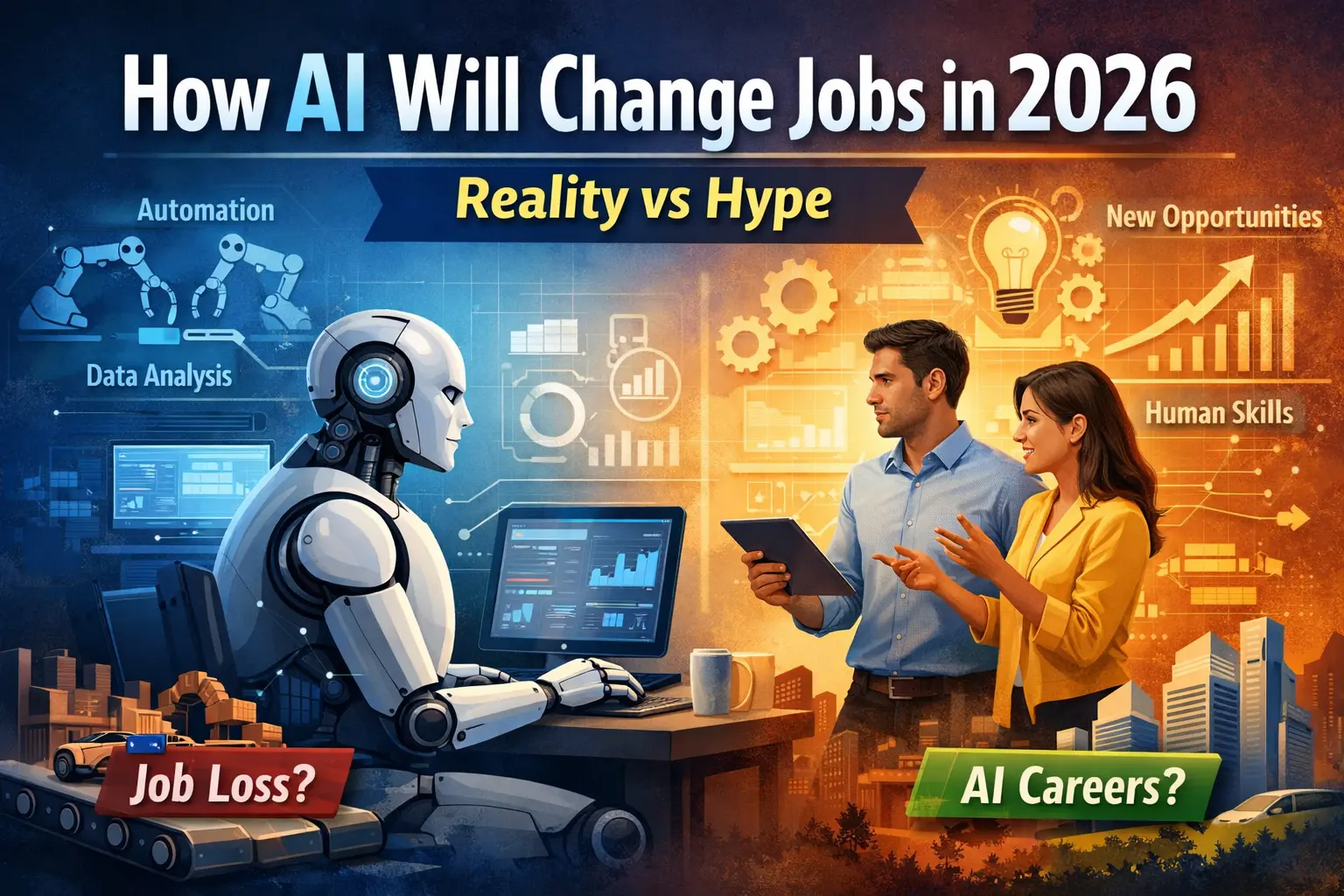
Artificial Intelligence (AI) has moved far beyond science fiction. By 2026, AI is no longer just a “future idea” — it is actively reshaping how people work, hire, and earn money.
But with all the headlines claiming “AI will replace all jobs”, an important question arises:
Is AI really a threat to jobs in 2026, or is it just hype?
In this article, we’ll separate reality from exaggeration, explain which jobs are at risk, which new opportunities are emerging, and how you can prepare for the AI-powered job market.
The Reality: AI Is Changing Jobs — Not Eliminating Everyone
One of the biggest misconceptions about AI is that it will completely replace human workers. In reality, AI is changing job roles, not wiping out the workforce.
AI excels at:
- Repetitive tasks
- Data analysis
- Pattern recognition
- Automation of routine workflows
Humans, however, are still better at:
- Creativity
- Emotional intelligence
- Critical thinking
- Strategic decision-making
In 2026, most companies are not replacing humans with AI — they are combining AI with human skills to improve productivity.
Jobs Most Likely to Be Affected by AI in 2026
Some roles are more vulnerable than others, especially those that involve repetitive or rule-based tasks.
High-Risk Jobs
- Data entry operators
- Basic customer support agents
- Telemarketers
- Simple content writers (low-quality, generic content)
- Manual report analysts
These jobs are not disappearing overnight, but demand for purely manual versions of these roles is declining.
Jobs That AI Cannot Fully Replace
Despite rapid AI progress, many professions remain highly human-dependent.
Low-Risk & Growing Jobs
- Software developers & system architects
- AI prompt engineers and AI trainers
- Digital marketers & SEO specialists
- UX/UI designers
- Healthcare professionals
- Teachers, mentors, and trainers
AI can assist these roles, but it cannot replace human judgment, empathy, and creativity.
The Biggest Hype: “AI Will Take All Jobs”
This is where fear-driven headlines exaggerate reality.
Why This Is Mostly Hype
- AI tools still need human supervision
- Businesses require accountability — humans provide that
- AI-generated output often needs correction and refinement
- Ethical, legal, and emotional decisions cannot be automated
History shows that every major technology shift creates more jobs than it destroys — AI is no different.
New Job Opportunities Created by AI in 2026
While some roles shrink, entirely new career paths are emerging.
AI-Driven Careers
- AI tool specialists
- Prompt engineers
- AI workflow designers
- Automation consultants
- AI content editors & quality reviewers
People who learn how to work with AI will have a strong advantage in the job market.
How AI Will Change Freelancing and Remote Work
Freelancing is evolving rapidly due to AI.
- Freelancers who use AI complete work faster
- Clients now expect higher quality at lower cost
- Skill-based freelancers outperform task-based freelancers
In 2026, freelancers who rely only on basic skills may struggle, while those who combine expertise with AI tools will thrive.
How to Prepare for the AI Job Market in 2026
The key is adaptation, not fear.
Practical Steps You Can Take
- Learn how AI tools work in your field
- Focus on problem-solving, not just execution
- Upgrade your digital and analytical skills
- Use AI as an assistant, not a replacement
- Build a personal brand around expertise
Those who adapt will stay relevant — those who resist change may fall behind.
Reality vs Hype: Final Verdict
Reality:
AI will automate repetitive tasks, enhance productivity, and reshape job roles.
Hype:
AI will eliminate all jobs and make humans useless.
The truth lies in the middle: AI is a tool, not a takeover.
Frequently Asked Questions (FAQs)
Will AI replace my job in 2026?
If your job is repetitive and rule-based, parts of it may be automated. If it requires creativity, decision-making, or human interaction, AI will assist — not replace you.
Is learning AI skills worth it?
Absolutely. AI literacy is becoming as important as basic computer skills were in the past.
Which skill is safest from AI?
Creative thinking, strategic planning, emotional intelligence, and technical problem-solving remain highly valuable.
Final Thoughts
AI in 2026 is not about humans vs machines — it’s about humans who use AI vs humans who don’t.
If you embrace AI, upgrade your skills, and stay adaptable, AI can become your biggest career advantage, not your biggest threat.
