Understanding Facilitated Diffusion: A Simple Guide for Students in 2026
Kamran Liaquat ali
- posted on
- No Comment
Biology explains how living cells survive, grow, and work every day. One very important process inside cells is facilitated diffusion. This process helps important substances move into and out of cells.
In 2026, biology education focuses on simple learning and clear understanding. Facilitated diffusion is often taught in schools, colleges, and medical studies because it plays a key role in cell life.
This guide explains facilitated diffusion in a clear and easy way. No complex words. No confusion. Just simple science.
What Is Facilitated Diffusion?
Facilitated diffusion is a process that helps molecules move across a cell membrane.
Some molecules cannot pass through the cell membrane on their own. These molecules need help. Facilitated diffusion provides that help.
In this process:
-
Molecules move from high concentration to low concentration
-
No energy is required
-
Special proteins help molecules cross the membrane
Because no energy is used, facilitated diffusion is called a passive transport process.
Why Do Cells Need Facilitated Diffusion?
Cell membranes are very selective. They protect the cell and control what enters and leaves.
Small molecules like oxygen can pass easily. But many important substances cannot.
Examples include:
-
Glucose
-
Ions
-
Amino acids
-
Water (in some cases)
Facilitated diffusion allows these substances to enter the cell safely and efficiently.
Without this process, cells would not survive.
The Role of the Cell Membrane
The cell membrane is made of a lipid layer. This layer blocks large, charged, or polar molecules.
This barrier is useful, but it also creates a problem. Cells still need nutrients.
Facilitated diffusion solves this problem by using membrane proteins that act like gates.
How Carrier Proteins Work
Carrier proteins are special proteins found in the cell membrane.
They work like helpers or doorkeepers.
Here is how they work step by step:
-
A molecule attaches to the carrier protein
-
The protein changes its shape
-
The molecule moves across the membrane
-
The protein returns to its original shape
This process happens quickly and smoothly.
Channel Proteins vs. Carrier Proteins
There are two main types of proteins involved in facilitated diffusion.
Channel Proteins
-
Form a tunnel through the membrane
-
Allow molecules to pass through easily
-
Often used for ions and water
Carrier Proteins
-
Bind to a molecule
-
Change shape to move it across
-
Used for glucose and amino acids
Both types help molecules cross the membrane without energy.
Selectivity and Specificity
Facilitated diffusion is very selective.
Each carrier protein only works with certain molecules.
This selectivity depends on:
-
Size of the molecule
-
Shape of the molecule
-
Electrical charge
For example:
-
Glucose uses a specific carrier protein
-
Sodium ions use a different channel
This protects the cell and keeps balance.
Examples of Facilitated Diffusion in the Body
Facilitated diffusion happens in many parts of the human body.
Glucose Absorption
Glucose enters cells using carrier proteins. This is very important for energy.
Nerve Cells
Ions like sodium and potassium move through channels. This allows nerve signals to travel.
Kidney Function
Facilitated diffusion helps balance salts and water in the body.
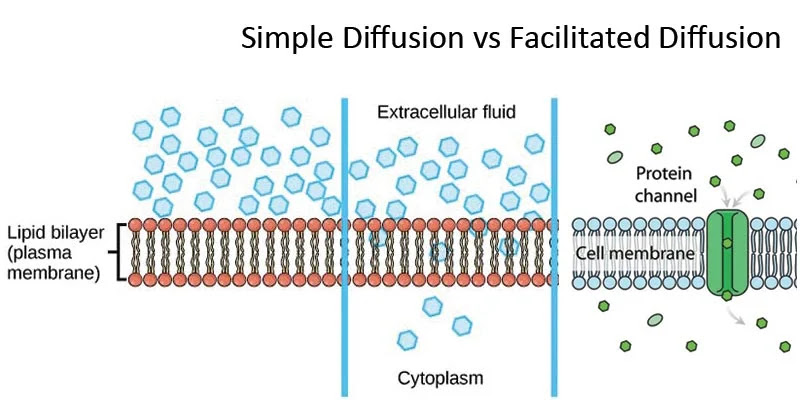
Facilitated Diffusion vs. Simple Diffusion
These two processes are similar but not the same.
Simple Diffusion
-
No proteins needed
-
Molecules pass directly through the membrane
-
Works for small and non-polar molecules
-
Example: oxygen and carbon dioxide
Facilitated Diffusion
-
Uses carrier or channel proteins
-
Needed for large or charged molecules
-
Very selective
-
Example: glucose and ions
Both processes do not require energy.
Regulation and Control in Cells
Cells can control facilitated diffusion.
They do this by:
-
Increasing or decreasing carrier proteins
-
Opening or closing channels
-
Responding to temperature and concentration changes
This helps cells adjust to different conditions.
Facilitated Diffusion in 2026 Education
In 2026, biology learning uses:
-
3D cell models
-
Interactive diagrams
-
Virtual labs
-
AI-based simulations
These tools help students understand facilitated diffusion visually.
Learning is now more practical and engaging.
Clinical Importance of Facilitated Diffusion
Problems with facilitated diffusion can cause health issues.
Diabetes
In diabetes, glucose transport into cells does not work properly.
Neurological Disorders
Ion channel problems affect nerve signals.
Genetic Conditions
Some diseases affect carrier protein structure.
Understanding facilitated diffusion helps doctors treat these conditions.
Why Facilitated Diffusion Is Important for Life
Facilitated diffusion supports:
-
Cell nutrition
-
Energy production
-
Nerve signaling
-
Muscle movement
-
Organ function
Without it, cells would starve or fail.
This process keeps the body balanced and healthy.
Common Misunderstandings
Many students confuse facilitated diffusion with active transport.
Key difference:
-
Facilitated diffusion uses no energy
-
Active transport uses energy
Another mistake is thinking all diffusion is the same. It is not.
Simple Summary
Facilitated diffusion:
-
Moves molecules across membranes
-
Uses carrier or channel proteins
-
Requires no energy
-
Is selective and controlled
-
Is vital for life
Frequently Asked Questions
Does facilitated diffusion need energy?
No. It is a passive process.
Can facilitated diffusion move molecules against the gradient?
No. Molecules move from high to low concentration.
Is water transported by facilitated diffusion?
Yes, through special channels called aquaporins.
Why is facilitated diffusion selective?
Because proteins only fit certain molecules.
Final Thoughts
Facilitated diffusion may seem simple, but it is essential for life.
It allows cells to receive nutrients, send signals, and stay healthy.
In 2026, better learning tools make this topic easier to understand than ever before.
By learning facilitated diffusion, we understand how life works at the cellular level.
