AI in Manufacturing: Real Uses, Benefits and How to Start
 Kamran Liaquat Ali
- posted on
- No Comment

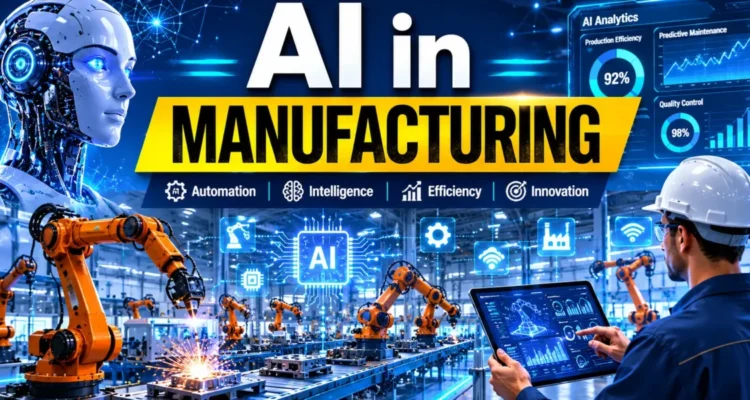
Quick answer: AI in manufacturing means using data and machine learning to run factories better. The most proven uses are predicting machine failures before they happen, spotting defects with cameras, tuning production settings, forecasting demand and guiding robots. The best results come from starting with one costly problem, using clean data and testing a small pilot before scaling up.
This guide explains the main uses in simple terms, the benefits and risks, and a step-by-step way to start. It is part of our Technology and AI guide.
What Is AI in Manufacturing?
Factories produce huge amounts of data from machines, sensors, cameras and business systems. AI looks for patterns in that data. It can then warn people about problems, suggest better settings or control a machine directly.
It is not the same as automation. A traditional machine follows fixed rules. An AI system learns from data and can handle changes, such as a new type of defect or a shift in demand.
Adoption is growing. NIST’s Manufacturing Extension Partnership tracks this in its overview of the rise of AI in US manufacturing.
9 Real Uses on the Factory Floor
1. Predictive Maintenance
Sensors measure vibration, heat and power use. AI learns what normal looks like and warns the team before a machine breaks. This reduces surprise downtime.
2. Quality Inspection With Cameras
Cameras photograph each part, and a vision model flags scratches, cracks or missing pieces. It works faster than manual checks and does not get tired.
3. Process Optimisation
AI finds the best settings for temperature, speed or pressure to reduce waste and energy use.
4. Demand and Inventory Forecasting
Models use past orders, seasons and market data to predict demand, so factories hold less excess stock.
5. Robots and Material Handling
AI helps robots see objects, pick mixed items and move goods safely around people. Read more in the future of AI robots.
6. Generative Design
Engineers set goals such as weight and strength, and software suggests many design options to compare.
7. Digital Twins
A digital twin is a live virtual copy of a machine, line or whole factory. Teams test changes on the copy before touching the real thing.
8. Energy Management
AI schedules energy-heavy jobs for cheaper hours and spots machines that waste power.
9. Assistants for Workers
Chat-based assistants answer questions from manuals and maintenance logs, and help new staff learn faster. Some are starting to act more like AI agents that can carry out multi-step tasks.
Benefits for Manufacturers
- Less unplanned downtime.
- Fewer defects and less scrap.
- Lower energy and material costs.
- Better delivery planning.
- Safer work, with robots doing heavy or risky tasks.
- Faster training for new workers.
Challenges and Risks
| Challenge | What it means |
|---|---|
| Poor data | Missing, messy or unlabelled data gives poor results |
| Cybersecurity | Connected machines create new ways for attackers to get in |
| Model drift | A model can become less accurate when materials or machines change |
| Integration | Old machines and software may not connect easily |
| Cost and ROI | Pilots are cheap, but scaling needs investment |
| Worker trust | Staff may resist tools they do not understand |
How to Implement It: 7 Steps
- Pick one costly problem. For example, a machine that breaks often or a product with high scrap.
- Measure the baseline. Record current downtime, defect rate or cost so you can prove the improvement.
- Check your data. Make sure you have enough clean, labelled data from the right sensors.
- Run a small pilot. Test on one machine or line for a few months.
- Fit it into daily work. Alerts must reach the right person with a clear action.
- Check safety and security. Review access, network security and what happens if the system fails.
- Scale only with evidence. Expand when the pilot shows clear results.
NIST’s roadmap for AI and machine learning in smart manufacturing covers these steps in more depth for industry teams.
Getting Started as a Small Manufacturer
Small firms do not need a data science team to begin. Start with tools that come built into newer machines, low-cost sensors on critical equipment, or a camera inspection system from a vendor. Pick one use case with a clear payback and grow from there.
What It Means for Workers
AI changes factory jobs more than it removes them. Routine checking and data entry shrink, while jobs that maintain equipment, analyse data and manage automated lines grow. Our article on AI jobs in 2026 covers the skills in demand.
What Comes Next for Smart Factories
Expect more digital twins, AI agents that plan maintenance and production, better robot vision, and more AI running on machines at the edge rather than in the cloud. Progress will be steady rather than sudden.
Frequently Asked Questions
What is the best use of AI in manufacturing?
Predictive maintenance and camera-based quality inspection are the most proven, because their savings are easy to measure.
Does AI replace factory workers?
It automates some tasks, but people are still needed to run, maintain and improve the systems.
Can small manufacturers use AI?
Yes. Start with one problem, use ready-made tools and keep the first project small.
What data does it need?
Sensor readings, machine logs, images, quality records and production data, all linked to the right time and machine.
Final Thoughts
AI in manufacturing works best when it solves a clear problem with good data. Start small, measure the results and involve the people who run the machines. For related topics, visit the Technology and AI guide.
