AI Jobs in 2026: 7 Powerful Changes, Reality vs Hype
 Kamran Liaquat ali
- posted on
- No Comment

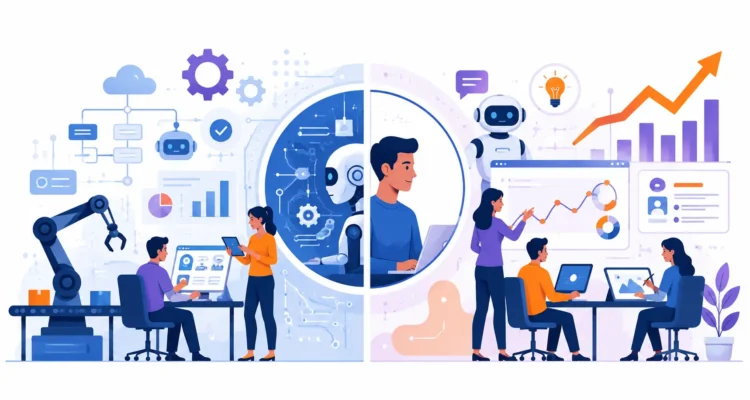
AI jobs in 2026 are at the center of one of the biggest debates about the future of work. Artificial intelligence can now write content, analyze data, generate software code, answer customer questions, create images, summarize documents, and automate parts of everyday business workflows.
Understandably, this rapid progress has created a major concern among workers and job seekers: will AI eventually replace human jobs?
The reality is more complicated than many headlines suggest. Some tasks are becoming easier to automate, some job roles are being redesigned, and workers in certain occupations face genuine disruption. At the same time, AI is creating demand for new skills and making human judgment, communication, creativity, and professional expertise more valuable in many workplaces.
Instead of asking whether AI will simply “take all jobs,” a better question is: which tasks will AI change, which workers will be most affected, and which skills will become more valuable?
This guide explores the reality behind AI jobs in 2026, separates evidence from hype, and explains seven major changes that workers, freelancers, students, and businesses should understand.
Table of Contents
For the broader context behind these workplace shifts, start with our complete Technology and AI Guide.
AI Jobs in 2026: What Does the Evidence Actually Say?
One of the most important distinctions in the AI employment debate is the difference between job exposure and job elimination.
An occupation being exposed to artificial intelligence does not automatically mean the entire occupation will disappear. Most jobs consist of many different tasks. AI may automate some of them, accelerate others, and have limited impact on responsibilities involving accountability, physical work, interpersonal communication, or complex real-world judgment.
According to the International Labour Organization’s research on generative AI and occupational exposure, roughly one in four workers globally are in occupations with some degree of exposure to generative AI.
However, exposure should not be interpreted as a prediction that one in four jobs will disappear. The research focuses on how occupations and tasks may be affected, and many jobs still contain responsibilities that require substantial human involvement.
This distinction is essential when discussing AI jobs in 2026. A marketing specialist, for example, may use AI to draft several advertising ideas but still determine the strategy, understand the customer, review the claims, interpret campaign data, and approve the final message.
Similarly, a software developer may use an AI coding assistant while remaining responsible for architecture, security, integration, testing, and production decisions.
1. AI Will Automate Tasks More Often Than Entire Jobs
The first major change affecting AI jobs in 2026 is task-level automation.
Generative AI is especially useful when work involves digital information that can be processed according to recognizable patterns or instructions.
Examples include:
- Summarizing documents
- Producing first drafts
- Classifying information
- Extracting structured data from text
- Generating routine reports
- Answering frequently asked questions
- Producing basic software code
- Translating or rewriting content
But most occupations involve much more than one repetitive responsibility.
A customer-service employee, for example, might answer simple questions, investigate unusual account problems, calm frustrated customers, coordinate with another department, and decide when an issue needs escalation. AI may perform the first task relatively well while the remaining responsibilities still require human involvement.
For employees and job seekers, understanding AI jobs in 2026 means identifying which parts of their work are increasingly automatable and which parts depend on expertise, context, communication, or judgment.
2. Routine Digital and Clerical Work Faces Greater Pressure
AI jobs in 2026 will not affect every occupation equally. Roles containing large amounts of repetitive information processing may experience faster automation than jobs requiring unpredictable physical or interpersonal work.
Potentially exposed activities include:
- Data entry
- Routine administrative processing
- Basic document preparation
- Template-based customer support
- Simple transcription
- Standardized reporting
- Basic content production
This does not mean every worker performing these tasks will lose employment. A more realistic possibility is that employers may require fewer hours for routine work while expecting remaining employees to handle more complex responsibilities.
As a result, AI jobs in 2026 may increasingly involve workers supervising automated systems, checking output quality, resolving exceptions, and making decisions that software cannot reliably make on its own.
3. Entry-Level Careers May Change Significantly
AI jobs in 2026 make entry-level employment especially important because because junior workers traditionally gain experience by completing relatively structured tasks.
New employees often begin with responsibilities such as research, documentation, basic analysis, routine coding, first drafts, or administrative processing. Many of these activities can now be assisted by generative AI.
The challenge is therefore not simply whether entry-level jobs continue to exist. Another important question is how beginners will develop professional judgment when AI performs part of the work that previously helped them learn.
The World Economic Forum has also examined how AI may reshape entry-level work and the skills required across different job families. :contentReference[oaicite:2]{index=2}
Employers may need to redesign junior positions around AI-assisted workflows while still providing workers with opportunities to develop problem-solving, communication, judgment, and domain expertise.
For job seekers, this means knowing how to complete a repetitive task may become less valuable than understanding why the task matters, how to evaluate its quality, and what to do when the expected process fails.
4. AI Skills Will Matter — But Domain Expertise Matters Too
Another major trend shaping AI jobs in 2026 is the growing importance of AI literacy.
For AI jobs in 2026, simply knowing how to write prompts is unlikely to be enough for most long-term careers.
A stronger combination is:
AI literacy + professional expertise + human judgment.
Consider two people using the same AI system to analyze a marketing campaign. Someone who understands customer behavior, analytics, conversion funnels, advertising strategy, and branding can evaluate the AI’s suggestions much more effectively than someone who only knows how to submit prompts.
The same principle applies to programmers, engineers, designers, analysts, and other professionals.
AI can produce an answer quickly. Professional expertise helps determine whether that answer is accurate, useful, incomplete, risky, or inappropriate for the situation.
5. Some Careers Will Grow Alongside AI Adoption
AI jobs in 2026 do not reflect automation pressure alone. It also increases demand for workers who can build, manage, integrate, evaluate, and govern AI-enabled systems.
Potential growth areas include:
- AI and machine-learning specialists
- Data specialists
- Software and application developers
- Cybersecurity professionals
- AI workflow and automation specialists
- AI governance and risk professionals
- AI product specialists
- Quality-assurance and human-review professionals
The World Economic Forum’s Future of Jobs Report 2025 identifies AI, big data, and cybersecurity among the technology skills expected to see rapid growth in demand.
At the same time, the report emphasizes that human capabilities such as creative thinking, resilience, flexibility, leadership, and collaboration remain important. :contentReference[oaicite:3]{index=3}
This suggests that many successful AI jobs in 2026 will not be purely technical. Businesses may need marketers, accountants, developers, managers, designers, and other professionals who understand how AI can be applied effectively within their own fields.
6. Human Skills May Become More Valuable, Not Less
In AI jobs in 2026, as AI makes certain technical activities faster, abilities that are difficult to automate can become important differentiators.
Critical Thinking
AI can produce convincing answers that are incomplete or incorrect. Workers need to verify information, compare alternatives, identify assumptions, and recognize when automated output should not be trusted.
Communication
Understanding what a client, colleague, employer, or customer actually needs involves context that cannot always be reduced to a simple prompt.
Creativity
Generative AI can quickly produce variations and ideas, but humans continue to define goals, select concepts, understand culture, and determine what is appropriate for a particular audience.
Accountability
Businesses cannot simply transfer responsibility to an AI system when a critical decision causes harm. Human oversight remains especially important where decisions involve money, safety, employment, privacy, or legal responsibilities.
Leadership and Collaboration
Managing teams, resolving conflict, negotiating priorities, mentoring employees, and motivating people require interpersonal abilities that extend beyond generating technically plausible answers.
7. AI Jobs in 2026 Will Change Freelancing and Remote Work
AI jobs in 2026 are also reshaping freelancing and remote work.
A freelancer who previously charged mainly for producing basic first drafts may now compete with inexpensive AI-generated content. Similar pressure can affect simple design variations, basic research, routine coding, and other standardized digital services.
However, AI can also make experienced freelancers much more productive.
A knowledgeable professional can use AI to accelerate research, brainstorming, repetitive coding, documentation, or initial drafts while spending more time on strategy, quality control, and client communication.
For freelancers, changes in AI jobs in 2026 are therefore making specialized knowledge and measurable outcomes more valuable than basic task completion.
For example, instead of offering only “five blog posts,” an experienced SEO professional could provide search-intent analysis, keyword research, content planning, editing, internal linking, technical recommendations, and performance monitoring.
The competitive advantage is not simply access to AI. It is knowing how to use AI within a valuable professional service.
Which Jobs Are Most Exposed to AI?
It is generally more accurate to discuss AI exposure rather than declare that particular occupations will definitely disappear.
Higher exposure tends to occur when a large portion of a role involves digital information that AI systems can process efficiently.
Examples of potentially exposed activities include:
- Routine data processing
- Standard document generation
- Basic content production
- Simple customer inquiries
- Template-based analysis
- Administrative organization
However, technical ability to automate a task is only one factor. Cost, regulation, reliability, business requirements, infrastructure, and the need for human supervision all influence whether automation is actually adopted.
Which Jobs Are More Difficult to Fully Automate?
No profession should be described as completely “AI-proof.” Technology continues to improve, and almost every occupation contains at least some responsibilities that software can potentially assist.
However, complete automation is generally more difficult where work depends heavily on:
- Physical interaction with unpredictable environments
- Complex interpersonal relationships
- High-stakes accountability
- Leadership and negotiation
- Professional judgment
- Hands-on skilled work
- Trust and empathy
Healthcare workers, skilled tradespeople, managers, educators, engineers, and other professionals may all use increasingly powerful AI systems without their complete occupations necessarily disappearing.
The better question is not simply, “Can AI affect this profession?” Instead ask: which tasks can AI perform reliably, economically, and responsibly?
Reality vs Hype: Will AI Take All Jobs?
The claim that AI will soon make human workers unnecessary is an oversimplification.
At the same time, saying that artificial intelligence will have little impact would also underestimate the scale of technological change.
The reality:
- Some tasks are already being automated.
- Some occupations have significantly higher AI exposure than others.
- Job descriptions and hiring requirements are changing.
- Workers increasingly benefit from AI literacy.
- New AI-related responsibilities are emerging.
- Human supervision remains important in many workflows.
The hype:
- Every AI-exposed job will disappear.
- AI exposure automatically means unemployment.
- Every business can replace workers simply by purchasing an AI tool.
- Human expertise is becoming irrelevant.
- Anyone can accurately predict exactly how many jobs AI alone will eliminate.
When evaluating AI jobs in 2026, workers should focus on how tasks are changing rather than treating automation as an all-or-nothing event.
How to Prepare for AI Jobs in 2026
People preparing for AI jobs in 2026 do not all need to become machine-learning engineers simply to remain employable. A more practical approach is learning how artificial intelligence is changing their existing profession.
1. Learn AI Tools Relevant to Your Work
Identify tools that are actually being adopted in your industry instead of trying every new AI application that appears online.
2. Strengthen Your Core Professional Skills
AI becomes more useful when the person using it understands the subject. Continue developing expertise in your actual profession.
3. Learn to Verify AI Output
Never assume an answer is correct simply because it sounds confident. Fact-checking, testing, and quality assurance are increasingly important skills.
4. Move Beyond Repetitive Execution
If most of your work involves predictable instructions, look for opportunities to develop strategy, analysis, communication, and decision-making skills.
5. Improve Your Data Literacy
Understanding data, metrics, and basic analytics can help professionals evaluate AI-generated insights more effectively.
6. Develop Communication and Collaboration Skills
Technical ability becomes more valuable when combined with the ability to explain ideas, understand requirements, and work effectively with others.
7. Build Evidence of Your Expertise
A portfolio, professional projects, case studies, and measurable results can show employers or clients that you offer more than access to automated tools.
Overall, preparing for AI jobs in 2026 means developing skills that complement automation rather than competing with AI on repetitive tasks alone.
What AI Means for Businesses and Employers
Businesses also need to approach AI adoption carefully.
Simply adding AI tools without redesigning workflows can create inaccurate output, security concerns, inconsistent quality, and uncertainty over responsibility.
Organizations should determine where automation creates real value, where human review is required, what information employees are allowed to share with AI systems, and who remains accountable for final decisions.
Training can be just as important as the technology itself. A powerful AI system used by employees who do not understand its limitations may create new problems instead of solving existing ones.
These employment changes form one part of the connected trends explained in our technology and AI trends pillar.
The Future of AI and Work Beyond 2026
Predictions become increasingly uncertain as we look further into the future. AI capabilities continue to improve rapidly, but technical capability is only one factor determining how labor markets change.
Adoption costs, regulation, trust, infrastructure, economic conditions, and organizational culture all influence how quickly workplaces transform.
The World Economic Forum’s broader labor-market outlook through 2030 expects major job creation and displacement from a combination of technological, demographic, economic, and environmental trends—not artificial intelligence alone. :contentReference[oaicite:4]{index=4}
The report estimates that nearly 40% of skills required on the job could change by 2030, reinforcing the importance of continuous learning and upskilling. :contentReference[oaicite:5]{index=5}
The future of AI jobs in 2026 and beyond will therefore depend not only on what technology can do, but also on how businesses, governments, and workers choose to use it.
Explore More Technology & AI Guides
Artificial intelligence is changing much more than employment. You can explore more practical articles about emerging technology, artificial intelligence, software, and digital trends in our Technology & AI section.
If you are interested in technical careers, coding, or software skills that complement the changing AI landscape, explore our Programming & Development guides as well.
Frequently Asked Questions About AI Jobs in 2026
Will AI replace jobs in 2026?
AI can automate parts of many jobs, but exposure to artificial intelligence does not automatically mean an entire occupation will disappear. Task automation and job transformation are important near-term effects, although displacement can occur in particular roles and industries.
Which jobs are most at risk from AI?
Jobs containing large amounts of repetitive, predictable, and digitally processed work generally have greater automation exposure. Clerical and administrative activities are among the areas frequently identified as highly exposed to generative AI.
Which jobs are safe from AI?
No occupation can be guaranteed to remain completely unaffected. Roles requiring complex judgment, physical work, interpersonal relationships, accountability, and unpredictable real-world interaction are generally more difficult to automate fully.
Is AI creating new jobs?
AI adoption is increasing demand for skills related to AI development, data, cybersecurity, automation, governance, and AI-enabled workflows. Existing professions are also being redesigned to incorporate AI tools.
Is prompt engineering still a useful skill?
Knowing how to communicate effectively with AI systems is useful, but prompt skills are strongest when combined with domain expertise, critical thinking, and the ability to evaluate AI-generated output.
Should I learn AI for my career?
For many digital and knowledge-based careers, AI literacy is increasingly valuable. Focus on learning how AI applies to your existing profession rather than learning tools without professional context.
Will AI replace software developers?
AI can assist with coding, debugging, documentation, and testing tasks. However, software engineering also involves requirements, architecture, security, integration, trade-offs, and accountability. The profession is likely to continue evolving as AI capabilities improve.
Are AI jobs in 2026 only for technical professionals?
No. Many AI jobs in 2026 involve applying artificial intelligence within existing professions rather than developing AI models directly. Marketers, managers, analysts, designers, educators, and other professionals can benefit from AI literacy.
Related practical guides cover AI coding assistants, agentic AI workflows, private on-device AI, AI in manufacturing, and the future of AI robots.
Return to the Technology and AI Guide whenever you want to compare how work, software, devices, and robotics are evolving together.
Final Verdict: AI Is Changing Work, Not Ending It
The debate around AI jobs in 2026 should not be reduced to either “AI will replace everyone” or “AI is nothing to worry about.” Both extremes miss what is actually happening.
Artificial intelligence is automating certain tasks, changing expectations for digital workers, and creating genuine disruption in some areas. At the same time, many occupations are being augmented rather than completely automated, while businesses continue to need people who can define problems, evaluate results, communicate effectively, and take responsibility for decisions.
The strongest career strategy is therefore neither ignoring artificial intelligence nor depending entirely on it.
Learn to use AI, strengthen your professional expertise, develop the human skills that complement automation, and become the person who can judge when technology should — and should not — be trusted.
