Agentic AI: How Autonomous Agents Transform Software Development
 Kamran Liaquat ali
- posted on
- No Comment

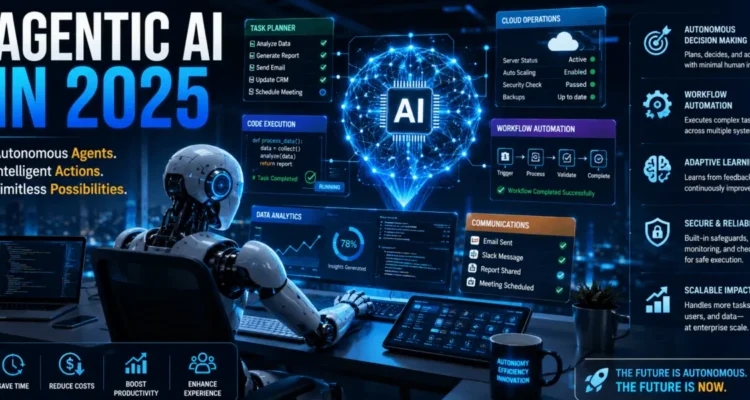
Agentic AI is changing artificial intelligence from a tool that only answers prompts into a system that can plan, use tools, take actions, check results, and continue toward a goal. For software teams and businesses, that means an AI assistant may do more than suggest a line of code: it can inspect a repository, create a plan, edit files, run tests, diagnose failures, and ask for approval before a sensitive action.
This guide explains what agentic AI is, how AI agents work, where they create real value, and how to deploy them safely. It also separates practical agent workflows from exaggerated claims about fully autonomous intelligence. For a wider view of the technologies shaping this shift, start with our technology and AI guide.
Quick answer: Agentic AI combines a capable model with instructions, memory, tools, and a feedback loop. The agent plans an action, executes it, observes the result, and adapts until the task is complete or human input is required. The best systems use limited permissions, clear success criteria, logs, testing, and human approval for high-impact decisions.
Table of Contents
What Is Agentic AI?
Agentic AI describes AI systems that can direct parts of their own process to achieve a user-defined objective. A normal chatbot usually waits for a prompt and returns a response. An AI agent can decide which step should happen next, select an approved tool, perform an action, inspect the outcome, and repeat the cycle.
Anthropic makes a useful distinction between workflows and agents. In a workflow, code defines the route that the model follows. In an agent, the model dynamically chooses how to proceed and which tools to use. Both belong to the broader family of agentic systems, and both can be valuable. A predictable workflow is often safer for repeatable tasks, while a flexible agent is better when the path cannot be fully specified in advance. This “simplest system that works” principle is central to Anthropic’s guidance on building effective agents.
Agentic AI vs Generative AI
Generative AI creates content such as text, images, audio, or code. Agentic AI uses generation as one capability inside a larger action loop. A generative model might draft an email; an agentic system could identify the appropriate recipient, retrieve account context, draft the message, request approval, send it through an authorized tool, and record the result.
The difference is therefore not simply a smarter model. It is the combination of reasoning, state, tool access, rules, and feedback. Many useful agents still rely on human decisions at important checkpoints.
AI Agents vs Automation
Traditional automation follows fixed rules: when event A happens, perform action B. Agentic AI can handle ambiguity between those points. It may interpret an unstructured request, compare several possible actions, recover from a failed tool call, or ask a clarifying question. However, fixed automation remains preferable when rules are stable, speed is critical, and variation adds no value.
How Agentic AI Works
Most agentic AI systems use the same core building blocks, even when products describe them differently.
1. Goal and Instructions
The user or application supplies an objective, boundaries, and completion criteria. “Improve this code” is vague; “reduce API latency without changing the public interface, run the test suite, and show every modified file” gives the agent a measurable target. Strong instructions also identify actions that always require approval.
2. Model and Planning
The underlying model interprets the goal and decides how to approach it. It may decompose a large objective into smaller tasks, rank alternatives, or revise its plan when new evidence appears. Planning can be explicit, with a visible checklist, or implicit inside the model’s action loop.
3. Tools and Permissions
Tools turn an answer into an action. Depending on the use case, an agent may search approved documents, query a database, call an API, edit a file, run a test, create a ticket, or prepare a transaction. Tool access should be narrowly scoped. An agent that only needs to read a calendar should not receive permission to delete events or send invitations.
4. Memory and Context
Short-term context tracks the current task, while persistent memory may store preferences, prior decisions, or verified facts for future sessions. Memory improves continuity, but it also introduces privacy, freshness, and access-control questions. Our guide to semantic memory in AI explains why useful recall requires more than saving every conversation.
5. Action, Observation, and Feedback
The agent takes an action, reads the result, compares it with the goal, and chooses the next step. In software development, that may mean editing code, running tests, reviewing the failure output, and correcting the implementation. The loop continues until success criteria are met, a limit is reached, or a human decision is needed.
Why Agentic AI Matters for Software Development
Software work contains many multi-step tasks with clear evidence of success: a test passes, a build completes, a vulnerability is removed, or a deployment meets health checks. That makes development a strong environment for agentic AI, especially when the system can operate inside a sandbox and produce an auditable change set.
Repository-Level Coding Tasks
A coding agent can explore a repository, locate relevant files, propose a plan, implement changes, run linters and tests, and summarize what it changed. This is more capable than one-shot code completion, but it still benefits from expert review. Compare current options in our best AI coding assistant guide.
Testing and Debugging
Agentic AI can reproduce an issue, inspect logs, generate a hypothesis, run a targeted test, and revise the hypothesis based on evidence. Reliable test oracles are essential. Without a trustworthy way to judge success, an agent may confidently optimize the wrong behavior or hide a regression behind a superficial fix.
Documentation and Maintenance
Agents can compare documentation with a codebase, identify stale examples, generate migration notes, or update repetitive configuration. They are particularly useful for bounded maintenance work where changes can be reviewed before merging.
DevOps and Incident Response
In operations, an agent can collect signals from monitoring tools, correlate an alert with a recent deployment, suggest a rollback, and prepare an incident timeline. High-impact actions such as deleting resources, rotating credentials, or changing production traffic should remain behind explicit approval gates.
Practical Agentic AI Use Cases
The best use cases have a meaningful goal, access to reliable tools, observable outcomes, and a clear way to escalate uncertainty.
Customer Support
A support agent can classify a request, retrieve account and policy information, recommend a resolution, draft a response, and route unusual cases to a human. It should cite the information it used and avoid making refunds, cancellations, or account changes outside defined limits.
Research and Knowledge Work
An agent can break a research question into subtopics, search approved sources, compare claims, flag contradictions, and create a source-linked briefing. The human still needs to assess source quality and conclusions, particularly for legal, medical, financial, or strategic decisions.
Business Operations
Agentic AI can reconcile records, prepare reports, triage incoming requests, update a CRM, or coordinate a multi-step onboarding process. In manufacturing, autonomous decision support can connect quality signals, maintenance schedules, and production data; see our guide to AI in manufacturing.
Personal Assistants
A personal agent may organize a schedule, summarize messages, compare travel options, or create a task plan. On-device processing can keep some sensitive context local and reduce cloud dependence. Learn how that model works in our on-device AI guide.
Benefits of Agentic AI
- Longer task completion: Agents can manage several connected steps instead of returning a single answer.
- Adaptive execution: They can react when a tool fails, information changes, or the first plan does not work.
- Consistent process support: Approved workflows, checklists, and validation rules can be applied across many tasks.
- Human leverage: People can spend more time defining goals, reviewing judgment calls, and handling exceptions.
- Auditable work: Well-designed systems record tool calls, decisions, approvals, and outcomes.
These gains are not automatic. Agentic AI often increases latency, token use, infrastructure cost, and operational complexity. A simple prompt, search tool, or fixed workflow can be the better solution when the task does not require adaptive planning.
Risks and Limitations
Incorrect Actions and Compounding Errors
An inaccurate answer is inconvenient; an inaccurate action can change data, contact a customer, or alter software. Because an agent performs multiple steps, one wrong assumption may influence everything that follows. Checkpoints, validation, and reversible actions reduce the blast radius.
Prompt Injection and Tool Abuse
Untrusted text in a webpage, document, email, or tool result can attempt to manipulate an agent. Agentic AI should treat external content as data, not authority. Sensitive instructions must come from trusted system rules, and tool parameters should be validated independently.
Excessive Permissions
Microsoft’s least-privilege guidance for AI agents recommends dedicated identities, approved data and tool access, logging, revocation paths, and time-limited elevated privileges. The principle is simple: an agent should have only the access needed for the current task, for only as long as it is needed.
Privacy and Memory
Persistent context can accidentally expose confidential information across users or tasks. Store only necessary data, apply retention limits, separate tenants, and give users a way to inspect or delete remembered information.
Cost, Latency, and Reliability
Every planning cycle and tool call adds time and expense. Agents may also enter unproductive loops. Set limits for steps, time, budget, and retries. When limits are reached, the system should stop safely and explain what remains incomplete.
How to Build and Deploy Agentic AI Safely
Start With a Bounded Task
Choose a task with a narrow scope, accessible data, and measurable success. Begin in read-only or recommendation mode. Expand permissions only after the agent performs reliably under realistic tests.
Use the Simplest Architecture
If a fixed workflow solves the problem, use it. Add agentic decision-making only where flexibility has clear value. Fewer moving parts make the system easier to test, secure, explain, and maintain.
Define Approval Gates
Require human confirmation before sending external messages, publishing content, changing production systems, spending money, deleting data, or accessing sensitive records. Display the proposed action and its consequences in plain language.
Separate Planning From Execution
Let the agent draft a plan, then validate the plan and each tool call against policy. Do not assume that a persuasive explanation makes an action safe. Authorization should be enforced by code and identity controls outside the model.
Test Failure Modes
Evaluate normal tasks, ambiguous requests, unavailable tools, malicious content, stale data, and conflicting instructions. Test whether the agent stops, escalates, and recovers safely. For coding agents, require tests, static analysis, reviewable diffs, and an isolated execution environment.
Log and Measure Outcomes
Track task completion, human corrections, tool failures, cost, latency, escalation rate, and policy violations. Logs should show which identity acted, what resource was accessed, what approval was granted, and what changed. Redact sensitive data and set retention limits.
Agentic AI and the Future of Work
Agentic AI is likely to change tasks before it replaces entire occupations. People will increasingly define objectives, supply domain context, review exceptions, and verify outcomes while agents handle routine execution. This makes judgment, process design, security awareness, and subject expertise more valuable, not less. Our analysis of AI jobs and changing work explores that transition in detail.
Teams should avoid measuring success only by how autonomous a system appears. A dependable agent that asks for help at the right time is more useful than a highly autonomous agent that completes the wrong task. The broader technology and AI guide places agents alongside coding tools, robotics, private assistants, and other connected trends.
Frequently Asked Questions
What is agentic AI in simple terms?
Agentic AI is AI that can pursue a goal through multiple steps. It can plan, use approved tools, observe results, and adjust its next action instead of only producing a one-time response.
Is agentic AI the same as an AI agent?
The terms overlap. Agentic AI describes the broader capability or design approach, while an AI agent is a specific system that uses those capabilities to perform tasks.
Can AI agents work without humans?
They can complete some bounded tasks independently, but responsible systems still need human ownership, monitoring, and approval for consequential actions. The required oversight depends on the risk and reversibility of the task.
What are common examples of agentic AI?
Examples include coding agents that edit and test software, support agents that investigate cases, research agents that build source-linked reports, and operations agents that analyze alerts and propose remediation.
What is the biggest risk of agentic AI?
The biggest risk is allowing an unreliable decision to become a real action with excessive access. Least-privilege permissions, external policy checks, approval gates, monitoring, and reversible operations are essential safeguards.
Final Thoughts
Agentic AI is most useful when it combines flexible reasoning with disciplined engineering. The model supplies interpretation and planning, while tools, permissions, tests, and human oversight keep actions grounded. Organizations should begin with narrow, measurable tasks and expand autonomy only when evidence supports it.
The winning approach is not maximum autonomy. It is appropriate autonomy: enough freedom to complete meaningful work, with clear boundaries and a reliable path back to human judgment. Continue exploring related developments in our complete technology and AI guide.
