The Future of AI Robots: Press Conference Insights
 Kamran Liaquat Ali
- posted on
- No Comment

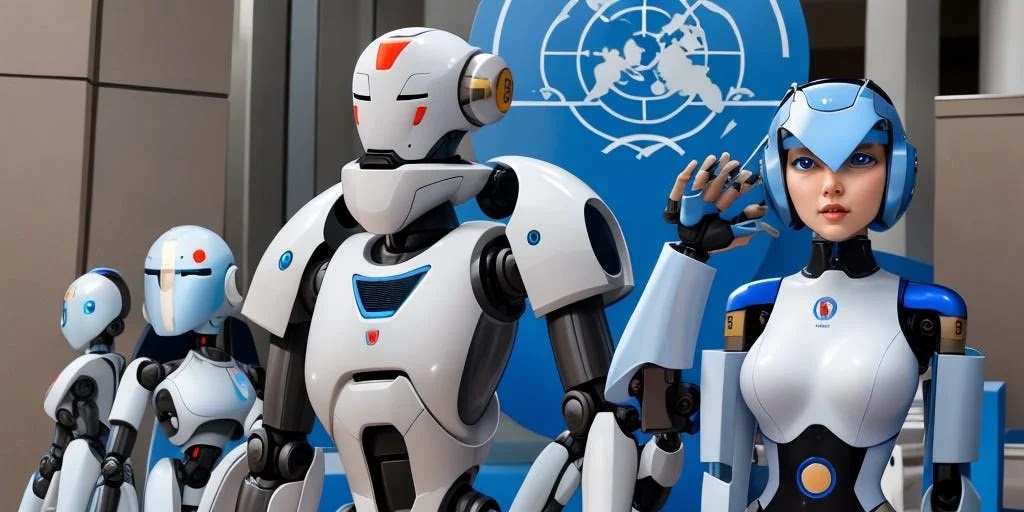
The future of AI robots is moving from rigid machines that repeat one task toward adaptable systems that can perceive environments, understand instructions, plan actions, and work safely with people. The future of AI robots is already visible in factories, warehouses, hospitals, laboratories, agriculture, and inspection, but general-purpose household humanoids remain far harder than polished demonstrations suggest.
This guide explains how AI robots work, where they are already useful, which advances matter most, and what safety, employment, privacy, and cost questions must be solved. For the wider context behind robotics, agents, on-device intelligence, and changing jobs, explore our technology and AI guide.
Quick answer: AI robots combine sensors, perception models, planning software, control systems, and physical hardware. Near-term growth will be strongest in bounded environments with measurable tasks. Human supervision, physical safeguards, cybersecurity, testing, and clear responsibility will remain essential.
Table of Contents
What Are AI Robots?
AI robots are physical machines that use artificial intelligence to interpret information and choose or adapt actions. A conventional industrial robot may repeat a precisely programmed path. An The future of AI robots includes machines that use cameras, force sensors, language instructions, or learned policies to handle variation within approved limits.
Intelligence does not mean consciousness. Most robots are specialized systems built for defined environments and outcomes. They may classify an object, navigate a mapped facility, grasp unfamiliar items, inspect a product, or recommend a next action without possessing human understanding.
AI Robots vs Traditional Robots
Traditional robots excel when the environment, object position, and task remain predictable. AI robots add perception and adaptation. This can reduce reprogramming and expand the range of situations a robot handles, but it also introduces uncertainty that must be measured and controlled.
How AI Robots Work
Sensors and Perception
Cameras, depth sensors, lidar, microphones, encoders, tactile sensors, force-torque sensors, and environmental instruments provide observations. Perception models identify objects, estimate position, recognize speech, detect obstacles, or infer the state of a task.
Planning and Reasoning
A planning layer turns a goal into steps while respecting available tools and constraints. For the future of AI robots, vision-language-action systems connect visual information and natural-language instructions with motor commands. Google DeepMind describes Gemini Robotics as reasoning about physical spaces, adapting to new situations, and breaking goals into manageable steps.
Control and Actuation
Controllers translate a plan into stable movement of motors, joints, wheels, grippers, or tools. Fast low-level control often remains separate from slower AI reasoning. Safety-rated systems can limit speed, force, workspace, and access independently of the AI model.
Learning and Feedback
Robots may learn from demonstrations, simulation, teleoperation, reinforcement signals, or recorded operations. During a task, they observe the result and adjust. This physical action loop resembles agentic AI, but mistakes can affect people, property, and equipment rather than only digital information.
7 Trends Shaping the Future of AI Robots
1. Vision-Language-Action Models
Multimodal models connect language, images, video, and action. Instead of programming every motion, a person can describe a goal and let the system interpret the scene. The challenge is converting flexible reasoning into precise, safe, and repeatable physical behavior.
2. Better Embodied Reasoning
Embodied reasoning concerns space, objects, tools, cause and effect, and physical constraints. Robots need to understand that an object may be fragile, blocked, hot, moving, or unsafe to approach. Model cards and independent evaluations are important because capability demonstrations do not reveal every limitation.
3. On-Device and Edge Intelligence
Running perception or control near the robot reduces latency and cloud dependence. It may also keep sensitive video or operational data local. Edge systems still need update security, monitoring, and fallback behavior. Learn more in our guide to on-device AI.
4. Simulation and Synthetic Data
Simulation lets developers train and test many scenarios without damaging equipment or endangering people. Synthetic environments can generate rare events and varied objects, but a simulation never perfectly matches reality. Physical validation remains necessary.
5. Collaborative and Mobile Robots
Collaborative robots assist near people, while autonomous mobile robots move materials through facilities. Flexible deployment is attractive where product mix or routes change. Risk assessment must consider the entire application, including payloads, tools, traffic, and human behavior.
6. Humanoid Platforms
Humanoid robots attract attention because workplaces and homes are designed around human reach, stairs, doors, and tools. A human-shaped platform could reuse those environments, yet legs, hands, balance, battery life, reliability, and cost create major engineering challenges. Wheeled or specialized robots often solve a task more efficiently.
7. Robots as Physical AI Agents
The future of AI robots may include systems that coordinate perception, enterprise software, maps, tools, and other robots. A warehouse robot could receive an order, plan a route, verify an item, move it, update inventory, and escalate an exception. Permissions and approval gates must constrain both digital and physical actions.
Where AI Robots Are Already Used
Manufacturing
In manufacturing, the future of AI robots builds on machines that weld, assemble, machine-tend, paint, inspect, package, and move material. AI expands perception, quality inspection, path adaptation, and predictive maintenance. Our AI in manufacturing guide explains how robotics fits into smart-factory systems.
Warehousing and Logistics
In logistics, the future of AI robots includes mobile systems that transport shelves, pallets, parcels, and supplies. Picking systems identify and grasp varied items. Reliable deployments use mapped zones, traffic rules, exception handling, charging plans, and human supervision.
Healthcare and Rehabilitation
In healthcare, the future of AI robots includes machines that assist surgery, rehabilitation, pharmacy operations, disinfection, logistics, and remote presence. Medical use requires clinical evidence, regulatory compliance, privacy protection, trained operators, and safe fallback.
Agriculture
In agriculture, the future of AI robots includes platforms that monitor crops, target weeds, harvest selected produce, inspect livestock, and automate repetitive field work. Weather, terrain, dust, lighting, and biological variation make real-world reliability difficult.
Inspection and Hazardous Work
Drones, crawlers, and mobile platforms inspect infrastructure, mines, offshore assets, disaster areas, and contaminated sites. Removing people from danger is a strong benefit, provided communication loss and robot failure do not create new hazards.
Professional and Consumer Services
Service robots clean floors, deliver goods, assist hospitality, provide telepresence, and support education. The International Federation of Robotics reported almost 200,000 professional service robots sold in 2024, a 9% increase, while noting staff shortages and medical demand as drivers in its World Robotics 2025 coverage.
Benefits of AI Robots
- Safety: machines can enter hazardous or ergonomically difficult environments.
- Consistency: controlled motion supports repeatable work and inspection.
- Availability: robots can support continuous operations with planned maintenance.
- Adaptability: perception helps handle more variation than fixed automation.
- Accessibility: assistive robots can extend mobility and independence.
- Data: robotic systems can record process evidence for improvement.
Major Risks and Limitations
Physical Safety
A wrong digital answer can mislead; a wrong robot action can cause injury. Use independent safeguards, speed and force limits, protected zones, emergency stops, validated recovery, and application-specific risk assessment. Never rely on a language model as the only safety layer.
Reliability in Unfamiliar Situations
Robots may fail when lighting, objects, surfaces, layouts, or human behavior differ from training. Measure performance across conditions, detect uncertainty, and stop or escalate when the system leaves its validated operating envelope.
Cybersecurity and Privacy
The future of AI robots also brings cybersecurity challenges because connected machines combine cameras, microphones, networks, software, accounts, and physical actuators. Apply secure updates, network segmentation, least privilege, encryption, logging, vulnerability management, and restricted remote access. Minimize and protect recorded personal data.
Cost and Maintenance
Total cost includes hardware, tooling, integration, floor changes, safety systems, training, energy, connectivity, spares, software, and support. A flexible demo may still be less economical than a simple fixture or conventional automation.
Jobs and Accountability
The future of AI robots will automate tasks, reshape roles, and create work in integration, maintenance, supervision, safety, and data. Organizations need training and transition plans. Responsibility for deployment must remain with identifiable people and companies, not an undefined “AI.” See our analysis of AI jobs and automation.
How to Evaluate an AI Robot
- Define the task: specify objects, environment, speed, accuracy, payload, and exceptions.
- Measure the baseline: compare safety, quality, throughput, labor, and total cost.
- Test real variation: include lighting, clutter, wear, people, network loss, and unusual inputs.
- Verify safeguards: ensure safety does not depend only on AI behavior.
- Review data practices: establish ownership, retention, access, and privacy.
- Plan failure recovery: define a safe stop, manual mode, and responsible responder.
- Pilot before scaling: expand only after evidence under representative conditions.
When Will General-Purpose Robots Become Common?
For the future of AI robots, no reliable date applies to every use case. The future of AI robots will expand from specialized machines that are already common because their environments and success criteria are bounded. General-purpose robots must handle enormous physical variety while remaining affordable, energy-efficient, dependable, understandable, and safe around people.
The future of AI robots will likely bring gradual expansion through controlled workplaces before unrestricted homes. Progress will arrive unevenly: a robot may perform several warehouse tasks reliably while still struggling with household clutter or delicate manipulation. Capability, economics, regulation, and public trust must advance together.
Preparing Teams for AI Robots
Organizations should prepare the workplace as carefully as the machine. Map how people, materials, vehicles, and information move today. Identify who will supervise AI robots, respond to exceptions, approve software changes, and maintain safety controls. Train workers before the pilot so they can recognize normal behavior, uncertainty, and conditions that require a safe stop.
Worker feedback should shape performance evaluation. Operators often notice awkward handoffs, hidden delays, unsafe shortcuts, and product variation that dashboards miss. Document feedback, update procedures, and retest after every meaningful change. The strongest future of AI robots is collaborative: machines handle suitable physical tasks while people provide context, judgment, creativity, and responsibility.
Robotics also connects with private assistants, autonomous agents, manufacturing, and employment. Our technology and AI trends guide explains how these systems influence one another.
Frequently Asked Questions
Will AI robots replace humans?
The future of AI robots will automate some tasks and change many jobs, but most real deployments combine machines with human judgment, maintenance, exception handling, and responsibility. Effects vary by occupation and industry.
Are humanoid robots the future?
Within the future of AI robots, humanoid form is useful in human-designed spaces, but it is not ideal for every task. Wheeled, fixed, aerial, and specialized robots may be safer, cheaper, faster, or more reliable.
Can AI robots think like humans?
Today, AI robots can perceive, predict, plan, and adapt within limits, but that does not establish human-like understanding or consciousness. Their competence can be narrow and brittle.
What industries use AI robots most?
AI robots are already used heavily in manufacturing and logistics, with growing applications in healthcare, agriculture, inspection, cleaning, construction, laboratories, and professional services.
What is the biggest barrier to AI robots?
For AI robots, the hardest challenge is reliable, safe physical performance across real-world variation at an acceptable total cost. For AI robots, a strong demonstration is not the same as dependable operation.
Final Thoughts
The future of AI robots will be shaped less by stage performances and more by evidence: safe task completion, useful economics, dependable maintenance, and trustworthy behavior. In the future of AI robots, specialized systems will continue delivering value while broader robots improve step by step.
