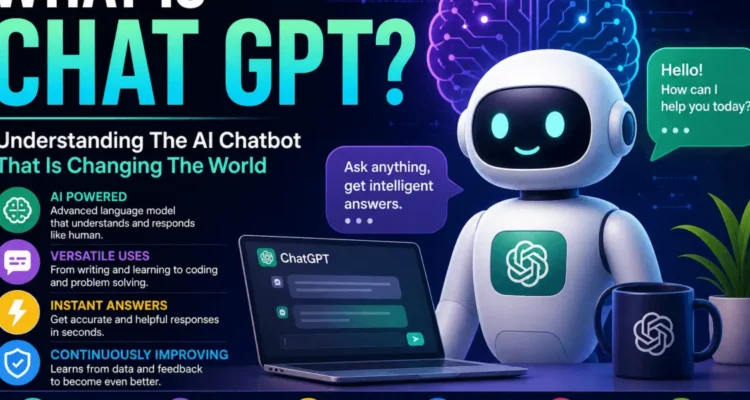
What is Chat GPT? 7 Powerful Facts, Uses, Pros & Cons (2026 Guide)

What is Chat GPT and how the ChatGPT AI assistant works

What is Chat GPT? Chat GPT is OpenAI’s conversational AI assistant for generating, understanding, and working with language and other supported content. This evergreen guide explains how it works, what it can do, its benefits and limitations, and how to use it responsibly.

Chat GPT capabilities change as OpenAI updates models, tools, plans, and regional availability. For the wider landscape, start with our technology and AI guide.

Quick answer: Chat GPT generates responses from instructions and context. It can be highly useful, but it can also make confident mistakes. Verify important claims, protect sensitive data, and keep a human responsible for decisions.

What Is ChatGPT?

For another overview, see our technology and AI trends guide. ChatGPT is an artificial intelligence assistant from OpenAI that accepts natural-language instructions and generates responses. Depending on currently enabled product features, it can help with writing, explanation, research, files, images, voice, data analysis, coding, and multi-step work. It is not a human expert or guaranteed source of truth.

ChatGPT becomes more useful when users provide accurate context, request a clear format, and review the result against reliable evidence. The appropriate level of checking depends on the possible impact of an error.

How ChatGPT Works

ChatGPT uses generative pre-trained transformer models. Training teaches statistical patterns across language and other supported data. Chat GPT users should remember this: during a conversation, the model generates output from the current instructions and context. Product tools may add web access, file analysis, memory, code execution, or connections to services.

ChatGPT becomes more useful when users provide accurate context, request a clear format, and review the result against reliable evidence. The appropriate level of checking depends on the possible impact of an error.

What GPT Means

GPT stands for generative pre-trained transformer. Generative means producing new output. Pre-trained refers to broad learning before interactive use. Transformer describes the neural-network architecture for processing relationships within context. ChatGPT is the assistant interface; a GPT model is part of the technology behind it.

ChatGPT becomes more useful when users provide accurate context, request a clear format, and review the result against reliable evidence. The appropriate level of checking depends on the possible impact of an error.

7 Powerful Facts About ChatGPT

ChatGPT is conversational, can follow formatting constraints, may work with multiple content types, and can use tools when enabled. Its answers can still be wrong. Features and limits vary by account, plan, region, and time. Human judgment remains necessary for important decisions.

ChatGPT becomes more useful when users provide accurate context, request a clear format, and review the result against reliable evidence. The appropriate level of checking depends on the possible impact of an error.

What Can ChatGPT Do?

Chat GPT users should remember this: people use chatgpt to brainstorm, outline, rewrite, summarize, translate, explain concepts, prepare study questions, analyze uploaded material, draft emails, create tables, compare options, and generate or review code. Businesses use it for approved knowledge work, documentation, data exploration, and workflow assistance.

ChatGPT becomes more useful when users provide accurate context, request a clear format, and review the result against reliable evidence. The appropriate level of checking depends on the possible impact of an error.

ChatGPT for Writing

Chat GPT users should remember this: a strong writing request identifies audience, purpose, tone, length, required facts, prohibited claims, and desired structure. Use ChatGPT for ideation and revision, then verify facts, sources, originality, and brand voice. Do not publish unreviewed output merely because it sounds fluent.

ChatGPT becomes more useful when users provide accurate context, request a clear format, and review the result against reliable evidence. The appropriate level of checking depends on the possible impact of an error.

ChatGPT for Students and Learning

Chat GPT users should remember this: students can request explanations at different levels, practice questions, feedback on reasoning, or examples. For Chat GPT, the best learning use promotes active learning: attempt the problem first, ask for hints, compare approaches, and explain the final answer. Follow school rules and never submit generated work dishonestly.

ChatGPT becomes more useful when users provide accurate context, request a clear format, and review the result against reliable evidence. The appropriate level of checking depends on the possible impact of an error.

ChatGPT for Coding

ChatGPT can explain code, propose implementations, write tests, diagnose errors, and review changes. Generated code must be executed, tested, scanned, and reviewed. Compare dedicated tools in our AI coding assistant guide and learn the risks of vibe coding.

ChatGPT becomes more useful when users provide accurate context, request a clear format, and review the result against reliable evidence. The appropriate level of checking depends on the possible impact of an error.

ChatGPT for Business

Chat GPT users should remember this: teams can draft proposals, summarize meetings, classify text, create checklists, and explore data. Organizations need approved accounts, data policies, access control, retention rules, human review, and clear ownership. Sensitive information should only be used under applicable organizational and product controls.

ChatGPT becomes more useful when users provide accurate context, request a clear format, and review the result against reliable evidence. The appropriate level of checking depends on the possible impact of an error.

Benefits of ChatGPT

Chat GPT users should remember this: benefits include speed, accessibility, flexible communication, rapid iteration, and support across many knowledge tasks. ChatGPT can reduce blank-page friction and make complex material easier to approach. Benefits depend on clear instructions, trustworthy context, suitable tools, and verification.

ChatGPT becomes more useful when users provide accurate context, request a clear format, and review the result against reliable evidence. The appropriate level of checking depends on the possible impact of an error.

Limitations and Risks

ChatGPT can hallucinate facts, citations, calculations, or events. It can misunderstand ambiguous requests, reflect bias, miss recent information, or produce insecure code. Never treat confidence as evidence. Verify high-stakes medical, legal, financial, safety, employment, and security information with qualified sources.

ChatGPT becomes more useful when users provide accurate context, request a clear format, and review the result against reliable evidence. The appropriate level of checking depends on the possible impact of an error.

Privacy and Data Controls

Chat GPT users should remember this: do not paste passwords, payment data, private keys, confidential client records, or unnecessary personal information into an AI service. Review current settings, workspace policies, retention, memory, and training controls. Official OpenAI documentation on data controls should be checked for current platform behavior because controls can change.

ChatGPT becomes more useful when users provide accurate context, request a clear format, and review the result against reliable evidence. The appropriate level of checking depends on the possible impact of an error.

ChatGPT Memory

Chat GPT users should remember this: memory can help retain approved preferences or useful context across interactions, but it does not mean perfect recall. Users should inspect, correct, or delete remembered information where controls allow. Our semantic memory guide explains meaning-based retrieval.

ChatGPT becomes more useful when users provide accurate context, request a clear format, and review the result against reliable evidence. The appropriate level of checking depends on the possible impact of an error.

How to Write Better ChatGPT Prompts

Chat GPT users should remember this: state the goal, give relevant context, define the audience, specify the output format, include constraints, and provide examples when helpful. Ask the model to identify assumptions or missing information. Break complex work into stages and evaluate each stage.

ChatGPT becomes more useful when users provide accurate context, request a clear format, and review the result against reliable evidence. The appropriate level of checking depends on the possible impact of an error.

A Practical Prompt Formula

Use role or perspective, task, context, constraints, quality criteria, and output format. For example: analyze this policy for a small-business owner, identify five risks, cite supplied sections, distinguish facts from assumptions, and return a prioritized table.

ChatGPT becomes more useful when users provide accurate context, request a clear format, and review the result against reliable evidence. The appropriate level of checking depends on the possible impact of an error.

ChatGPT vs Search Engines

Chat GPT users should remember this: a search engine primarily retrieves and ranks sources. ChatGPT synthesizes a conversational response and may use search when enabled. For current news, prices, laws, specifications, or quotations, use source-backed browsing and open the original pages.

ChatGPT becomes more useful when users provide accurate context, request a clear format, and review the result against reliable evidence. The appropriate level of checking depends on the possible impact of an error.

ChatGPT vs AI Agents

ChatGPT is an assistant interface, while an AI agent can plan and use tools across multiple steps toward a goal. The boundaries overlap as assistants gain tools. Our agentic AI guide explains permissions, action loops, and human approval.

ChatGPT becomes more useful when users provide accurate context, request a clear format, and review the result against reliable evidence. The appropriate level of checking depends on the possible impact of an error.

How to Verify ChatGPT Answers

Chat GPT users should remember this: check primary sources, dates, calculations, names, links, and quotations. Ask for uncertainty and counterarguments, but verify independently because a model can produce convincing explanations for an error. For consequential tasks, keep an audit trail of sources and human approvals.

ChatGPT becomes more useful when users provide accurate context, request a clear format, and review the result against reliable evidence. The appropriate level of checking depends on the possible impact of an error.

Frequently Asked Questions

ChatGPT is an AI assistant, not a conscious person. It may be free or paid depending on the current offering. Chat GPT users should remember this: it can help beginners, professionals, and businesses, but models, limits, tools, and pricing change. It cannot guarantee accuracy. Chat GPT users should remember this: consult official openai documentation for current availability.

A Step-by-Step ChatGPT Workflow

Chat GPT users should remember this: begin by defining the outcome and the audience. Supply only relevant background, then ask ChatGPT to restate the task and identify missing information. Request a plan before a long answer. Review the plan, correct assumptions, and complete the work in smaller stages.

Chat GPT users should remember this: after generation, verify factual claims and calculations with primary sources. Check whether quotations exist, links lead to the claimed pages, and examples satisfy the constraints. Revise for accuracy, clarity, bias, privacy, accessibility, and tone. Chat GPT users should remember this: a final human review should decide whether the output is ready to use.

Common ChatGPT Mistakes to Avoid

  • Giving a vague request and expecting a precise result
  • Trusting invented citations or statistics without opening sources
  • Sharing unnecessary confidential or personal data
  • Using generated code without testing and security review
  • Asking ChatGPT to make a high-impact decision without qualified oversight
  • Assuming product features, limits, pricing, or model names never change

Responsible-Use Checklist

  1. Classify the risk and sensitivity of the task.
  2. Remove data that ChatGPT does not need.
  3. Provide authoritative context and clear constraints.
  4. Require sources for factual or current claims.
  5. Verify outputs through independent evidence and testing.
  6. Keep a qualified human responsible for the final decision.

More ChatGPT Questions Answered

Is ChatGPT always connected to the internet?

No. Web access depends on the current product, selected mode, tools, and account availability. When current information matters, confirm that search is being used and inspect the cited original sources.

Can ChatGPT replace Google?

They solve overlapping but different problems. ChatGPT is useful for synthesis and conversation; search is useful for discovering and comparing sources. Many tasks benefit from both.

Can ChatGPT create original work?

It can generate new combinations of language and ideas, but users remain responsible for accuracy, copyright, attribution, originality requirements, and organizational policy.

Why does ChatGPT sometimes give different answers?

Chat GPT users should remember this: responses depend on wording, context, selected model or mode, enabled tools, and generation variability. Define evaluation criteria and compare outputs instead of expecting identical wording.

Final Thoughts

ChatGPT is most valuable as a collaborative tool for thinking, creating, analyzing, and learning. For Chat GPT users, its fluency makes verification more important, not less. Use it with clear goals, minimal sensitive data, reliable sources, and human accountability. Explore related developments in our complete technology and AI guide.

Leave A Comment