Engineering and Manufacturing Guide: 9 Powerful Concepts
 Kamran Liaquat Ali
- posted on
- No Comment

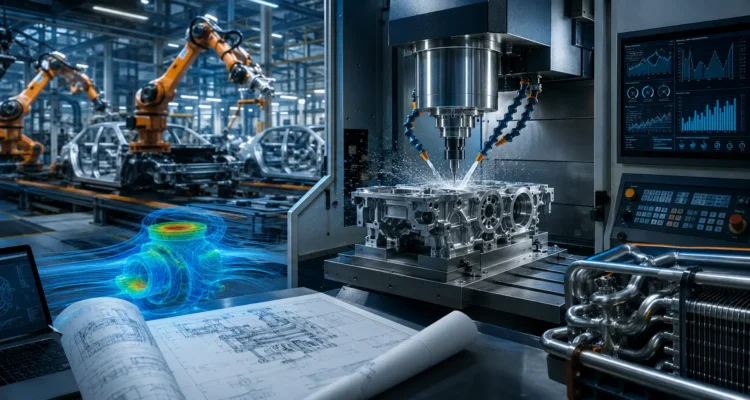
An engineering and manufacturing guide explains how ideas become safe, reliable, and repeatable products or systems. Every industrial activity—from shaping a metal component to controlling indoor temperature or generating electricity—combines a physical process, measurable requirements, suitable equipment, quality controls, and informed decisions. This evergreen guide provides a practical framework for understanding those elements, then connects them to nine detailed explainers covering machining, automotive production, thermal systems, fluid simulation, regulated manufacturing, and cloud-enabled operations.
Table of Contents
You do not need an engineering degree to use this engineering and manufacturing guide. Students can use it to build a clear mental model, professionals can use it to compare processes, and business leaders can use it to ask better questions before approving equipment, suppliers, automation, or process changes. The goal is not to replace specialist calculations. It is to show how the major parts of engineering and manufacturing fit together and where deeper technical analysis becomes necessary.
What Are Engineering and Manufacturing?
Engineering applies scientific, mathematical, and practical knowledge to design, analyze, improve, and maintain products, processes, structures, and systems. Manufacturing is the organized conversion of materials, components, energy, and information into useful products at a required level of quality, cost, safety, and output. Engineering determines what should be built and how it should perform; manufacturing determines how to produce it consistently at the required scale.
The two disciplines overlap throughout a product life cycle. Design engineers specify geometry, materials, loads, interfaces, and performance. Manufacturing engineers decide whether a component should be machined, formed, cast, welded, molded, printed, or assembled. Quality teams define inspection methods. Maintenance teams protect equipment availability. Operations teams balance throughput, inventory, labor, and energy. Strong results appear when these functions share data and make decisions as one system rather than as isolated departments.
The 5-Question Framework for Understanding Any Industrial Process
The most useful part of this engineering and manufacturing guide is a reusable five-question framework. Apply it whenever you encounter an unfamiliar machine, plant, production method, or technical article. The questions reveal the physical logic, performance limits, business constraints, and risks behind a process.
1. What Physical Transformation Is Happening?
Start by identifying what changes. A cutting tool removes material. A press changes a sheet’s shape. A heat exchanger transfers thermal energy without mixing two fluids. A pump raises fluid pressure. A chemical process changes molecular composition. An assembly line joins parts into a functional product. A power plant converts stored energy into heat, mechanical rotation, and finally electricity. Naming the transformation prevents technical terminology from hiding the basic purpose.
Next, identify inputs and outputs. Inputs may include raw material, components, electricity, fuel, compressed air, cooling water, software instructions, and operator time. Outputs include the desired product plus heat, noise, chips, scrap, emissions, wastewater, and data. A complete process model accounts for both valuable output and unavoidable losses.
2. What Accuracy, Capacity, and Performance Are Required?
A process is only useful when it meets measurable requirements. Accuracy describes closeness to a target; precision describes consistency; tolerance defines the acceptable variation. Capacity may be expressed as parts per hour, liters per minute, heat-transfer rate, electrical output, or another process-specific measure. Engineers also evaluate surface finish, strength, temperature, pressure, efficiency, reliability, and service life.
Requirements should be demanding enough to protect function but not unnecessarily strict. An excessively tight tolerance can increase machining time, inspection cost, scrap, and supplier risk without improving the product. The right engineering decision connects every specification to a functional reason, a verified test, or a legal requirement.
3. How Do Materials, Energy, Heat, and Fluids Behave?
Materials respond differently to force, temperature, corrosion, fatigue, and wear. Steel may provide strength and temperature resistance; aluminum can reduce mass; polymers can offer corrosion resistance and complex molded shapes; composites can combine high strength with low weight. Material selection also affects tool wear, joining methods, recyclability, lead time, and total cost.
Energy flow matters in nearly every operation. Motors convert electrical energy into motion. Friction creates unwanted heat. HVAC equipment moves heat to maintain comfort. Boilers release energy from fuel, while turbines turn thermal energy into mechanical work. Fluid behavior determines pressure drop, mixing, cooling, ventilation, and aerodynamic performance. An engineering and manufacturing guide must therefore connect mechanical action with thermal and fluid effects instead of treating them as separate topics.
4. Which Safety, Quality, and Regulatory Controls Apply?
Industrial success is not measured by output alone. A process must protect workers, users, communities, and the environment. Hazards can include moving machinery, pressure, electricity, heat, chemicals, noise, dust, lifting, confined spaces, and unexpected startup. Risk assessment considers both the likelihood and severity of harm, then selects controls that reduce exposure.
The OSHA hierarchy of controls prioritizes elimination and substitution, followed by engineering controls, administrative measures, and personal protective equipment. This order matters because controls designed into equipment are generally less dependent on perfect human behavior. Requirements vary by country, industry, and application, so qualified professionals must identify the exact laws, standards, permits, and validation rules that apply.
5. How Are Data and Digital Technology Improving the Process?
Modern manufacturing produces data as well as physical goods. Sensors measure temperature, vibration, pressure, speed, dimensions, energy use, and defects. Control systems react in real time. Manufacturing execution systems track work orders and traceability, while enterprise systems connect purchasing, inventory, production, and finance. Simulation can test ideas before costly hardware is built.
Smart manufacturing links operational technology with information technology so that people and systems can act on timely information. A useful overview from NIST describes smart manufacturing as the integration of these technologies in a real-time environment. The objective is not technology for its own sake; it is better visibility, faster learning, safer work, consistent quality, and more responsive production.
The Engineering-to-Manufacturing Life Cycle
A reliable product normally moves through connected stages rather than jumping directly from an idea to mass production. The exact terminology differs by industry, but the following sequence provides a dependable overview.
- Define the need: identify users, operating conditions, required functions, constraints, and success criteria.
- Develop concepts: compare possible architectures, materials, energy sources, and production methods.
- Analyze and design: create calculations, models, drawings, risk assessments, and preliminary specifications.
- Prototype and test: expose assumptions, measure performance, and discover failure modes before scale-up.
- Plan production: select equipment, tooling, suppliers, inspection points, work instructions, and process parameters.
- Validate the process: demonstrate that the process can repeatedly meet requirements under realistic conditions.
- Operate and control: monitor safety, quality, delivery, cost, energy, and equipment condition.
- Improve and sustain: investigate losses, manage changes, maintain documentation, and apply lessons to future designs.
The engineering and manufacturing guide also shows why feedback should travel in both directions. Production difficulties may reveal a design that is expensive to manufacture. Field failures may expose an overlooked load or environmental condition. Supplier variation may require a better specification. This feedback loop is the foundation of design for manufacturability, reliability growth, and continuous improvement.
How Engineers Select a Manufacturing Process
The engineering and manufacturing guide emphasizes that there is rarely one universally “best” process. Selection depends on geometry, material, quantity, tolerance, surface requirements, lead time, available skills, safety, sustainability, and economics. Machining is flexible and precise but removes material. Casting can create complex metal shapes but requires process control and tooling. Forming can be fast at scale but may require expensive dies. Additive manufacturing supports complex geometries and rapid iteration but may have limitations in speed, material properties, finishing, or qualification.
In this engineering and manufacturing guide, volume changes the answer. A method suitable for ten prototypes may be uneconomical for one million units. Engineers compare fixed costs—such as dies, fixtures, programming, and validation—with variable costs such as material, machine time, labor, energy, inspection, and scrap. They also consider flexibility. A dedicated line can achieve high output, while general-purpose equipment may respond better to product variety.
Quality, Variation, and Process Capability
The engineering and manufacturing guide emphasizes that every real process varies. Material batches differ, tools wear, machines heat up, sensors drift, and operators encounter changing conditions. Quality engineering separates common variation inherent in the system from special causes such as a damaged tool, incorrect setting, contaminated material, or failed sensor. Inspection detects outcomes, but process control aims to prevent defects.
A sound control plan identifies critical characteristics, measurement methods, sampling frequency, reaction plans, and responsible roles. Measurement systems must themselves be suitable; an unreliable gauge can create false confidence or unnecessary rejection. Traceability becomes especially important when a failure affects safety, regulated products, or expensive field service.
Quality should be designed into the process rather than added at final inspection. Clear specifications, capable equipment, mistake-proofing, preventive maintenance, trained people, verified software, and controlled changes work together. This engineering and manufacturing guide treats quality as a system property, not the job of one department.
Automation, Robotics, and Human Expertise
The engineering and manufacturing guide emphasizes that automation can improve repeatability, speed, traceability, and safety when the task and business case are appropriate. Fixed automation suits stable high-volume work. Programmable systems support multiple products. Robots can handle welding, painting, material movement, inspection, and operations in hazardous or ergonomically difficult environments. Machine vision can identify orientation, verify assembly, and detect visible defects.
Automation does not eliminate the need for people. It changes the work toward system design, programming, setup, monitoring, maintenance, troubleshooting, improvement, and judgment. Poorly understood processes should not be automated blindly; automation can reproduce a bad method faster. Teams should first define the requirement, stabilize the process, assess hazards, and plan how operators and maintainers will interact with the system.
Maintenance, Reliability, and Asset Performance
The engineering and manufacturing guide emphasizes that a production system cannot deliver quality when critical assets are unavailable or unstable. Reactive maintenance repairs equipment after failure. Preventive maintenance uses planned intervals. Condition-based maintenance uses evidence such as vibration, temperature, lubricant condition, electrical signatures, or performance trends. Predictive methods estimate developing failure so intervention can be scheduled before breakdown.
The best strategy depends on consequence, detectability, failure pattern, and cost. A low-cost noncritical fan may be allowed to run to failure; a safety-critical pressure system requires rigorous inspection and protection. Maintenance planning should include spare parts, isolation procedures, calibration, documentation, skills, and post-maintenance verification. Reliability is created through good design and sustained through disciplined operation.
Energy Efficiency and Sustainable Manufacturing
The engineering and manufacturing guide emphasizes that industrial sustainability includes more than installing efficient equipment. Teams examine material yield, scrap, rework, water, compressed air, steam, heat loss, transport, packaging, emissions, equipment utilization, and product life. A process with a high nameplate efficiency can still waste resources when it idles, leaks, produces defects, or operates far from its intended load.
A practical approach begins with measurement and a defined boundary. Map where material and energy enter, where useful transformation occurs, and where losses leave. Prioritize improvements by technical feasibility, risk, life-cycle benefit, and verified payback. Heat recovery, insulation, variable-speed drives, leak repair, optimized scheduling, process integration, and improved yield can all matter, but the right solution depends on site conditions.
Current Engineering and Manufacturing Guides
The following nine explainers extend this pillar into specific systems and processes. Each child article answers a distinct search intent while remaining connected to the engineering and manufacturing guide. Use the descriptions below to choose the most relevant starting point.
Machining and Production
The engineering and manufacturing guide connects readers to 7 Powerful Benefits of CNC Machining in Modern Manufacturing explains how computer numerical control converts digital instructions into repeatable machine motion. It covers precision, consistency, complex geometry, productivity, safety, and the relationship between programming, tooling, workholding, and inspection.
The engineering and manufacturing guide connects readers to Cutting Tool of Lathe Machine focuses on the tool that removes material from a rotating workpiece. Readers can learn about tool geometry, materials, cutting conditions, wear, surface finish, and the practical factors that influence safe and efficient turning.
Assembly and Automotive Production
The engineering and manufacturing guide connects readers to Automobile Manufacturing Process: 7 Powerful Stages Explained follows vehicle production from design and material preparation through stamping, body assembly, painting, powertrain installation, final assembly, and quality checks. It shows how many specialized processes must remain synchronized across a complex supply network.
Thermal and Energy Systems
The engineering and manufacturing guide connects readers to Shell and Tube Heat Exchangers: A Simple Guide to Heat Transfer explains how two fluids exchange thermal energy while remaining physically separated. It introduces the shell, tubes, baffles, flow arrangements, fouling, maintenance, and performance factors used in industrial service.
The engineering and manufacturing guide connects readers to What Is a Thermal Power Plant? traces energy conversion from a heat source through steam generation, turbine rotation, and electric generation. It also discusses cooling, efficiency, emissions, operating tradeoffs, and the role of thermal plants in power systems.
The engineering and manufacturing guide connects readers to Understanding HVAC: 7 Essential Things You Should Know About Indoor Comfort applies thermal and fluid principles at building scale. It covers heating, cooling, ventilation, humidity, filtration, controls, energy performance, and why correct sizing and maintenance matter.
Fluid Dynamics and Simulation
The engineering and manufacturing guide connects readers to Demystifying Computational Fluid Dynamics (CFD) shows how numerical models approximate fluid flow and heat transfer. The guide introduces geometry, meshing, boundary conditions, solver choices, convergence, validation, and the limitations engineers must understand before trusting a colorful result.
Regulated Manufacturing
The engineering and manufacturing guide connects readers to Change Control in Pharma explains why modifications to materials, equipment, software, methods, facilities, or documents require formal assessment in pharmaceutical operations. It covers risk, approval, validation, traceability, implementation, and effectiveness checks.
Digital and Cloud Manufacturing
The engineering and manufacturing guide connects readers to Potential of Cloud Manufacturing explores how networked platforms can connect design resources, production capacity, data, and services across locations. It considers scalability, collaboration, visibility, cybersecurity, interoperability, and the organizational changes needed to gain real value.
How the Nine Topics Connect
The engineering and manufacturing guide makes clear that these subjects are not isolated. CFD may help optimize airflow in an HVAC system, cooling in a power plant, or thermal performance in a heat exchanger. CNC machines and lathe cutting tools demonstrate how digital instructions, material behavior, motion, heat, and inspection meet at the point of production. Automotive manufacturing combines machining, forming, joining, automation, logistics, and quality at high volume.
Pharmaceutical change control illustrates a general principle relevant to every industry: modifications need proportional evaluation, documented decisions, and verification. Cloud manufacturing expands that principle across connected organizations and data systems. Together, the nine articles form a practical learning path from physical processes to integrated digital operations.
A Practical Checklist for Evaluating Any Process
- Define the intended function and measurable output.
- Identify material, energy, information, and labor inputs.
- Map each physical transformation and transfer step.
- Record critical dimensions, temperatures, pressures, flows, and timing.
- Identify hazards and apply the hierarchy of controls.
- Confirm applicable laws, standards, permits, and customer requirements.
- Evaluate process capability and measurement-system suitability.
- Estimate fixed, variable, maintenance, quality, and life-cycle costs.
- Plan preventive maintenance, calibration, and spare-part support.
- Measure energy, material yield, waste, and environmental impact.
- Define data ownership, cybersecurity, access, and backup requirements.
- Establish a controlled method for approving and verifying changes.
The engineering and manufacturing guide uses this checklist to turn the engineering and manufacturing guide into a repeatable decision tool. Not every item carries equal weight in every project, but skipping one without conscious evaluation can create a hidden risk that appears later during production, audit, maintenance, or field use.
Common Engineering and Manufacturing Mistakes
Optimizing One Metric While Hurting the System
A faster machine does not improve output if it overwhelms inspection, creates downstream inventory, or increases defects. A cheaper component can raise maintenance or warranty cost. A high-efficiency unit may underperform when poorly sized. Use system-level measures rather than rewarding one department or machine at the expense of the whole value stream.
Automating an Unstable Process
If inputs, methods, or requirements continually change, automation can make diagnosis harder. Standardize the work, understand variation, confirm safety, and define exception handling first. Then select automation that supports the real need rather than forcing the operation around a fashionable technology.
Treating Documentation as Paperwork
Drawings, specifications, maintenance records, validation evidence, and change history preserve organizational knowledge. Poor document control allows obsolete instructions and inconsistent settings to return. Documentation should be accurate, accessible, version-controlled, and connected to the physical configuration actually in service.
Ignoring Operators and Maintainers
People closest to the equipment often recognize recurring disturbances, awkward access, unsafe workarounds, and early failure signals. Involving them in design reviews and improvement work provides evidence that may not appear in a model or management report. Good engineering combines analysis with disciplined observation.
Skills for Modern Engineering and Manufacturing Careers
Strong professionals combine depth in one area with enough breadth to collaborate across disciplines. Core skills may include technical drawing, materials, mechanics, thermodynamics, fluid behavior, manufacturing methods, metrology, statistics, controls, programming, maintenance, quality systems, safety, and project management. Communication is equally important because decisions must be understood by operators, suppliers, customers, auditors, and leaders.
Practical learning should connect theory to evidence. Study a real process, identify inputs and outputs, read its drawings or diagrams, observe operating conditions, measure performance, and explain failure modes. Learn to state assumptions and uncertainty. Software tools change, but the ability to define a problem, test a model, interpret data, and communicate risk remains durable.
Frequently Asked Questions
What is the easiest way to understand a manufacturing process?
According to this engineering and manufacturing guide, identify the physical transformation first, then determine the required accuracy and output, how materials and energy behave, which safety and quality controls apply, and how data is used. These five questions explain the structure of most manufacturing processes.
What is the difference between engineering and manufacturing?
According to this engineering and manufacturing guide, engineering designs and analyzes products, processes, and systems to meet defined requirements. Manufacturing organizes the materials, equipment, people, controls, and information needed to produce the result consistently at the required scale. The disciplines overlap during design, validation, production, maintenance, and improvement.
What are the main types of manufacturing processes?
According to this engineering and manufacturing guide, common groups include casting and molding, forming, machining, joining, additive manufacturing, surface treatment, assembly, and continuous processing. A product may use several groups. The best choice depends on material, geometry, volume, tolerance, properties, cost, lead time, and qualification requirements.
How does Industry 4.0 relate to manufacturing?
According to this engineering and manufacturing guide, industry 4.0 generally describes connected manufacturing that combines sensors, automation, industrial networks, software platforms, analytics, and digital models. Its practical value comes from improved visibility, traceability, decision speed, flexibility, and coordination—not simply from installing more technology.
Why is tolerance important in manufacturing?
According to this engineering and manufacturing guide, tolerance defines the acceptable variation from a specified target. It allows designers to protect function while acknowledging that no real process produces identical results. Tolerances influence equipment selection, production speed, inspection, cost, assembly, and interchangeability.
How can a manufacturer improve quality?
According to this engineering and manufacturing guide, improve quality by clarifying requirements, controlling process inputs, verifying measurement systems, monitoring variation, maintaining equipment, training people, preventing mistakes, investigating root causes, and controlling changes. Final inspection alone cannot create a capable process.
Do I need an engineering background to read this guide?
According to this engineering and manufacturing guide, no. This engineering and manufacturing guide explains concepts in plain language for students, professionals, and decision-makers. Designing, operating, or approving safety-critical systems still requires suitable qualifications, standards, site data, and specialist judgment.
Final Thoughts
The machines, software, and business models used in industry will continue to change, but the underlying engineering questions remain stable. What transformation occurs? What performance is required? How do material, energy, heat, and fluids behave? Which controls protect safety and quality? How can data support better decisions? Answering those questions creates a reliable foundation for learning any new topic.
Use this engineering and manufacturing guide as your central reference, then explore the nine linked articles for focused explanations of CNC machining, lathe tools, automotive production, heat exchangers, thermal power, HVAC, CFD, pharmaceutical change control, and cloud manufacturing. Return as the library grows; each new process can be understood through the same disciplined framework.
