7 Powerful Benefits of CNC Machining in Modern Manufacturing
 Kamran Liaquat ali
- posted on
- No Comment

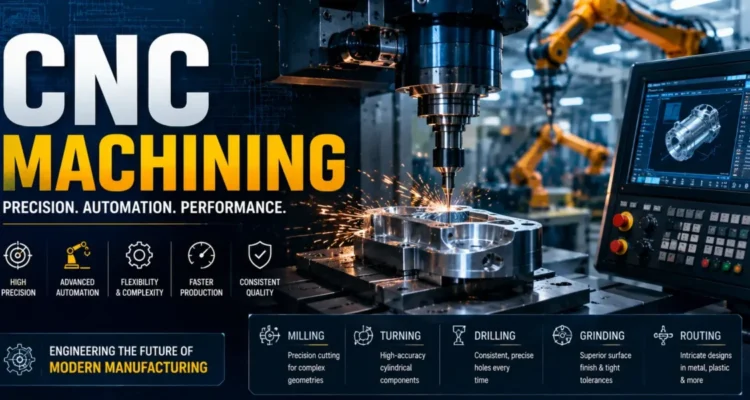
CNC machining is a subtractive manufacturing process in which computer-controlled machine tools remove material from a workpiece to create a specified shape, size, and surface finish. It combines a digital design, programmed toolpaths, rigid machines, cutting tools, workholding, measurement, and trained people. CNC machining is widely used for prototypes, production parts, tooling, aerospace components, automotive systems, medical devices, electronics, energy equipment, and industrial machinery.
Table of Contents
This guide explains how CNC machining works, the most common machine types, seven important benefits, realistic limitations, cost factors, quality control, safety, and how to choose a supplier. For the wider industrial context, see our engineering and manufacturing guide.
What Is CNC Machining?
CNC means computer numerical control. A CNC controller interprets programmed instructions and commands machine axes, spindle speed, tool changes, coolant, and other functions. The process can cut metals, polymers, composites, wood, foam, and specialized materials when the machine, tooling, and parameters are suitable.
CNC machining is subtractive because it starts with stock and removes material. Milling uses rotating cutters against a secured workpiece. Turning rotates the workpiece while a tool removes material. Drilling creates or enlarges holes, while grinding and other finishing methods can achieve demanding surfaces and dimensions.
How CNC Machining Works
- Design: engineers create a three-dimensional CAD model and drawing with dimensions, tolerances, materials, finishes, and inspection requirements.
- Manufacturing planning: the team chooses stock, machine, orientation, fixtures, tools, operations, and inspection stages.
- CAM programming: software converts geometry into toolpaths and machining instructions.
- Post-processing: the toolpaths are translated into machine-specific CNC code.
- Setup: an operator installs tools, loads stock, sets work offsets, verifies fixtures, and checks the program.
- Machining: the machine performs controlled movements while the spindle and cutting tools remove material.
- Inspection: measurements confirm that dimensions, geometry, finish, and other requirements are satisfied.
- Release: approved parts move to cleaning, finishing, assembly, packaging, or the next operation.
Automation does not eliminate skill. Programmers and operators must understand materials, cutting mechanics, machine behavior, workholding, measurement, and risk. A perfect CAD model can still produce a defective part if the setup is unstable, the tool wears unexpectedly, or the inspection plan misses a critical feature.
Main Types of CNC Machines
CNC Milling Machines
CNC mills use rotating tools to cut a secured workpiece. Three-axis machines move along X, Y, and Z. Four-axis and five-axis systems add rotation, allowing more surfaces to be reached with fewer setups. Milling is common for pockets, slots, holes, contours, faces, and complex prismatic parts.
CNC Lathes and Turning Centers
Turning rotates the workpiece while tools cut external and internal cylindrical features. Modern turning centers may include live tooling, multiple spindles, and additional axes for milling and drilling. Our guide to the cutting tool of a lathe machine explains tool geometry, materials, wear, and cutting conditions.
CNC Routers, Grinders, and Specialized Systems
Routers often process wood, plastics, composites, and sheet materials. CNC grinders use abrasive wheels for high accuracy and finish. Other systems include electrical discharge machining, laser and waterjet equipment, Swiss-type lathes, mill-turn centers, and machines designed for specific industries.
7 Powerful Benefits of CNC Machining
1. Repeatable Precision
CNC machining can repeat programmed motion consistently when the machine, process, environment, tooling, and measurement system are capable. This helps produce interchangeable parts and maintain critical dimensions across a batch. Actual capability depends on part size, material, geometry, machine condition, setup, temperature, and inspection.
2. Complex Geometry
Computer-controlled axes can create contours, pockets, hole patterns, threads, angled faces, and compound surfaces that would be difficult to produce manually. Multi-axis CNC machining can reach several sides in one setup, reducing repositioning and the variation introduced by repeated clamping.
3. Efficient Production
Once a stable setup and program are established, CNC machining can produce parts with predictable cycles and reduced manual intervention. Automatic tool changers, pallet systems, bar feeders, probing, and robotic loading can extend productive time. Efficiency must include setup, inspection, maintenance, and changeover—not cycle time alone.
4. Digital Repeatability and Traceability
Programs, tool lists, setup instructions, offsets, drawings, and inspection records can be controlled as digital information. This supports repeat orders and traceability when revisions are managed correctly. Uncontrolled copies remain dangerous, so manufacturers need clear approval, storage, access, and backup rules.
5. Flexible Prototyping and Production
The same general-purpose machine can produce different parts by changing programs, tools, fixtures, and stock. CNC machining is useful for prototypes, bridge production, custom work, replacement parts, and moderate volumes. Dedicated tooling may become more economical when quantities are extremely high.
6. Broad Material Choice
Machining works with many engineering alloys and nonmetals. Aluminum offers low mass and good machinability; steels provide varied strength and wear resistance; titanium and nickel alloys support demanding environments but are harder to cut. Plastics require attention to heat, clamping, and dimensional stability.
7. Integration With Modern Manufacturing
CNC machining can connect with CAD/CAM, probing, coordinate measurement, production planning, tool management, condition monitoring, and connected factory platforms. The cloud manufacturing guide explains how distributed capacity, software, and expertise may be coordinated as services.
Materials Used in CNC Machining
Common metals include aluminum, carbon steel, stainless steel, tool steel, brass, bronze, copper, titanium, magnesium, and nickel-based alloys. Nonmetal options include acetal, nylon, polycarbonate, PEEK, PTFE, acrylic, foam, wood, and certain composites. Material certificates may be required for critical applications.
Material selection affects cutting force, temperature, tool wear, burr formation, achievable finish, dimensional stability, and cost. Engineers should specify the grade and condition needed for function without creating an unnecessary sourcing or machining burden.
Cutting Tools, Speeds, and Feeds
Cutting tools may use high-speed steel, carbide, ceramics, cubic boron nitride, diamond, or specialized coatings. Geometry controls chip formation, cutting force, heat, and surface finish. Tool choice depends on material, operation, rigidity, coolant, machine power, and production goals.
Cutting speed relates to the velocity at the cutting edge. Feed describes tool advancement, often per tooth or revolution. Depth and width of cut determine engagement. Aggressive parameters may reduce cycle time but increase force, heat, chatter, deflection, or wear. Conservative settings can waste capacity. CNC machining parameters should be developed with tool guidance, machine limits, experience, and verified results.
Workholding and Setup
Workholding must locate the part repeatably and resist cutting forces without distorting the material or blocking tool access. Options include vises, chucks, collets, fixtures, vacuum systems, magnetic tables, soft jaws, and custom devices. Datum selection should connect the manufacturing setup with drawing requirements.
Setup planning often determines cost and quality more than the program itself. Multiple setups add handling, alignment, and opportunity for error. Multi-axis machines can reduce setups, but they require appropriate access, programming, collision control, and operator competence.
Tolerances and Surface Finish
A tolerance defines acceptable variation. Tighter tolerances can require slower cuts, stable temperature, rigid setups, finishing passes, specialized measurement, and more inspection. Designers should connect every tolerance to function, assembly, interchangeability, or safety rather than using unnecessarily tight defaults.
Surface finish depends on tool geometry, feed, speed, machine condition, vibration, material, coolant, and toolpath. A visually smooth surface is not proof of dimensional accuracy. Drawings should distinguish size, form, orientation, location, and roughness requirements.
Quality Control for CNC Parts
Inspection may use calipers, micrometers, height gauges, bore gauges, surface instruments, optical systems, probes, and coordinate measuring machines. The method must be capable of resolving the tolerance with acceptable uncertainty. First-article inspection verifies setup and interpretation before full production.
In-process probing can detect location, size, or tool breakage, but it does not replace a complete quality strategy. Control plans should identify critical characteristics, frequency, reaction plans, records, and responsibility. Process capability is more valuable than sorting defects after machining.
CNC Machining Safety
Hazards include rotating spindles, moving axes, sharp tools, flying chips, hot surfaces, mist, noise, heavy stock, stored energy, and automatic motion. Guards, interlocks, enclosures, safe work procedures, training, maintenance, and lockout/tagout must suit the equipment and local requirements.
The OSHA machine-guarding guidance explains that safeguards protect people from rotating parts, nip points, flying chips, and sparks. Operators should never bypass guards or reach into a machine cycle. Setup and maintenance require authorized procedures and verified isolation.
Limitations of CNC Machining
- Material is removed, creating chips and potentially lower yield than near-net-shape methods.
- Tool access limits internal corners, deep cavities, and hidden features.
- Complex parts may require expensive machines, fixtures, tools, and programming.
- Hard or heat-resistant materials can increase wear and cycle time.
- Setup cost may dominate very small orders.
- Extremely high volume may favor casting, molding, forming, or dedicated automation.
- Accuracy depends on process capability and measurement, not CNC control alone.
What Determines CNC Machining Cost?
Cost includes material, programming, setup, machine time, tools, fixtures, inspection, finishing, scrap risk, documentation, packaging, and overhead. Complex geometry and tight tolerances increase effort. Large stock removal consumes time and tools, while difficult access may require extra setups.
Designers can reduce cost through standard materials, accessible features, realistic tolerances, standard hole sizes, generous internal radii, fewer setups, and clear drawings. A design-for-manufacturability review should occur before release, when changes are still inexpensive.
How to Choose a CNC Machining Supplier
- Confirm experience with the required material, geometry, tolerance, quantity, and industry.
- Review machine capacity, axis travel, spindle, tooling, workholding, and inspection equipment.
- Ask how programs, revisions, customer files, and cybersecurity are controlled.
- Evaluate material traceability, calibration, nonconformance, corrective action, and change notification.
- Request realistic lead time including material, setup, outside processing, and inspection.
- Use samples or first articles when risk warrants them.
- Assess communication and technical problem solving, not price alone.
CNC Machining in Automotive and Smart Factories
CNC machining produces engine, transmission, suspension, tooling, mold, fixture, battery, and prototype components. Our guide to the automobile manufacturing process shows how machining fits within stamping, body assembly, painting, final assembly, and quality control.
Connected machines can provide cycle, alarm, tool, quality, and condition data. Analytics may support maintenance or bottleneck analysis. Digital technology adds value only when data is reliable and teams act on it. A stable physical process remains the foundation.
Understanding G-Code and CNC Programs
G-code is a common name for the instructions that define controlled movement and machine functions. Commands may position axes, set feed, control spindle rotation, call tools, activate coolant, and coordinate cycles. Modern CAM systems generate much of this code from toolpaths, but programmers must still verify the output and understand how the machine will respond.
A post-processor translates CAM output for a specific controller and machine configuration. Using the wrong post can create invalid motion or unsafe behavior. Programs should be simulated, reviewed, transferred securely, identified by revision, and proven under controlled conditions. Manual edits on the shop floor should follow an approval and documentation process so the master record matches the released program.
Process Planning for a Machined Component
Process planning determines how a design will become a conforming part. The planner reviews material, stock size, datum structure, tolerances, surfaces, tool access, heat treatment, coatings, inspection, quantity, and delivery. Operations are sequenced so early cuts create stable references and later cuts protect critical features.
Roughing removes material efficiently while leaving allowance for finishing. Semi-finishing can equalize stock and prepare demanding surfaces. Finishing passes target final dimensions and texture with controlled force and tool condition. Deburring, cleaning, marking, and preservation should be planned rather than treated as informal tasks after CNC machining.
A traveler or work instruction should state machine, fixture, program revision, tools, offsets, inspection points, and reaction steps. Good planning reduces dependence on memory and makes repeat orders more reliable.
Design for CNC Machining
Design for manufacturability aligns part geometry with realistic cutting and inspection. Internal corners require a tool radius; deeper cavities need longer, less rigid tools; thin walls can deflect; inaccessible surfaces may require extra setups. A small design change can reduce cycle time, tooling, and quality risk without changing function.
Use standard stock and tool sizes where practical. Avoid extremely deep narrow pockets, tiny internal radii, and tolerances tighter than function requires. Provide clear datums and identify truly critical features. If a surface needs a special finish, coating, or heat treatment, consider how later processing may change dimensions.
Design reviews should involve manufacturing and quality before release. Early collaboration prevents ambiguous drawings and expensive revisions after programs, fixtures, or material have already been purchased.
Maintenance and Tool-Life Management
Machine accuracy and availability depend on lubrication, coolant control, filtration, spindle condition, axis geometry, way covers, chip removal, probes, tool changers, and scheduled inspection. A machine can continue running while gradually losing capability, so maintenance should include evidence about condition and part quality.
Tool-life management tracks use and replaces cutters before wear creates defects or breakage. Fixed limits are simple but may waste remaining life or miss unusual wear. Condition monitoring can use load, vibration, acoustic, temperature, or dimensional trends. The correct method depends on process stability, cost, and the consequence of failure.
After maintenance, collision, or major repair, teams should verify machine functions and relevant accuracy before releasing production. Changes to offsets or calibration must be documented.
Common CNC Machining Problems
Chatter and Vibration
Chatter can create poor finish, noise, tool damage, and dimensional variation. Possible causes include weak workholding, excessive tool overhang, unsuitable speed or feed, worn tools, or an unstable machine–tool–part combination. Corrective action should address the cause rather than merely slow every operation.
Tool Wear and Breakage
Wear can result from heat, abrasion, adhesion, impact, chemical effects, or incorrect parameters. Review chip form, edge condition, coolant delivery, engagement, material variation, and runout. A broken tool may also damage the part, fixture, spindle, or following tool.
Dimensional Drift
Temperature, tool wear, workpiece stress, probing error, fixture movement, and machine condition can shift dimensions. Automatic compensation should be controlled and based on trustworthy measurements. Repeated offset changes without root-cause analysis can hide a deteriorating process.
Burrs and Poor Surface Finish
Burrs depend on material, tool condition, edge geometry, cutting direction, and support. Deburring methods must not damage critical edges or surfaces. Finish problems should be investigated through tooling, parameters, rigidity, runout, coolant, and material rather than judged only by appearance.
Frequently Asked Questions
What does CNC stand for?
CNC stands for computer numerical control. It describes machines that follow programmed commands to control motion and manufacturing functions.
Is CNC machining accurate?
CNC machining can achieve demanding accuracy when the complete process is capable. Machine condition, temperature, material, setup, tool wear, programming, and measurement all affect the result.
What is the difference between CNC milling and turning?
Milling usually rotates the tool against a secured workpiece. Turning rotates the workpiece while a tool cuts cylindrical features. Modern centers can combine both operations.
Can CNC machines make prototypes?
Yes. CNC machining is useful for functional prototypes made from production-grade materials, especially when dimensions, threads, sealing surfaces, or mechanical properties matter.
Does CNC machining require an operator?
Yes. Automation can reduce continuous attendance, but qualified people are still required for planning, programming, setup, tool management, inspection, maintenance, troubleshooting, and safety.
Which materials can be CNC machined?
Many metals, plastics, composites, wood products, and foams can be machined. Suitability depends on material behavior, equipment, tooling, safety, required finish, and economics.
Final Thoughts
CNC machining delivers precision, complexity, flexibility, and repeatability by connecting digital instructions with controlled physical cutting. The best results come from a complete system: clear requirements, suitable materials, capable machines, stable workholding, correct tools, verified programs, trained people, maintenance, safety, and reliable measurement.
Use CNC machining when its strengths match the quantity, geometry, material, tolerance, schedule, and life-cycle cost. Return to our engineering and manufacturing guide to connect machining with cloud manufacturing, CFD, automotive production, thermal systems, and the wider industrial landscape.
