Bulk Image Alt Text Checker – Powerful Free SEO Audit Tool
 Kamran Liaquat ali
- posted on
- No Comment

Enter the main homepage only. The tool will automatically detect the sitemap and scan up to 500 URLs.
Looking for your XML sitemap…
| # | Preview | Source Page | Image URL | ALT Text | Status | Recommendation |
|---|
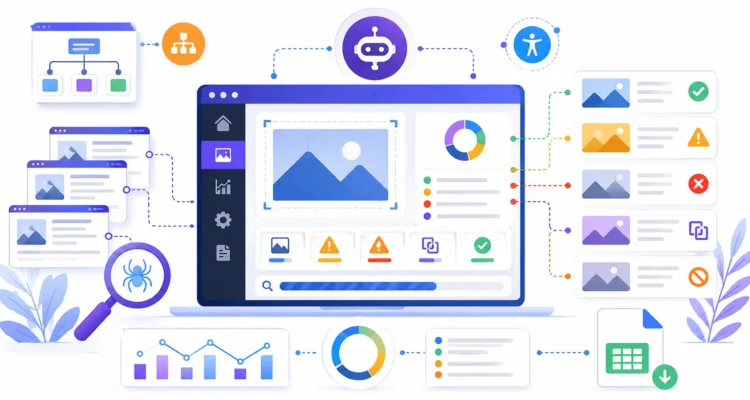
Bulk Image Alt Text Checker is a free website audit tool that helps you scan up to 500 URLs and identify images with missing, empty, or duplicate alt text. Instead of opening every webpage and inspecting images manually, you can enter your website homepage URL and run a site-wide image alt text audit from one place.
The tool automatically looks for your XML sitemap, discovers eligible pages, scans images across the website, and creates an easy-to-review report. You can see the source page, image URL, image preview, existing alt text, status, and recommended action. When the audit is complete, you can also export the results as a CSV file for further analysis.
Table of Contents
What Is a Bulk Image Alt Text Checker?
A Bulk Image Alt Text Checker is an SEO auditing tool designed to inspect the HTML alt attributes of images across multiple webpages. An alt attribute provides a text alternative for an image when appropriate. It can help users who rely on assistive technologies understand meaningful visual content and can also provide search engines with useful context about an image.
Checking alt text manually may be manageable on a website with five or ten pages. However, a blog containing hundreds of articles may contain thousands of images. Opening every post, locating every image, and checking its HTML individually can consume hours.
Our tool automates much of that repetitive work. It can scan up to 500 website URLs in one audit and organize detected images into clear status categories.
Why Is Image Alt Text Important?
Alt text has an important role in web accessibility and can also support image-related SEO when it accurately describes meaningful images. However, alt attributes should be written for their actual purpose rather than stuffed with keywords.
1. Alt Text Supports Accessibility
People who cannot see an image may use screen readers and other assistive technologies to understand webpage content. Appropriate alternative text can communicate the purpose or information contained in a meaningful image.
Not every image needs a written description. Purely decorative images can intentionally use an empty alt attribute, such as alt="", so assistive technology can ignore them. This is why our checker distinguishes between a missing alt attribute and an empty alt attribute instead of treating them as exactly the same issue.
2. Alt Text Provides Image Context
Descriptive alt text can provide additional context about an image and its relationship to the surrounding page. A useful description should explain what matters about the image without unnecessarily repeating nearby text.
3. Image Audits Save Time
A single WordPress article can contain a featured image, screenshots, illustrations, author avatars, icons, and other visual elements. Multiply that by hundreds of posts and manually checking every image becomes impractical.
A bulk image audit allows you to find potential issues first and then spend your time fixing the pages that actually require attention.
How to Use the Bulk Image Alt Text Checker
Using our Bulk Image Alt Text Checker is simple and does not require registration.
- Enter your website homepage URL, for example https://example.com.
- Click the Start Image ALT Audit button.
- The tool will look for your XML sitemap.
- Eligible website URLs will be collected automatically.
- The audit will scan up to 500 URLs.
- Review the images detected on each scanned page.
- Filter the report by Good, Missing ALT, Empty ALT, Duplicate ALT, or Errors.
- Export the final results as a CSV file if you want to work with the report offline.
For the best results, enter the main homepage rather than an individual article, category, tag, or internal page. The homepage allows the checker to identify the correct domain and discover its sitemap.
What Does the Image ALT Audit Check?
The report is designed to provide more information than a simple yes-or-no alt text test.
Missing ALT Attribute
A missing alt attribute means the image element does not contain an alt attribute at all. The tool flags these images so you can inspect them and determine whether appropriate alternative text should be added.
Empty ALT Attribute
An empty alt attribute looks like alt="". This is not automatically an error. Empty alt text is appropriate for some decorative images that do not add meaningful information to the page.
The checker therefore identifies empty alt attributes separately. You should review the image and decide whether it is decorative or meaningful before changing anything.
Duplicate ALT Text
The tool can also highlight alt text that appears repeatedly among scanned images. Duplicate text is not automatically bad. For example, the same site logo used across multiple pages may reasonably have consistent treatment.
However, if many unrelated images have exactly the same description, the result can reveal generic or automatically copied alt text that deserves review.
Good ALT Text
Images containing non-empty alt attributes are initially classified as having alt text. This does not mean the wording is guaranteed to be perfect. Human review is still important because an automated checker cannot fully determine whether a description accurately communicates the purpose and context of every image.
Scan Errors
If a webpage cannot be retrieved, the audit can report a scan error. Possible causes include server restrictions, timeouts, security rules, authentication requirements, or an inaccessible URL.
Missing ALT vs Empty ALT: What Is the Difference?
This distinction is particularly important when performing an image accessibility audit.
Missing ALT:
<img src="seo-dashboard.webp">In this example, no alt attribute exists.
Empty ALT:
<img src="decorative-shape.webp" alt="">Here, the alt attribute exists but intentionally contains no text. An empty alt attribute can be suitable when an image is purely decorative. Therefore, you should not automatically add descriptive text to every empty alt attribute reported by an automated tool.
How to Write Better Image Alt Text
Good alternative text should be useful, concise, and relevant to the purpose of the image. Describe what the user needs to understand rather than trying to force SEO keywords into every image.
For example, imagine an article contains a screenshot showing the WordPress media settings used to add image alternative text.
Weak alt text:
image seo wordpress seo image optimization best seo
Better alt text:
WordPress media settings showing the image alt text field
The second version describes the image naturally and gives the reader meaningful context.
Avoid Keyword Stuffing
Do not repeat the same focus keyword across every image simply because you want to improve SEO. Alt text should reflect the individual image and its role on the page.
Avoid Unnecessary Phrases
You usually do not need to begin every description with phrases such as “image of” or “picture of.” Describe the useful information directly when possible.
Consider the Surrounding Content
The best alt text depends on why the image appears on that particular page. The same image could require different treatment in different contexts, which is another reason automated results should be reviewed by a person.
Bulk Image Alt Text Checker Features
- Up to 500 URL scans: Audit hundreds of website pages in one session.
- Automatic sitemap detection: The tool searches common sitemap locations and robots.txt.
- Homepage URL validation: Helps prevent accidentally auditing only a single internal page.
- Image preview: Quickly identify the visual element associated with a result.
- Source page reporting: See exactly where an image was detected.
- Image URL reporting: View or open the original image resource.
- Missing ALT detection: Find images without an alt attribute.
- Empty ALT detection: Review images using an intentionally or accidentally empty alt value.
- Duplicate ALT detection: Identify repeated alt descriptions for manual review.
- Result filters: Focus on specific categories instead of reviewing every image.
- CSV export: Download your audit and continue working in Excel or Google Sheets.
- No sign-up required: Run an audit without creating an account.
A Bulk Image Alt Text Checker helps website owners quickly identify image accessibility and optimization issues across large websites without manually checking every page.
Who Should Use the Bulk Image Alt Text Checker?
The tool can be useful for anyone responsible for maintaining website content, including:
- WordPress website owners
- Bloggers and publishers
- SEO professionals
- Web developers
- Content managers
- Digital marketing agencies
- E-commerce website managers
- Website accessibility reviewers
It is particularly useful after a website migration, redesign, theme change, large content import, or image optimization project. These changes can sometimes leave older images with inconsistent or missing attributes.
Why Use a Bulk Image Alt Text Checker Instead of Manual Checking?
Manual inspection gives you complete control, but it does not scale well. A website containing 300 pages with five images per page could require reviewing approximately 1,500 image elements.
A bulk checker performs the discovery stage for you. Instead of searching for potential issues manually, you receive a report showing which images deserve attention. You can then review those results individually and make informed corrections.
This approach is particularly useful during periodic SEO audits because you can run the checker again after making changes and confirm whether previously identified issues have been resolved.
Bulk Image Alt Text Checker Limitations
No automated website checker can perfectly understand the purpose of every image. Keep the following limitations in mind when reviewing your results:
- An empty alt attribute may be intentional for a decorative image.
- Duplicate alt text is not automatically an SEO or accessibility problem.
- The presence of alt text does not guarantee that the description is useful or accurate.
- Some websites block automated requests.
- Images loaded through complex JavaScript may not appear in the initial HTML response.
- Protected or login-only pages cannot normally be audited.
- URLs missing from the XML sitemap may not be included in the bulk scan.
Use the report as an auditing assistant rather than automatically changing every item it flags.
Combine Image SEO With Other On-Page SEO Checks
Image optimization is only one part of a complete on-page SEO review. After checking your images, you can explore our Free Online SEO Tools collection to inspect additional elements of your website, including headings, metadata, keywords and other important optimization factors.
- Bulk H1 Tag Checker – scan up to 500 pages for missing or multiple H1 headings.
- SEO Title Length Checker – review title length, character count, and search preview.
- Meta Description Checker – check description length and preview your search snippet.
- Keyword Density Checker – analyze keyword frequency without manually counting phrases.
- URL Slug Generator – turn titles into clean and readable URL slugs.
- Explore All Free SEO & Writing Tools.
Learn More About Image Alt Text
For additional guidance, you can review the official Google Search Central image SEO documentation. For accessibility-focused guidance on alternative text, see the W3C Web Accessibility Initiative image tutorial.
Bulk Image Alt Text Checker FAQs
Is the Bulk Image Alt Text Checker free?
Yes. The Bulk Image Alt Text Checker is free to use and does not require account registration.
How many pages can I scan?
The current version can scan up to 500 eligible URLs discovered from a website sitemap.
Does the tool check every image?
The checker analyzes image elements detected in the HTML of scanned pages. Images that are injected only after complex JavaScript execution or are located on pages outside the discovered sitemap may not be detected.
Is an empty alt attribute always bad?
No. An empty alt="" can be appropriate for purely decorative images. The tool reports empty alt attributes so you can determine whether each one is intentional.
Is missing alt text the same as empty alt text?
No. Missing alt means the image element has no alt attribute. Empty alt means the attribute exists but its value is empty. They can have different accessibility implications.
Are duplicate alt tags bad for SEO?
Not necessarily. Repeated alt text can be legitimate when the same image or function appears in multiple places. However, repeated descriptions on unrelated images may indicate that the alt text was copied without considering the image context.
Should I put keywords in every image alt tag?
No. Write alt text according to the image’s purpose and context. Avoid inserting keywords that do not naturally describe the image.
Why does the tool ask for my homepage URL?
The homepage helps the tool establish the correct website domain and locate its robots.txt file and XML sitemap. This allows the checker to discover multiple pages instead of auditing only one URL.
Can I export my image ALT audit?
Yes. After completing the audit, you can export the results as a CSV file for further review or record keeping.
Why do some pages show scan errors?
A scan error can occur when a server blocks automated requests, a page times out, access requires authentication, or the URL returns an HTTP error. Check the affected page manually before assuming there is an SEO problem.
Final Thoughts
Finding image alt text issues manually becomes increasingly difficult as a website grows. The Bulk Image Alt Text Checker gives you a faster way to inspect images across up to 500 website URLs, identify missing or empty alt attributes, review repeated descriptions, and export the findings for further action.
Run your website through the tool above, review each flagged image in context, fix genuine issues, and then perform another scan to confirm your improvements. Combined with regular heading, title, meta description, link, and image optimization checks, this can help you maintain a cleaner and more accessible website.
